 NL·0139
Herbarium of the Nature Library
- Name
- Rhizophora mangle
- Family
- Rhizophoraceae
- Native to
- Tropical Atlantic and eastern Pacific coasts: Florida, Caribbean, Gulf of Mexico, Central and South America, West Africa; introduced to Hawaii
- Habitat
- Mangrove, Intertidal estuary
Red mangrove
Rhizophora mangle
Also calledMangle rojo (Spanish) · Mangue-vermelho (Brazilian Portuguese) · Palétuvier rouge (French) · Mangle (Taíno origin)
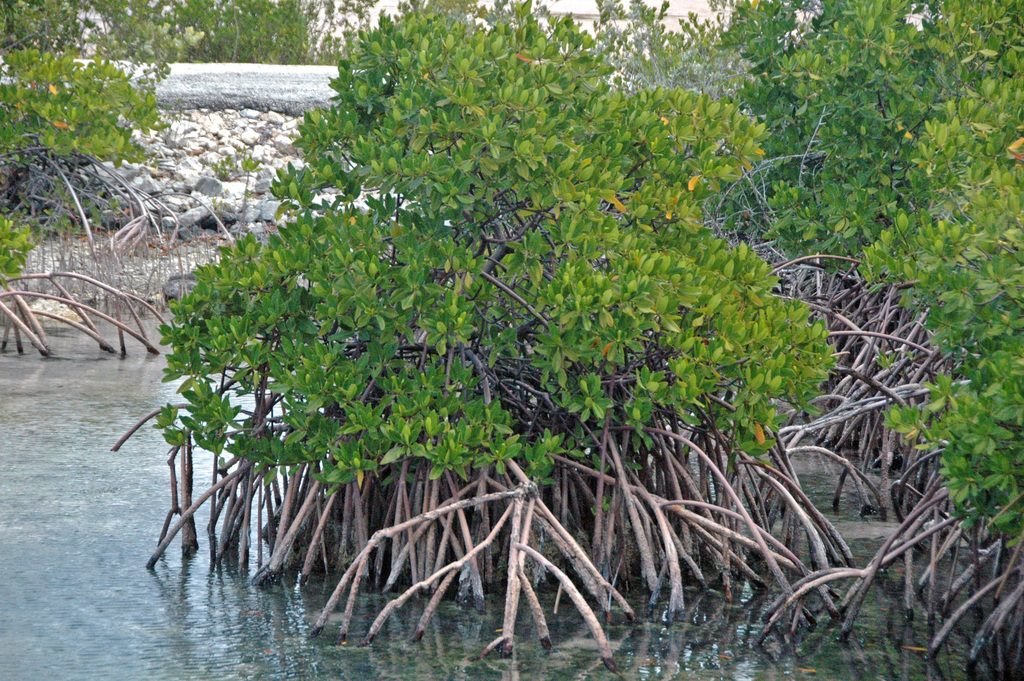
A tree that walks into the sea on stilts. Red mangroves arch prop roots into salty mud, keep most of the salt out at the root surface, and drop seedlings that have already germinated on the tree and can float for months. Their roots shelter young fish and buffer coasts from storms.
Rhizophora mangle, also known as the red mangrove, is a salt-tolerant, small-to-medium sized evergreen tree restricted to coastal, estuarine ecosystems along the southern portions of North America, the Caribbean as well as Central America and tropical West Africa. Its viviparous "seeds", in actuality called propagules, become fully mature plants before dropping off the parent tree. These are dispersed by water until eventually embedding in the shallows. Wikipedia
What it can do
- iIs viviparous: seeds germinate on the tree and drop as pencil-like propagules up to about 30 cm long
- iiIts propagules float and stay viable for months, colonising new coasts
- iiiIts roots filter out most salt from seawater
- ivBreathes through lenticels on prop roots that stand above the anoxic mud
- vBuilds coastlines by trapping sediment and buffers storm surge
At the table
Propagules have been eaten as famine food after processing, but they are astringent and bitter; generally not eaten.
In the medicine cabinet
| Tradition | Use |
|---|---|
| Caribbean and Latin American folk medicine | Bark decoction as an astringent for diarrhoea, sore throat and wounds |
Weight of evidence
Traditional. Long historical use; little or no modern clinical evidence.
Active compounds
tannins, polyphenols
Fruit & seed


Fruit
Berry with viviparous seedling
Ripens: Much of the year, peaking in summer
Brown leathery fruit from which a long green propagule grows while still on the tree.


Seed
~15–30 cm propagule
Germinates on the tree into a long, cigar-shaped propagule
- Dispersal
- Ocean currents
- Germination
- Already germinated; plant the propagule upright in tidal mud
Photographs from Wikimedia Commons under open licences; hover for the photographer, click for the file.
Where it lives
Recorded sightings
—
geo-referenced records in GBIF, from museums, herbaria and field observers.
Native range
Tropical Atlantic and eastern Pacific coasts: Florida, Caribbean, Gulf of Mexico, Central and South America, West Africa; introduced to Hawaii
Drag the globe to turn it. Dots are where records exist, not a range map; darker means more records.
In the old herbals & bestiaries
Woodcuts and engravings matched from the Source Library’s scanned books by name. Plates marked “relative” show a close kin rather than this exact species. Click a plate to read the page it came from, with translation.

The natural history of Carolina, Florida, and the Bahama Islands : containing two hundred a...
Catesby, Mark, bioloog, kunstenaar · 1743 · p.198

The Natural History of Carolina Florida and Bahama Islands Vol. 2
Mark Catesby · 1743 · p.196

Mark Catesby — Piscium, serpentum, insectorum (pt. 1) (1750)
Mark Catesby · 1750 · p.198

Garden of Malabar, Vol. 2 (Hortus Indicus Malabaricus)
Hendrik van Rheede · 1683 · p.256

A voyage to the islands Madera Barbados Jamaica Vol. 1
Hans Sloane · 1707 · p.584

The natural history of Carolina, Florida, and the Bahama Islands : containing two hundred a...
Catesby, Mark, bioloog, kunstenaar · 1743 · p.199
In the stacks
Searching the stacks…
Every page naming Rhizophora mangle in the Biodiversity Heritage Library →
Marginalia
The word 'mangle' came into Spanish from the Taíno of the Caribbean. Tannin from red mangrove bark was used across the tropics to tan leather and preserve fishing nets and sails, giving them a red-brown colour.
Curiosity
Mangrove propagules can drift for months and still root, which is how Rhizophora reached both sides of the Atlantic.
Kinship

Photographs: iNaturalist contributors under the licences shown. Records: GBIF.org. Historical plates: Source Library (CC BY-SA 4.0; originals public domain). Summary text: Nature Library editors and Wikipedia (CC BY-SA). Medicinal and edibility notes are historical and educational, not advice. iNaturalist taxon 60335.