 NL·0151
Herbarium of the Nature Library
- Name
- Populus tremuloides
- Family
- Salicaceae
- Native to
- Across Canada and Alaska, south through the Rocky Mountains to northern Mexico
- Habitat
- Boreal forest, Montane forest, Parkland
Quaking aspen
Populus tremuloides
Also calledAzaadi (Ojibwe) · Álamo temblón (Spanish) · Peuplier faux-tremble (French) · Amerikanische Zitterpappel (German)
One aspen grove in Utah, called Pando, is a single male clone with about 47,000 trunks on one root system, covering some 43 hectares and weighing around 6,000 tonnes. It is often called the heaviest known organism. Aspen leaves flutter in the faintest breeze on flattened stalks.
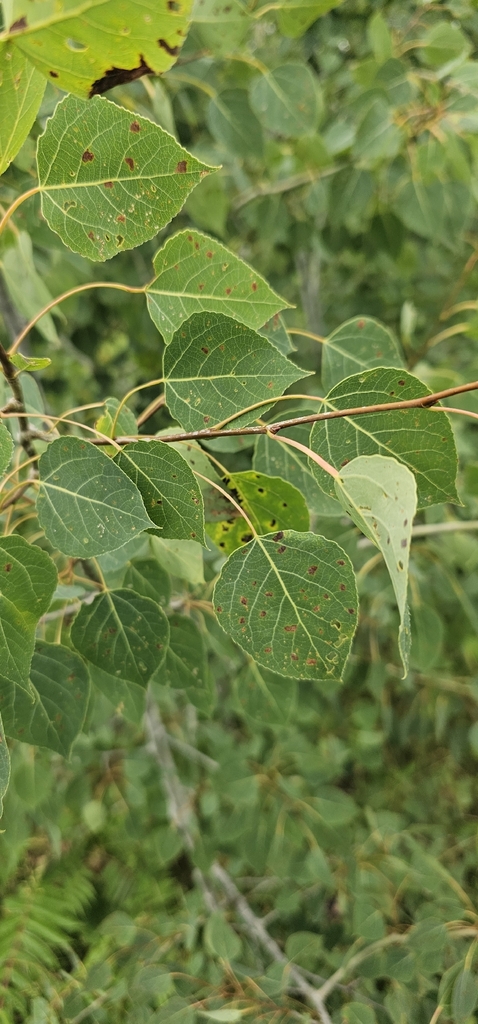
Populus tremuloides is a deciduous tree native to cooler areas of North America, one of several species referred to by the common name aspen. It is commonly called quaking aspen, trembling aspen, American aspen, mountain or golden aspen, trembling poplar, white poplar, and popple, as well as others. The trees have tall trunks, up to 25 metres tall, with smooth pale bark, scarred with black. The glossy green leaves, dull beneath, become golden to yellow, rarely red, in autumn. The species often propagates through its roots to form large clonal groves originating from a shared root system. These roots are not rhizomes, as new growth develops from adventitious buds on the parent root system. Wikipedia
What it can do
- iSpreads by root suckers into vast clones; Pando is one genetic individual of about 47,000 stems
- iiIts flattened leaf stalks make leaves tremble in the slightest wind
- iiiPhotosynthesises through its pale green-white bark, even in winter
- ivRe-sprouts quickly after fire, acting as a natural firebreak and pioneer
- vIs the most widely distributed tree in North America
At the table
Eateninner bark (spring, famine food) · catkins
Inner bark was eaten in spring by Indigenous peoples and in hard times. Bark contains salicin and related compounds, so people with aspirin allergy should avoid it.
In the medicine cabinet
| Tradition | Use |
|---|---|
| Indigenous North American medicine (e.g. Cree) | Bark tea for fever, pain and coughs; the bark's white powder used as sunscreen |
Weight of evidence
Traditional. Long historical use; little or no modern clinical evidence.
Active compounds
salicin, populin, tremuloidin
Fruit & seed
Fruit
Capsule
Ripens: Late spring
Catkins of small capsules that release cottony seeds.
Seed
<1 mm
Minute seeds with cottony hairs
- Dispersal
- Wind
- Germination
- Sow immediately on moist soil; viability lasts only days to weeks
How to grow it
Hardiness (USDA zones)
USDA 1–7. Survives winters down to about -51 °C.
- Light
- Full sun
- Water
- Moderate
- Soil
- Adaptable; moist, well-drained
- Propagation
- Root cuttings or suckers; fresh seed
- To harvest
- Ornamental; individual stems live about 100–150 years
- Climates
- Boreal, Continental, Montane
- 1Take root cuttings or dig a sucker in early spring
- 2Plant in full sun with space to spread
- 3Expect suckers; mow or cut them where unwanted
- 4Protect young stems from deer and elk browsing
Can it grow where you are?
Where it lives
Recorded sightings
—
geo-referenced records in GBIF, from museums, herbaria and field observers.
Native range
Across Canada and Alaska, south through the Rocky Mountains to northern Mexico
Drag the globe to turn it. Dots are where records exist, not a range map; darker means more records.
In the old herbals & bestiaries
No plate in the Source Library names this exact species, so these show its closest relatives as the old naturalists drew them: same genus, or the same kind of plant. Click a plate to read the page it came from, with translation.

Latin Herbal
Relative · 1484 · p.233

Latin Herbal with German Synonyms
Relative · 1484 · p.261

Herbarius
Relative · 1485 · p.234

Herbarius latinus (with Dutch synonyms)
Relative · 1486 · p.231

Latin Herbal with German Synonyms
Relative · 1486 · p.234

Herbal of Virtues
Relative · 1499 · p.233

Garden of Health
Relative · 1507 · p.276

On the Names of Plants
Relative · Hieronymus Bock (Tragus) · 1552 · p.1155

Commentaries on the Six Books of Dioscorides
Relative · Pietro Andrea Mattioli · 1560 · p.205

Commentaries on the Six Books of Dioscorides on Medical Matter
Relative · Pietro Andrea Mattioli · 1563 · p.204
In the stacks
Searching the stacks…
Every page naming Populus tremuloides in the Biodiversity Heritage Library →
Marginalia
Pando was identified as one clone in the 1970s, and genetic testing in 2008 confirmed it. A 2024 genetic study estimated Pando may be between about 16,000 and 80,000 years old, though this is uncertain.
Curiosity
Pando is not regenerating well, because mule deer and elk eat nearly all young shoots; fenced areas are being used to help it.
Kinship



Photographs: iNaturalist contributors under the licences shown. Records: GBIF.org. Historical plates: Source Library (CC BY-SA 4.0; originals public domain). Summary text: Nature Library editors and Wikipedia (CC BY-SA). Medicinal and edibility notes are historical and educational, not advice. iNaturalist taxon 54840.