On eBird ↗
Sardinian Warbler
Live sightings near you, the range map, bar charts of when it is seen, and Macaulay Library photos and recordings.
Sardinian Warbler
Curruca melanocephala
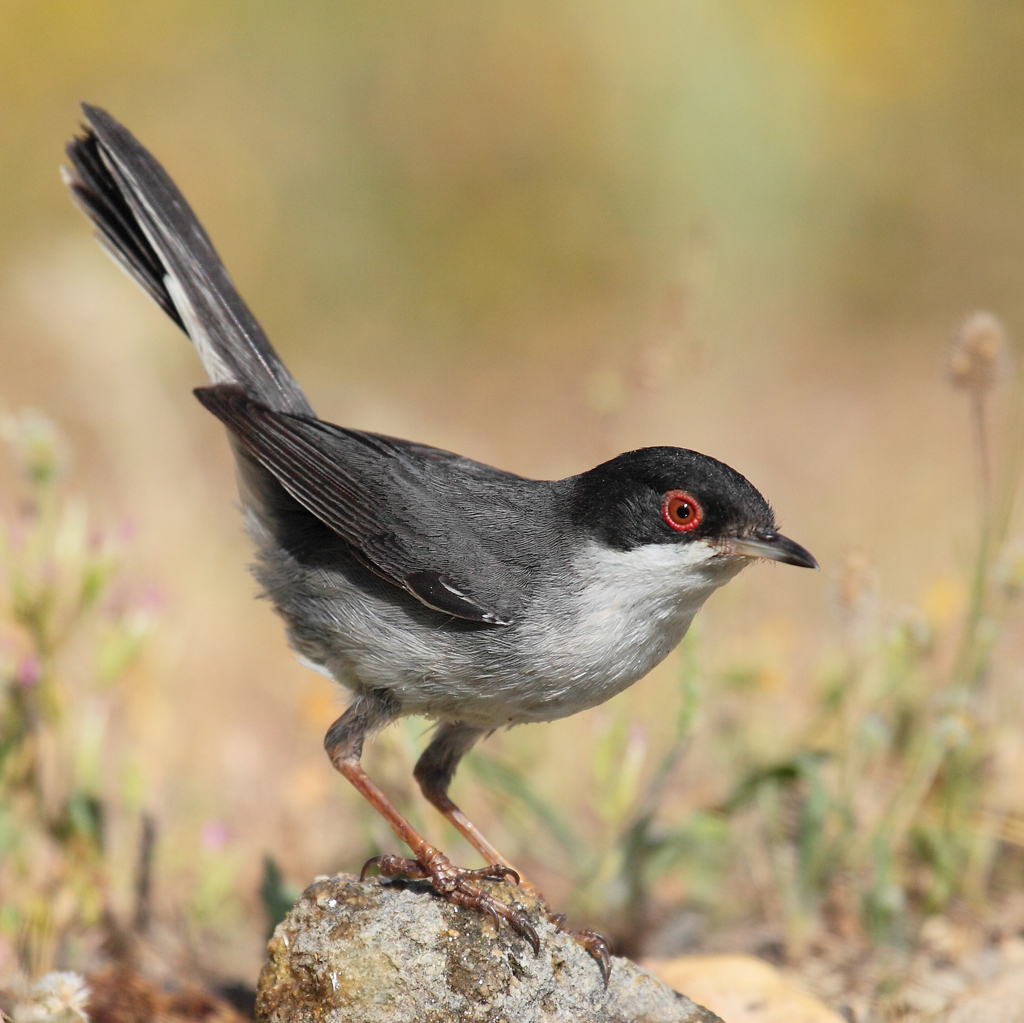
The Sardinian warbler (Curruca melanocephala) is a common and widespread Sylviidae warbler from the Mediterranean region. Like most Curruca species, it has distinct male and female plumages. The adult male has a grey back, whitish underparts, black head, white throat and red eyes. Plumages are somewhat variable even in the same locality, with the intensity of a reddish hue on upper- and/or underside that varies from absent to (in some subspecies) pronounced. The female is mainly brown above and buff below, with a grey head. The Sardinian warbler's song is fast and rattling, and is very characteristic of the Mediterranean areas where this bird breeds.
From the article Sardinian warbler on Wikipedia (CC BY-SA), quoted section by section
Range & habitat
It breeds in the southernmost areas of Europe and just into Asia in Turkey and the eastern end of the Mediterranean. This small passerine bird, unlike most "warblers", is not particularly migratory, but some birds winter in North Africa, and it occurs as a vagrant well away from the breeding range, as far as Great Britain.
Wikipedia: “Distribution and habitat”
What it does
This is a bird of open country and cultivation, with bushes for nesting. The nest is built in low shrub or brambles, and 3-6 eggs are laid. Like most "warblers", it is insectivorous, but will also take berries and other soft fruit.
Wikipedia: “Behaviour and ecology”
Listen
Looking for field recordings…
Where it lives
Recorded sightings
—
geo-referenced records in GBIF, from museums, herbaria and field observers.
Drag the globe to turn it. Dots are where records exist, not a range map; darker means more records.
In the stacks
Searching the stacks…
Every page naming Curruca melanocephala in the Biodiversity Heritage Library →
This page is assembled live from iNaturalist, GBIF, Wikipedia, the Source Library and the Internet Archive. It is not yet part of the hand-edited codex. iNaturalist taxon 1289472.