- Animals
- ›Chordates
- ›Vertebrates
- ›Mammals
- ›Therians
- ›Placental Mammals
- ›Primates, Rodents, and Allies
- ›Rodents
- ›Squirrels, Dormice, and Mountain Beavers
- ›Squirrels
- ›Ground and African Tree Squirrels
- ›Holarctic Ground Squirrels
- ›Urocitellus
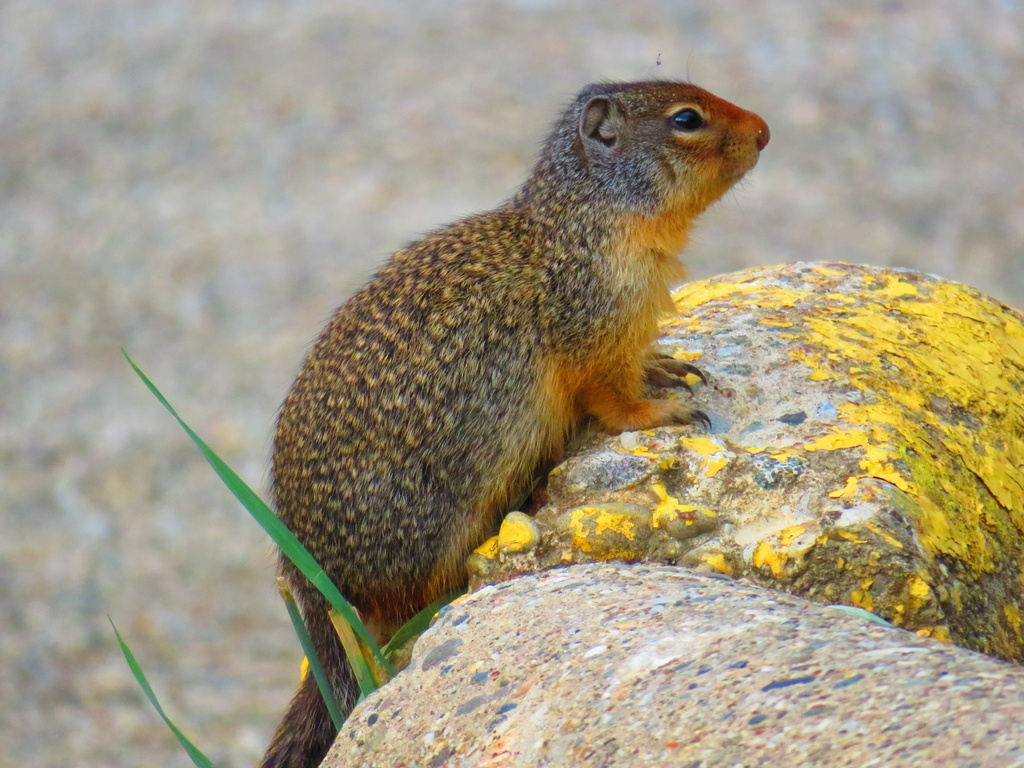
Columbian Ground Squirrel
Urocitellus columbianus
The Columbian ground squirrel (Urocitellus columbianus) is a species of rodent common in certain regions of Canada and the northwestern United States. It is the second largest member of the genus Urocitellus, which is part of the tribe Marmotini, along with marmots, chipmunks, prairie dogs, and other holarctic ground squirrels. They are stout, with short dense fur, which is characteristically tawny across the bridge of the nose. Social encounters sometimes are initiated with kissing behavior and the most common activity above ground is standing at attention. Residing in mountainous terrain and high plains in northern latitudes, they hibernate for 8 to 9 months of the year in burrows, which may be used for many years. They are emaciated when emerging in the spring. The Columbian ground squirrel came to the attention of the scientific community through writings produced by Lewis and Clark, while 21st century molecular genetics has more finely illuminated its ties with other close relatives.
From the article Columbian ground squirrel on Wikipedia (CC BY-SA), quoted section by section
Description
The Columbian ground squirrel is one of the largest members of the genus, the largest being the Arctic ground squirrel. They have a relatively sturdy, robust build. They measure 325–410 mm (12.8–16.1 in) in length overall, with a tail measuring 80–116 mm (3.1–4.6 in). The hind feet measure 47–57 mm (1.9–2.2 in) and the ear 16–22.5 mm (0.63–0.89 in). The hair is dense and relatively short. The facial fur is bronze across the bridge of the nose. The fur along the back, legs, and feet is a more cinnamon buff, with darker fur closer to the body. There is a pale beige to buff ring of fur around the eye. The neck fur is gray along the sides of the cheeks. The flanks may be light beige or gray. They have a darker tail, with darker underfur and some lighter beige markings above and dark to grayish white below. Molting occurs diffusely, without a clear line of delineation.
Two subspecies have been described, which vary in appearance. Compared with U. c. columbianus, the population U. c. ruficaudus has a tail more rufous and less gray above. The sides of the face and throat are also more deeply rust shaded. The legs and feet are darker as well. The skull of U. c. ruficaudus is broader, with more robust zygomatic arches. Several albino variants have been found. An albino squirrel was captured alive by a student near Pullman, Washington in 1932. It had been in an alfalfa field. …
Range & habitat
The Columbia ground squirrel is found in western areas of North America. It occurs in the Rocky Mountains, from as far north as western Alberta and southeastern British Columbia. They are found in the western parts of Montana, through central Idaho and into northern and eastern reaches of Washington. They are also found along plains of eastern Washington. In Oregon, they occur in mountainous area in the east-central part of the state. They reside between 700–8,000 feet (210–2,440 m) in elevation. The known fossil record of the Columbia ground squirrel consists of specimens recovered from the Wasden fossil site (Owl Cave) in Bonneville County, Idaho. Fossils from this site date to the late Pleistocene (Rancholabrean). The site is located at 1,584 metres (5,197 ft) elevation. Fossils of small mammals deposited at this site are primarily attributed to owl predation. The distribution of the Columbia ground squirrel in Oregon was assessed based on consideration of animals obtained in 71 localities. Over 98% were obtained in the Blue Mountains ecoregion, which includes the Wallowa and Blue Mountain ranges. The remaining squirrels came from the Owyheee Uplands.
Wikipedia: “Distribution and habitat”
What it does
Columbian ground squirrels in Alberta hibernate around 250 days a year, with only 69–94 days of activity observed. The amount of time active varies depending on local climate as well as variations in behavior of animals of different sexes and ages. Each sex and age group hibernates at different soil depths and begins hibernation when the soil temperature of their hibernaculum is at its warmest. During hibernation, the squirrels are positioned vertically in a tight ball. The temperature drops significantly, the heart rate slows and respirations are scarcely perceptible. The first group to emerge is adult males, which is likely due to their need to regrow their testes for breeding, as the testes of other ground squirrels have been found to shrink in size and stop sperm production during hibernation. Adult males are followed by adult females, yearlings, then juveniles. Animals at higher elevations and latitudes emerge later. They emerge from hibernation and start breeding earlier at low elevations. They raise one litter per year. Young are born naked, blind, and toothless. After 5–6 days, their weight has doubled. They are covered with dark silky hair by day 12. Around day 17, the eyes are beginning to open. They may emerge into the sunlight outside the den around day 21–24. …
Wikipedia: “Behavior”
Listen
Looking for field recordings…
Where it lives
Recorded sightings
—
geo-referenced records in GBIF, from museums, herbaria and field observers.
Drag the globe to turn it. Dots are where records exist, not a range map; darker means more records.
In the stacks
Searching the stacks…
Every page naming Urocitellus columbianus in the Biodiversity Heritage Library →
This page is assembled live from iNaturalist, GBIF, Wikipedia, the Source Library and the Internet Archive. It is not yet part of the hand-edited codex. iNaturalist taxon 179998.