- Animals
- ›Chordates
- ›Vertebrates
- ›Mammals
- ›Therians
- ›Placental Mammals
- ›Primates, Rodents, and Allies
- ›Primates
- ›Monkeys, Apes, and Tarsiers
- ›Monkeys and Apes
- ›New World Monkeys
- ›Cebid Monkeys
- ›Capuchins
- ›Sapajus
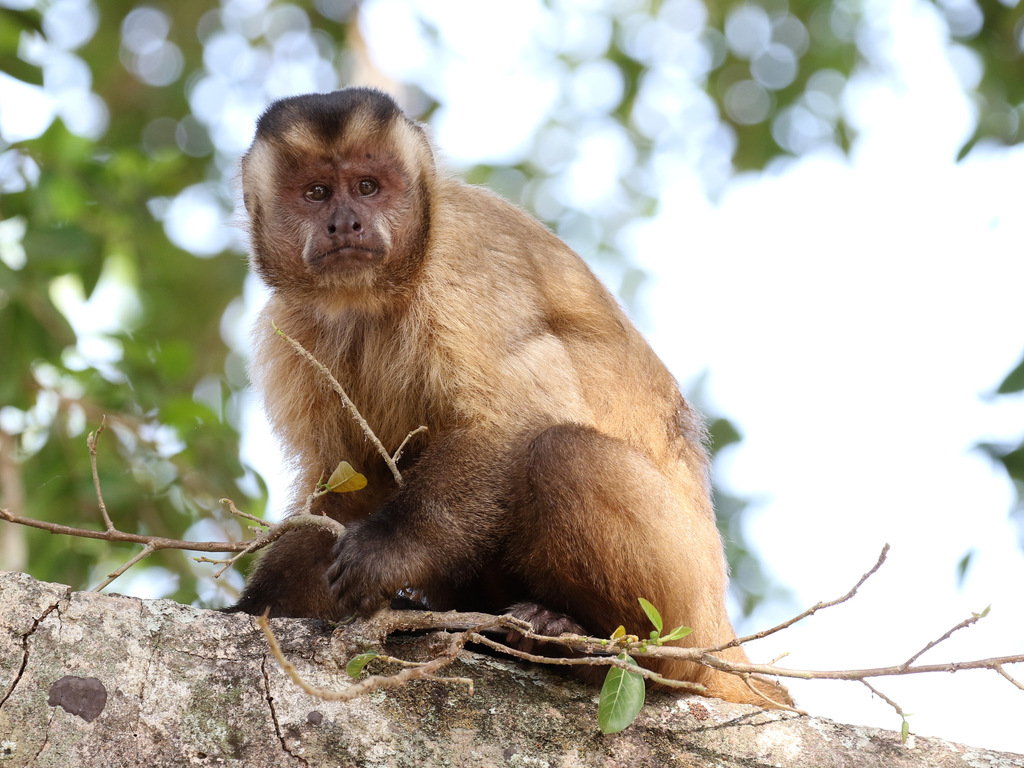
Black-striped Capuchin
Sapajus libidinosus
The black-striped capuchin (Sapajus libidinosus), also known as the bearded capuchin, is a New World monkey in the family Cebidae. They are native to northern and central Brazil. These capuchins mostly live in dry forests, and savannah landscapes between the Rio Araguaia and the Rio Grande. Known for its tool use, the black-striped capuchin has been shown to use tools in a wide variety of situations, ranging from using rocks for nut cracking to using sticks for digging. They were, until recently, considered a subspecies of the tufted capuchin, but because of more research and insights, they are considered their own species by many.
They often live in highly social groups ranging from 6-20 individuals. Females are philopatric, show coalition, and linear dominance hierarchy. Females reach sexual maturity around 5 years of age and give birth about every 24 months to a single infant.
From the article Black-striped capuchin on Wikipedia (CC BY-SA), quoted section by section
Description
The black-striped capuchin has only a few physical features that distinguishes it from other tufted capuchins. Similarly, to other tufted capuchins it has a thick and strong tail. It has fur colored light to dark brown on its body, with darker black fur on its tail, arms, legs, and head. It gets the name "bearded capuchin" because it tends to have a darker face, but lighter hair around the mouth and lower face. As it reaches sexual maturity, it gets dark spots on its head as well as sideburns on its face. Yet the features that most distinguish it include orange fur on its neck as well as the yellow tinted fur on its dorsal side. Males and females often have a similar height of around 37 cm (15 in) but show strong sexual dimorphism in their weights, with males around 3.5 kg (7.7 lb) and females around 2.1 kg (4.6 lb). The bearded capuchin can live up to 25 years in the wild, but much longer when in captivity.
Range & habitat
The black-striped capuchin can be found in northern and central Brazil. Specifically, in the Cerrados, Caatingas, and Pantanal of Brazil.
== References ==
Wikipedia: “Distribution”
What it does
When a female black-striped capuchin decides she is ready to mate, she will follow a male and attempt to get his attention in various ways including throwing rocks and sticks. Males will react first with disinterest and aggression, this is followed by a behavior dubbed "touch and go". Females will touch a male, and then flee before the male can inflict aggression. After some time, males react with interest and the pair can mate. Females have offspring on average once every two years to a single infant. This infant will be initially carried on the mothers belly, but will transition to her back. They forage independently at two years of age, and are weaned slowly. In Rondônia, it associates with the Bare-eared Squirrel Monkey (Saimiri ustus), and further south with the Black-capped Squirrel Monkey (Saimiri Boliviensis). It is also found with the White-nosed Saki (Chiropotes albinasus).
Wikipedia: “Reproduction”
Listen
Looking for field recordings…
Where it lives
Recorded sightings
—
geo-referenced records in GBIF, from museums, herbaria and field observers.
Drag the globe to turn it. Dots are where records exist, not a range map; darker means more records.
In the stacks
Searching the stacks…
Every page naming Sapajus libidinosus in the Biodiversity Heritage Library →
This page is assembled live from iNaturalist, GBIF, Wikipedia, the Source Library and the Internet Archive. It is not yet part of the hand-edited codex. iNaturalist taxon 516974.