- Animals
- ›Chordates
- ›Vertebrates
- ›Mammals
- ›Therians
- ›Placental Mammals
- ›Primates, Rodents, and Allies
- ›Rodents
- ›Squirrels, Dormice, and Mountain Beavers
- ›Squirrels
- ›Ground and African Tree Squirrels
- ›Holarctic Ground Squirrels
- ›Urocitellus
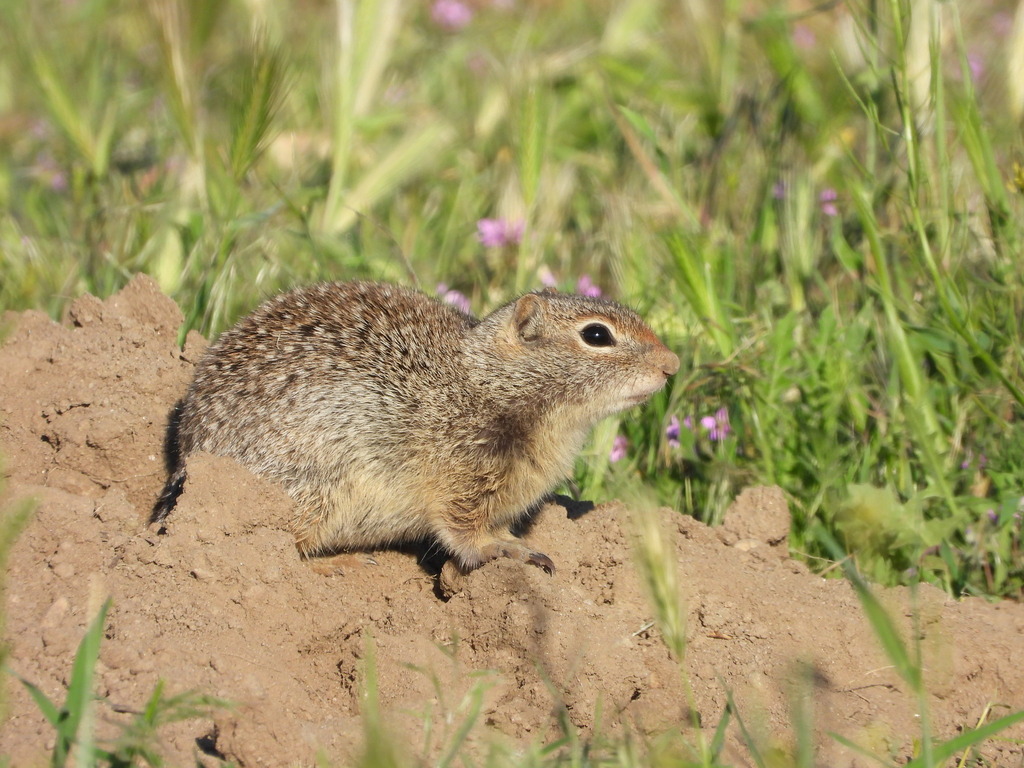
Idaho Ground Squirrel
Urocitellus brunneus
The northern Idaho ground squirrel (Urocitellus brunneus) is a species of the largest genus of ground squirrels. This species and the southern Idaho ground squirrel were previously considered conspecific, together called the Idaho ground squirrel.
The species is about 233 mm in length and weighs 120 to 290 grams. The northern Idaho ground squirrel has sexual dimorphism and a dark-reddish gray coat.
From the article Northern Idaho ground squirrel on Wikipedia (CC BY-SA), quoted section by section
Description
The species has sexual dimorphism, with males being normally larger than females. Their weight ranges from 120 to 290 grams, and they are, on average, 233 mm in length, though their range is 209 mm to 258 mm. They have a dark-reddish grey coat with reddish-brown spots. Some of the northern Idaho ground squirrel's qualities include tan feet and ears, a tail, a brownish-grey throat, and a white eye ring.
Range & habitat
The habitat of the northern Idaho ground squirrel consists of dry rocky meadows. Ground with deep soil and scattered with ponderosa pine and Douglas-fir forests at the elevation between 915 and 1,650 meters is the preferred habitat of the squirrels. Original vegetation in the habitat of the NIDGS was big sage brush, bitterbrush, native bunch grasses, and forbs, but now the area is dominated by cheatgrass and medusahead.During the winter, the NIDGS hibernates in environments with larger coverage compared to the active season habitats. The NIDGS mainly hibernates at a completely different habitat than the active season habitat. The northern Idaho ground squirrel lives in the Adams and Valley Counties in western-central Idaho. The species used to occupy 1,600 km2, but now the species only occupies less than 20 km2. The species is sub-divided into small, isolated populations that survive on isolated islands of suitable but unconnected habitat patches. These populations contain less than 100 individuals, and often less than 20. …
Wikipedia: “Distribution and habitat”
What it does
The northern Idaho ground squirrel has an 8-month hibernation period from August to late April. Their diet consists of mostly forbs, grasses, shrubs, trees, rushes, and sedges. The squirrel's active season is from April to July, and then the species spends the rest of the year hibernating.
Within the first two weeks of the active period, the NIDGS starts reproducing. Females reproduce only once per year. In the mating process, the males protect the sexually receptive females from other potential male rivals. Mating occurs over about 2 weeks. Copulations occur underground. Males depart from the female's burrow after mating, and they do not provide paternal care to pups or protection to their mates. The gestation period of the species is 3.5 weeks. There are 4-6 weaned pups per litter. Juveniles leave their natal burrow at weaning (late-April to early-May), and begin dispersing soon thereafter. The species constructs three types of burrows: nest burrows, auxiliary burrows, and hibernation burrows. Nest burrows are for mating and raising young; they are usually 5–120 cm deep, with 3-11 surface openings, 2-13 branching tunnels, and 1-7 chambers; in well-drained soil the nest is in the deepest part of the burrow. The auxiliary ("escape") burrows do not contain nests; they are linear, less than 50 cm, built 100 m from nest burrows, and are constructed in shallow soils. …
Wikipedia: “Diet and life history”
Listen
Looking for field recordings…
Where it lives
Recorded sightings
—
geo-referenced records in GBIF, from museums, herbaria and field observers.
Drag the globe to turn it. Dots are where records exist, not a range map; darker means more records.
In the stacks
Searching the stacks…
Every page naming Urocitellus brunneus in the Biodiversity Heritage Library →
This page is assembled live from iNaturalist, GBIF, Wikipedia, the Source Library and the Internet Archive. It is not yet part of the hand-edited codex. iNaturalist taxon 179996.