- Animals
- ›Chordates
- ›Vertebrates
- ›Mammals
- ›Therians
- ›Placental Mammals
- ›Primates, Rodents, and Allies
- ›Rodents
- ›Squirrels, Dormice, and Mountain Beavers
- ›Squirrels
- ›Ground and African Tree Squirrels
- ›Holarctic Ground Squirrels
- ›Otospermophilus
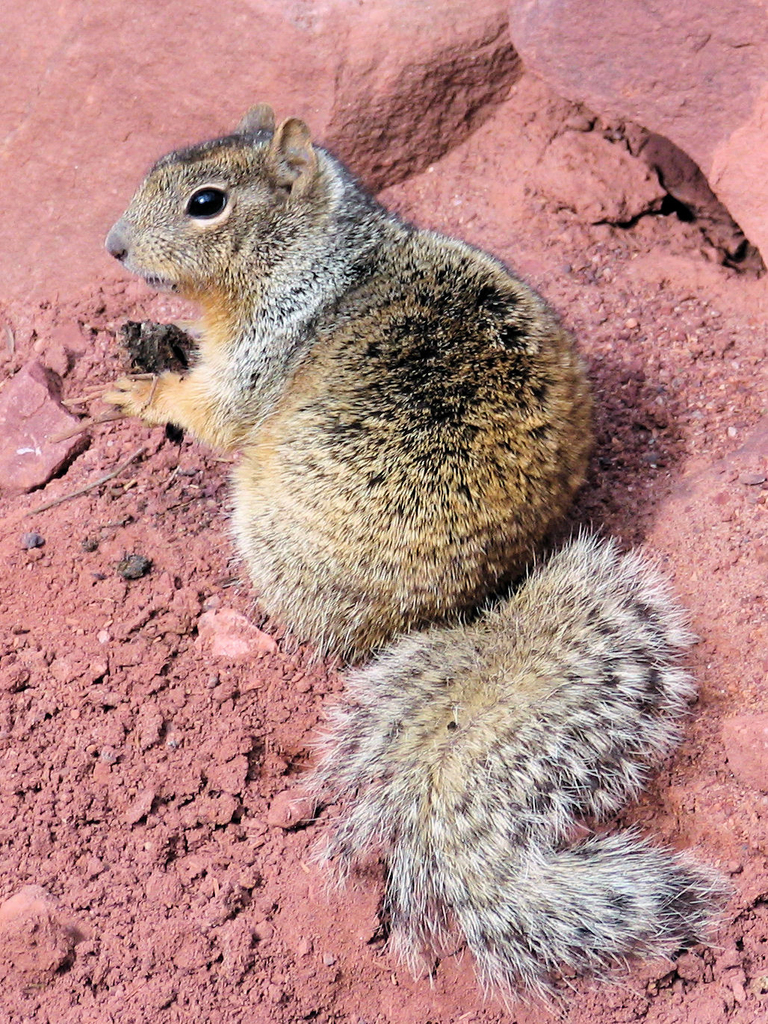
Rock Squirrel
Otospermophilus variegatus
The rock squirrel (Otospermophilus variegatus) is a species of rodent in the family Sciuridae. It is native to Mexico and the Southwestern United States, including southern Nevada, Utah, Colorado, Arizona, New Mexico, Texas, and the panhandle of Oklahoma.
In Texas, they can be found in the western, central and Panhandle regions. They are especially common in the Texas Hill Country, a Subregion in central Texas.
From the article Rock squirrel on Wikipedia (CC BY-SA), quoted section by section
Description
Rock squirrels are one of the largest members of the family Scuridae, with adults measuring up to 21 inches (53 cm) in length. In front and on top, the squirrel's coat is a speckled grayish brown; on the rear and bottom, the gray becomes a more mottled brownish-black tone. They have a marked light-colored ring around their eyes and pointed ears that project well above their heads. Rock squirrels have a long, bushy tail with white edges.
Wikipedia: “Characteristics”
Range & habitat
Because of their specialized habitat requirements, there are only a few states in the US where these creatures can sustain themselves. These squirrels inhabit rocky mountains, canyon walls, cliffs, and steep rocky hills and only a few areas within North America contain such landscapes. These squirrels can be found throughout the southern US border along with Mexico in states like California, Arizona, Utah, Colorado, Oklahoma, New Mexico and parts of Texas. Contrary to popular belief, in Mexico these squirrels are not found in eastern coastal lowlands, but they inhabit areas of Jalisco, Guerrero, Guanajuato, Mexico, Morelos, Colima and Puebla. In the western edge of the range of these squirrels in the US, they mostly inhabit parts of southeasternmost corners of California, which includes some of the most arid areas in the entire state.
Wikipedia: “Geographic Range”
What it does
The female rock squirrel has two litters a year, with three to nine young in each litter. The first litter is typically born from April to June, while the second is born in August or September. They are active in the early morning and late afternoons when the weather is warm; when very hot, they may estivate. They are social, and live in colonies with several females and one dominant male that fights other mature males to protect the group. Subordinate males lurk at the outer boundaries of the group. Rock squirrels dig burrows with their sharp claws and muscular legs. The burrows provide shelter, safety, living space, and food storage. Burrow systems can be complex and lengthy, as they are enlarged over a period of years. Entrances are usually hidden beneath rocks and can be wider than 3 inches. In the northern reach of their habitat, rock squirrels hibernate during the colder months of the year. In southern areas, rock squirrels may not hibernate at all. They can withstand long periods of time without water, some even up to 100 days. When alarmed, they whistle a short, sharp, oscillating call.
Wikipedia: “Life history/behavior”
Listen
Looking for field recordings…
Where it lives
Recorded sightings
—
geo-referenced records in GBIF, from museums, herbaria and field observers.
Drag the globe to turn it. Dots are where records exist, not a range map; darker means more records.
In the stacks
Searching the stacks…
Every page naming Otospermophilus variegatus in the Biodiversity Heritage Library →
This page is assembled live from iNaturalist, GBIF, Wikipedia, the Source Library and the Internet Archive. It is not yet part of the hand-edited codex. iNaturalist taxon 180008.