- Animals
- ›Chordates
- ›Vertebrates
- ›Mammals
- ›Therians
- ›Placental Mammals
- ›Primates, Rodents, and Allies
- ›Rodents
- ›Squirrels, Dormice, and Mountain Beavers
- ›Squirrels
- ›Ground and African Tree Squirrels
- ›Holarctic Ground Squirrels
- ›Xerospermophilus
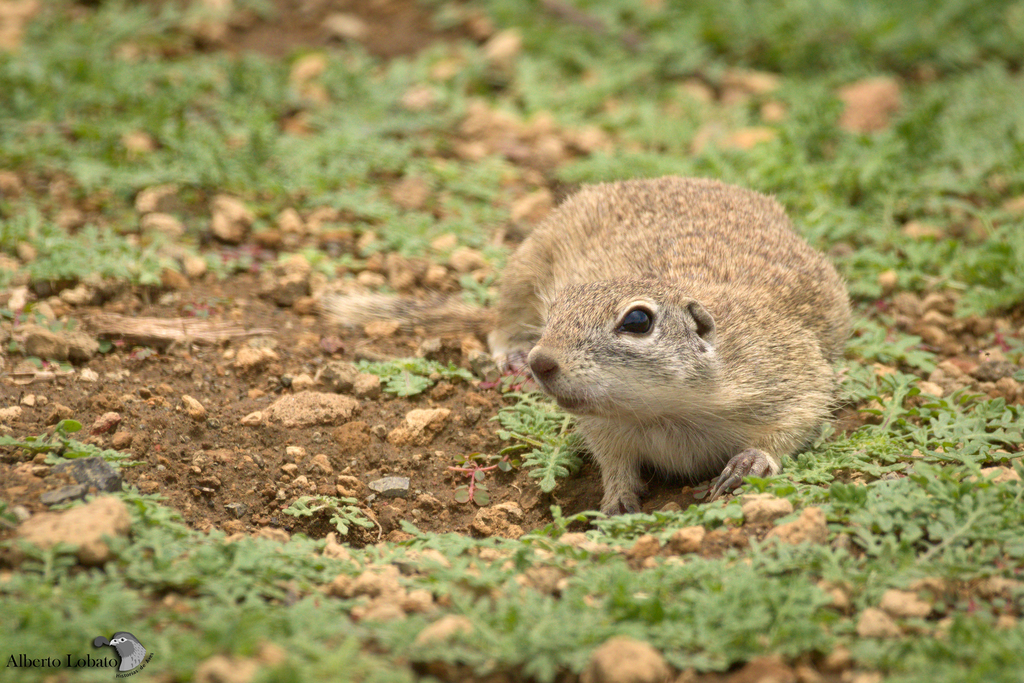
Perote Ground Squirrel
Xerospermophilus perotensis
The Perote ground squirrel (Xerospermosphilus perotensis) is a species of rodent in the family Sciuridae. It is endemic to Mexico and is currently at risk of extinction. Perote ground squirrels live within the same area as rock squirrels (Otospermophilus variegatus) but they use different microhabitats. In one case it also shares its habitat with the Mexican ground squirrel (Ictidomys mexicanus). Perote ground squirrels have traits similar to those of spotted ground squirrels (X. spilosoma pallescens) found...
From the article Perote ground squirrel on Wikipedia (CC BY-SA), quoted section by section
Description
Perote ground squirrels have traits similar to those of spotted ground squirrels (X. spilosoma pallescens) found in the northern Mexican Plateau; however they are larger, have shorter tails and yellow backs. Its skull is relatively narrow with a large braincase and they have heavy, thick teeth. Perote ground squirrels have two annual cycles, an active phase (March–November) and a hibernation phase (December–February). Some overlap may occur in March and November however. X. perotensis was first described as a species in 1893. Much research is being done recently, and many scientists think it should be classified as a subspecies of X. spilosoma. "In either case, and regardless of the position one might adopt around species concepts, it is evident that X. perotensis constitutes an independent and isolated biological entity that has evolved under restricted geographical and ecological contexts as a consequence of recent Pleistocene events".
Range & habitat
The habitat range of the Perote ground squirrel is in the Oriental Basin (5250 km2) between Puebla and Veracruz. The basin is surrounded by high mountains thought to have arisen from volcanic activity. This also accounts for the pockets of arid and semiarid land. The semiarid land in Perote is the most humid in the area with an average rainfall of 369.77 mm between June and September. The average temperature is 11.9 °C with highs of 14.73 °C and lows of 8.80 °C. Perote ground squirrels only live in alkaline grasslands, arid scrubs and hilly, rocky areas where they will dig their burrows. However, due to agriculture, overgrazing, and the urbanizing of the area, the suitable habitat for the squirrel is down to 16 small localities. These areas are mostly narrow strips (20–50 m) separated by an average distance of 15.8 km. This species is threatened by extensive habitat fragmentation and deforestation within its restricted range due to timber extraction and clearing of forest for agriculture. While the squirrel once occupied a range of approximately 5250 square kilometers, it now only occupies an area totaling 2457 square kilometers. The Oriental Basin is surrounded almost entirely by a belt of temperate mountain ranges, which prevent the squirrel from dispersing to new habitat. …
Wikipedia: “Distribution and habitat”
What it does
X. perotenses is a generalist species in its diet. It is mostly found in croplands and open areas with low vegetation. In most studies, researchers bait traps with oats in order to catch individuals.
Wikipedia: “Diet”
In human culture
Perote ground squirrels form family groups within individual burrow systems. In some cases males will leave the burrow to locate females in dispersed areas. This causes aggression between adults and yearling males that ultimately leads to further male migration. Adult males become active in March (before sub-adults and females). Copulation occurs between April and May and pregnant and/or lactating females were most common in June–August. The average number of embryos was found to be six, where the average number of live juveniles was four. Due to the habitat destruction and fragmentation of land, there are fewer opportunities for breeding between genetically diverse individuals. Perote ground squirrels have been seen mating within their own family, which may lead to inbreeding. However, results have shown that "no inbreeding coefficient value for any population was significantly different from zero, implying that inbreeding had little effect on genetic structure."
Wikipedia: “Life history and reproduction”
Listen
Looking for field recordings…
Where it lives
Recorded sightings
—
geo-referenced records in GBIF, from museums, herbaria and field observers.
Drag the globe to turn it. Dots are where records exist, not a range map; darker means more records.
In the stacks
Searching the stacks…
Every page naming Xerospermophilus perotensis in the Biodiversity Heritage Library →
This page is assembled live from iNaturalist, GBIF, Wikipedia, the Source Library and the Internet Archive. It is not yet part of the hand-edited codex. iNaturalist taxon 179991.