On eBird ↗
Wilson's Warbler
Live sightings near you, the range map, bar charts of when it is seen, and Macaulay Library photos and recordings.
Wilson's Warbler
Cardellina pusilla
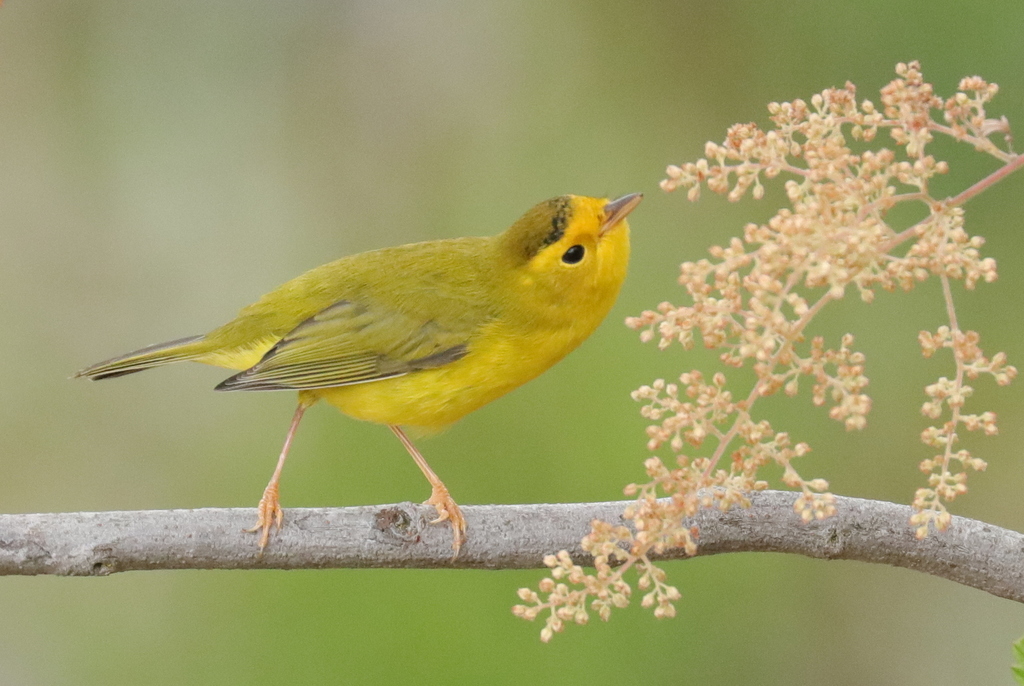
Wilson's warbler (Cardellina pusilla) is a small New World warbler. It is greenish above and yellow below, with rounded wings and a long, slim tail. The male has a black crown patch; depending on the subspecies, that mark is reduced or absent in the female. It breeds across Canada and south through the western United States, and winters from Mexico south through much of Central America. It is a very rare vagrant to western Europe.
From the article Wilson's warbler on Wikipedia (CC BY-SA), quoted section by section
Description
Wilson's warbler is a small passerine, ranging from 10 to 12 cm (3.9 to 4.7 in) in length, with a wingspan of 14–17 cm (5.5–6.7 in) and a mass of 5–10 g (0.18–0.35 oz). It has a plain green-brown back and yellow underparts. The male has a small black cap. Males of the western race C. p. chryseola are greener above and brighter than males of the eastern, nominate race. Individuals from Alaska and the west-central portion of the species' range average slightly larger than those found in eastern and Pacific coastal populations. Its song is a chattering series of loud descending notes. The call is a flat "chuff". Wilson's warbler resembles the yellow warbler: the latter is readily distinguished by its different shape, yellow wing markings, and yellow tail spots.
Range & habitat
The breeding habitat is fairly open woodland with undergrowth or shrubs and thickets in moist areas with streams, ponds, bogs, and wet clearings. Wilson's warbler breeds in northern Canada and the western US; it winters in overgrown clearings and coffee plantations, forest edges, deciduous forests, tropical evergreens, pine-oak forests, mangroves, thorn-scrub, riparian gallery forests, brushy fields, and mixed forests. At all seasons, it prefers secondary growth, riparian habitats, lakes, montane and boreal forests with overgrown clearcuts. It is a very rare vagrant to Western Europe.
Wikipedia: “Distribution and habitat”
What it does
Wilson's warbler is an insectivore, feeding primarily on insects gleaned from leaves and twigs, or caught by flycatching. Some of these insects include beetles, bees, or caterpillars. Wilson's warbler is an active forager, moving rapidly through shrubs, on the ground, and sometimes in taller trees during the winter. Feeding birds often twitch their tails or flick their wings nervously. The observed feeding rate of the male Wilson's warbler was not significantly different between males with or without mates. It also eats a few berries.
Wikipedia: “Feeding”
Listen
Looking for field recordings…
Where it lives
Recorded sightings
—
geo-referenced records in GBIF, from museums, herbaria and field observers.
Drag the globe to turn it. Dots are where records exist, not a range map; darker means more records.
In the stacks
Searching the stacks…
Every page naming Cardellina pusilla in the Biodiversity Heritage Library →
This page is assembled live from iNaturalist, GBIF, Wikipedia, the Source Library and the Internet Archive. It is not yet part of the hand-edited codex. iNaturalist taxon 145276.