On eBird ↗
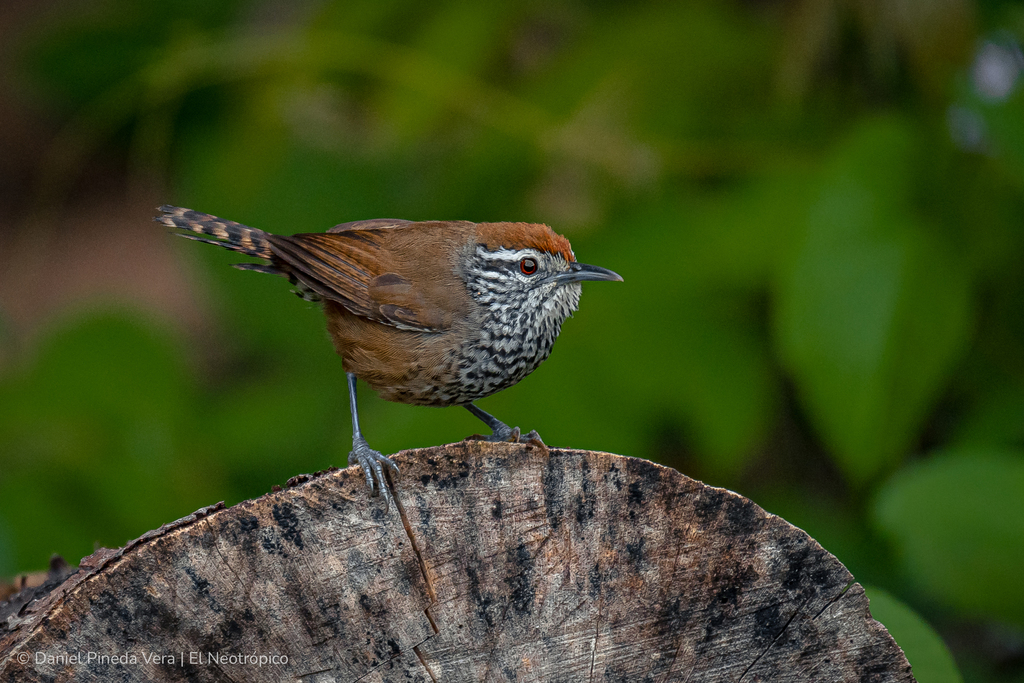
Spot-breasted Wren
Live sightings near you, the range map, bar charts of when it is seen, and Macaulay Library photos and recordings.
Spot-breasted Wren
Pheugopedius maculipectus
The spot-breasted wren (Pheugopedius maculipectus) is a species of bird in the family Troglodytidae. It is found in Belize, Costa Rica, El Salvador, Guatemala, Honduras, Mexico, and Nicaragua. Its natural habitats are subtropical or tropical dry forests, subtropical or tropical moist lowland forests, subtropical or tropical moist montane forests, and heavily degraded former forest.
From the article Spot-breasted wren on Wikipedia (CC BY-SA), quoted section by section
Description
The spot-breasted wren is 12.5 to 14 cm (4.9 to 5.5 in) long; males weigh 14.3 to 16.8 g (0.50 to 0.59 oz) and females 12.4 to 16.2 g (0.44 to 0.57 oz). Adults of the nominate subspecies have a reddish brown crown and upperparts; the rump is more chestnut. Their tail is dull brown with narrow dark bars. They have a white supercilium and the rest of the face and neck are streaked with black and white. The throat, chest, and the center of the belly are pale gray with black spots and the flanks and lower belly are orange-buff with no spots. Juveniles are paler than the adult and the facial markings and spots are less extensive and dimmer. P. m. microstictus is not as reddish as the nominate and the spots on its breast are smaller and fewer. P. m. canobrunneus is paler than the nominate and its crown is light buffy cinnamon. P. m. umbrinus (including petersi and varians) is larger and darker than the nominate.
Range & habitat
The subspecies of spot-breasted wren, including the two that are not universally accepted, are found thus:
P. m. microstictus, northeastern Mexico from southeastern Nuevo León and central Tamaulipas states south to eastern San Luis Potosí and northern Veracruz P. m. maculopectus, eastern Mexico from Veracruz south to Puebla and northern Oaxaca P. m. canobrunneus, the Yucatán Peninsula, northern Belize, and Guatemala's Petén Department P. m. umbrinus, southern Mexico south through southern Belize, most of Guatemala, El Salvador, northern and central Honduras, and the Caribbean slopes of Nicaragua and extreme northern Costa Rica P. m. petersi, northern Honduras south through Nicaragua to northern Costa Rica P. m. varians, Pacific slope of Chiapas, Mexico, and Guatemala and El Salvador The spot-breasted wren occurs in a wide variety of habitats including humid coastal and dry forest (intact, disturbed, and regrowing) and cocoa and citrus plantations. In elevation it ranges from sea level to 1,300 m (4,300 ft) in Mexico and Honduras but only up to 200 m (660 ft) in Costa Rica.
Wikipedia: “Distribution and habitat”
What it does
The spot-breasted wren forages at low levels in dense vegetation, usually in pairs or family groups. Its diet is not well defined but is probably mostly invertebrates.
Wikipedia: “Feeding”
Listen
Looking for field recordings…
Where it lives
Recorded sightings
—
geo-referenced records in GBIF, from museums, herbaria and field observers.
Drag the globe to turn it. Dots are where records exist, not a range map; darker means more records.
In the stacks
Searching the stacks…
Every page naming Pheugopedius maculipectus in the Biodiversity Heritage Library →
This page is assembled live from iNaturalist, GBIF, Wikipedia, the Source Library and the Internet Archive. It is not yet part of the hand-edited codex. iNaturalist taxon 144864.