On eBird ↗
Buff-breasted Wren
Live sightings near you, the range map, bar charts of when it is seen, and Macaulay Library photos and recordings.
Buff-breasted Wren
Cantorchilus leucotis
The buff-breasted wren (Cantorchilus leucotis) is a species of bird in the family Troglodytidae, the wrens. It is found in the Amazon Basin of northern Brazil and Amazonian Colombia, Ecuador, Peru and northern-border Bolivia; also the Guianan countries Guyana, Suriname, French Guiana. It occurs in non-Amazonian regions of Venezuela and Colombia and its range extends into eastern Panama.
From the article Buff-breasted wren on Wikipedia (CC BY-SA), quoted section by section
Description
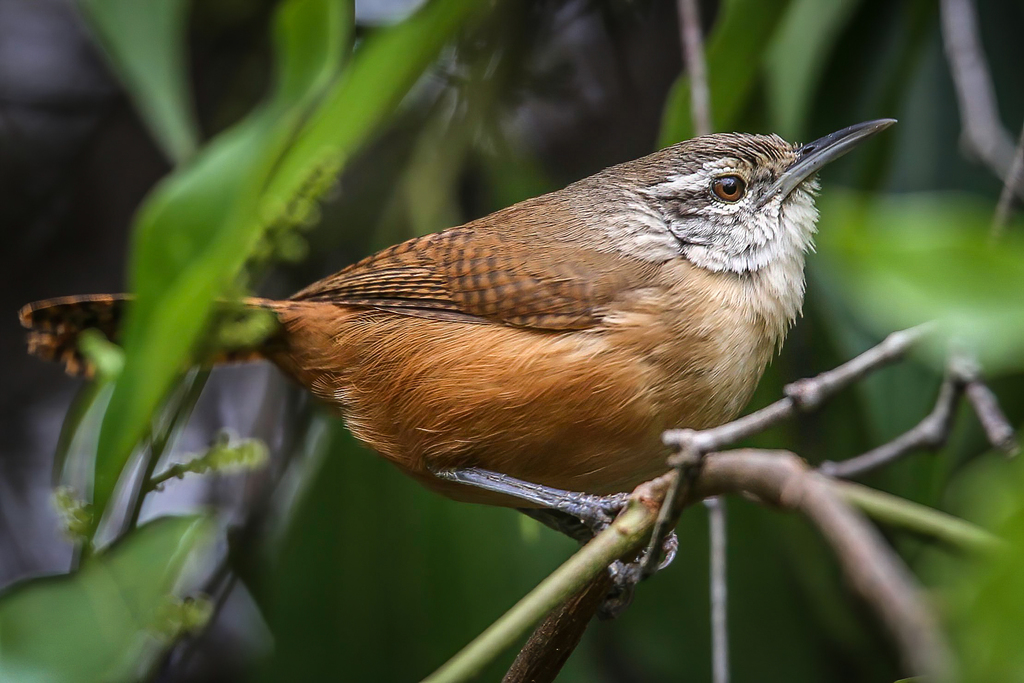
Male buff-breasted wrens weigh 18.5 to 22.8 g (0.65 to 0.80 oz) and females are lighter at 16.0 to 19.5 g (0.56 to 0.69 oz), but the sexes are otherwise similar. There is considerable variation in plumage across the species' wide range. Adults' head, nape, shoulders, tail, and back are rufescent to grayish brown; the tail is heavily barred. The throat, supercilium, and the rest of the face range from whitish through gray to gray-brown. The chest is buffy and the belly more cinnamon. Fledglings are duller overall than adults and the buff of their chest is paler.
Range & habitat
The core range of the buff-breasted wren is northern and central South America, especially the Amazon Basin; the range includes most of Venezuela, and northern Colombia extending into eastern Panama. In the west at the Andes and southwards through Amazonian eastern Peru, it only enters the extreme northwest border regions of Bolivia. The range includes the Guianas, the Amazon River outlet island Ilha de Marajo, and Panama's Pearl Islands. The range southeastwards in Brazil covers the entire central-southern and southeast Amazon Basin. From here the range extends almost to the southeastern Atlantic coast of Brazil, but is mainly in the southern Cerrado, and possibly into the adjacent northeastern Pantanal. Buff-breasted wrens occur in a variety of habitats, but most are characterized by low to medium height vegetation. Examples include secondary forest and its edges and regenerating clearings. Of lesser importance are mangrove forest and shade coffee plantations. In Venezuela they inhabit only gallery forest along waterways in otherwise grassland areas. In Amazonia they are mostly found on the borders of várzea forest and on older river islands. They have been observed in primary forest in Bolivia and the subspecies C. l. collinus inhabits the dry scrub of Colombia's Serranía de Macuira.
Wikipedia: “Distribution and habitat”
What it does
The buff-breasted wren forages in pairs or family groups and will join mixed-species foraging flocks. Typically they hunt between 1 and 6 m (3.3 and 19.7 ft) above ground but also do so on the forest floor and as high as 18 m (59 ft). They hop or make short flights through thick vegetation, gleaning and probing for insects, spiders, and other small arthropods.
Wikipedia: “Feeding”
Listen
Looking for field recordings…
Where it lives
Recorded sightings
—
geo-referenced records in GBIF, from museums, herbaria and field observers.
Drag the globe to turn it. Dots are where records exist, not a range map; darker means more records.
In the stacks
Searching the stacks…
Every page naming Cantorchilus leucotis in the Biodiversity Heritage Library →
This page is assembled live from iNaturalist, GBIF, Wikipedia, the Source Library and the Internet Archive. It is not yet part of the hand-edited codex. iNaturalist taxon 144878.