- Plants
- ›Vascular Plants
- ›flowering plants
- ›Dicots
- ›Woodsorrels, Quandongs, and Allies
- ›quandong family
- ›Elaeocarpus
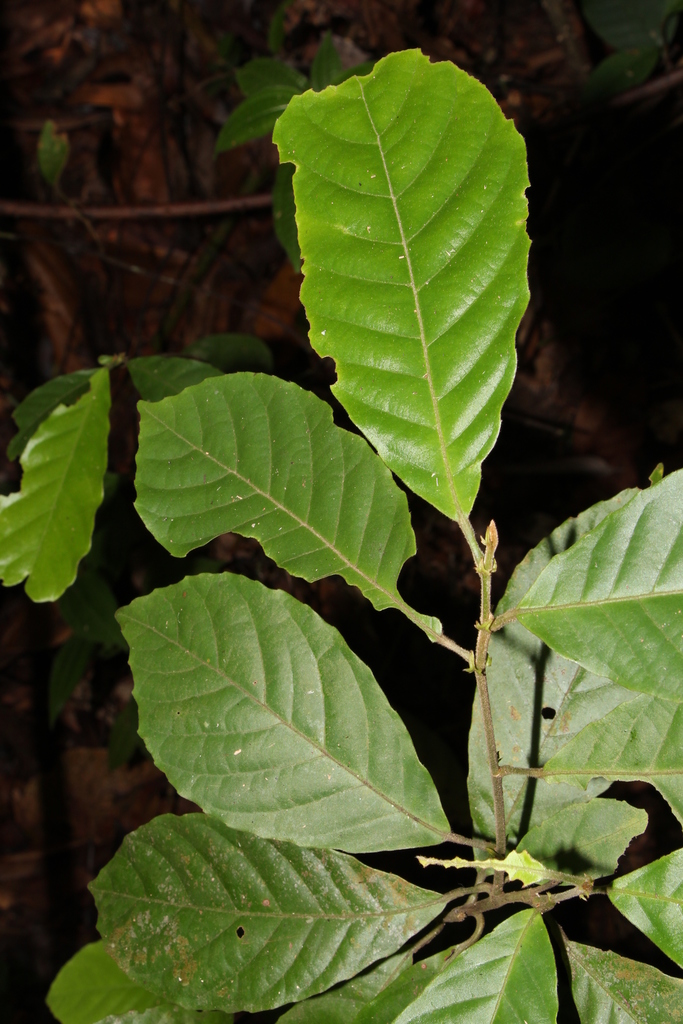
Elaeocarpus stipularis
Elaeocarpus stipularis is a tree in the Elaeocarpaceae family. It is found from the Aru Islands, eastern Indonesia, to Philippines, and through Mainland Southeast Asia to Odisha, India. It has edible fruit, its wood is used and some medical uses are ascribed to it.
From the article Elaeocarpus stipularis on Wikipedia (CC BY-SA), quoted section by section
Description
The evergreen, 10–20 m (33–66 ft) tall tree has a simple broad leaves. Its wood density is 0.46g/cm3 It fruits from November to May in Selangor, Malaysia.
Range & habitat
The species is found from northwestern islands of the Sahul/Australian continent, across southern Wallacea and throughout Southeast Asia: Indonesia (Aru Islands, southern Maluku, East and West Nusa Tenggara, Bali, Jawa, Sumatera, Kalimantan), Timor Leste, Singapore, Malaysia (Peninsular Malaysia, Sabah, Sarawak, Brunei, the Philippines (Mindanao including Bangsamoro and Mimaropa), Thailand, Cambodia, Vietnam, Laos, Myanmar and India (Andaman Islands, Nicobar Islands, Odisha). The varieties alticola and atjehensis are found in Sumatera. The varieties brevipes, castaneus and rejangensis are found in Borneo. The varieties longipetiolatus and nutans are found from Borneo to the Philippines (notably Palawan for var. longipetiolatus and the Sulu Archipelago for var. nutans) The variety siamensis is found in Thailand, Myanmar and India (including Assam and notably Odisha).
Wikipedia: “Distribution”
What it does
Parts of the plant (particularly the fruit) are eaten by the fruitbats Balionycteris maculata, Chironax melanocephalus, Cynopterus brachyotis and Cynopterus horsfieldii, the kanchil Tragulus kanchil, the langur Presbytis femoralis, the pheasant Lophura erythrophthalma, the porcupine Trichys fasciculata, the rats Leopoldamys sabanus and Maxomys whiteheadi, the squirrels Rhinosciurus laticaudatus and Lariscus insignis, and the treeshrew Tupaia glis. In Thung Yai Naresuan Wildlife Sanctuary, Thailand, the Asian black bear (Ursus thibetanus) and the sun bear (Helarctos malayanus) consume the fruit.
Wikipedia: “Ecology”
At the table
The trunk of the species is used to make short-lived constructions in Cambodia, while the twigs are often used as firewood. Amongst inhabitants of southern Shan State, Myanmar, the fruit of the var. siamensis are eaten. The bark of the taxa is used by the Karo people of Sumatera to treat impotence. The Temuan people living in the Ayer Hitam Forest of Selangor, Malaysia, use a poultice of pulped leaves of the tree to treat sores.
Wikipedia: “Uses”
In human culture
Karl Ludwig von Blume, a botanist born in Braunschweig but who studied in the Netherlands, described the nominate species in his Bijdragen tot de Flora van Nederlandsch Indië (Contributions to the Flora of the Netherlandish Indies) in 1825. Mark James Elgar Coode (born 1937), British botanist, reviewed the taxa and published the accepted varieties in the Kew Bulletin in 2001, see below.
Wikipedia: “History”
Where it lives
Recorded sightings
—
geo-referenced records in GBIF, from museums, herbaria and field observers.
Drag the globe to turn it. Dots are where records exist, not a range map; darker means more records.
In the stacks
Searching the stacks…
Every page naming Elaeocarpus stipularis in the Biodiversity Heritage Library →
This page is assembled live from iNaturalist, GBIF, Wikipedia, the Source Library and the Internet Archive. It is not yet part of the hand-edited codex. iNaturalist taxon 425830.