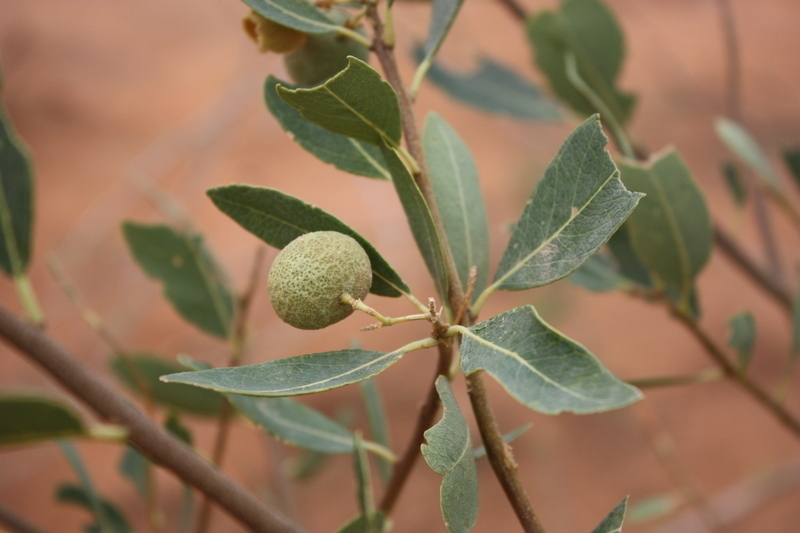
Hanza
Boscia senegalensis
Boscia senegalensis, commonly known as hanza, is a member of the family Capparaceae.
The plant originated from West Africa. Still a traditional food plant in Africa, this little-known fruit has potential to improve nutrition, boost food security, foster rural development and support sustainable landcare. It produces products for consumption, household needs, and medicinal and agricultural uses.
From the article Boscia senegalensis on Wikipedia (CC BY-SA), quoted section by section
Description
Boscia senegalensis is a perennial woody plant species of the genus Boscia in the caper family, Capparaceae. This plant is classified as a dicot. This evergreen shrub can grow anywhere from 2 to 4 m (6 ft 7 in to 13 ft 1 in) in height under favourable conditions. The leaves of the plant are small and leathery, reaching 12 cm × 4 cm (4.7 in × 1.6 in). B. senegalensis produces fruits, clustered in small bunches, in the form of yellow spherical berries, up to 1.5 cm (0.59 in) in diameter. These fruits contain 1–4 seeds, which are a greenish hue when mature. Common names include: aizen (Mauritania and Western Sahara), mukheit (Arabic), hanza (Hausa), bere (Bambara), ngigili (Fulani), mandiarha (Berber), anza (Zarma) and 'taedent (Tamasheq). The fruits are also known as dilo (Hausa), bokkhelli (Arabic), gigile (Fulani) and kanduwi (Tamasheq).
Range & habitat
Boscia senegalensis is a wild species, native to the Sahel region in Africa. It has not yet been domesticated. It currently grows in: Algeria, Benin, Burkina Faso, Cameroon, Central African Republic, Chad, Ghana, Guinea, Kenya, Mali, Mauritania, Niger, Nigeria, Senegal, Somalia, Sudan, and Togo. Boscia senegalensis grows in altitudes of 60–1,450 m (200–4,760 ft), in temperatures between 22–30 °C (72–86 °F) and with rainfall conditions of 100–500 mm (3.9–19.7 in) annually. It can be found growing in marginal soils: rocky, lateritic, clay stony hills, sand dunes, and sand-clay plains. These characteristics make it a highly resilient species, able to grow without expensive inputs even in the extremely hot and dry desert region of the Sahel.
Wikipedia: “Distribution and habitat”
At the table
Fruits are ready for human consumption at the beginning of the rainy season, when most crops are just being planted, and there is little other food available. Fruits can be consumed raw and cooked. Raw fruits initially contain a sweet pulp that then dries out to a sugary solid, difficult to separate from seed. Fruits are often cooked prior to consumption. Juice can also be extracted and boiled down into a butter-like consistency that can be mixed with millet and milk to make cakes. In Sudan, the fruit is fermented into a beer. The seeds of B. senegalensis are also important sources of nutrition, especially during times of famine. To gain access to the seeds, fruits are dried in the sun, pounded to remove the outer seed coat and soaked in water for several days, changing the water every day. The seed soaking process, also known as debittering, is essential to remove bitter and potentially toxic components. Seeds are usually cooked prior to consumption. Cooked seeds are texturally similar to a chickpea and can be used as a cereal substitute in stews, soups and porridges. Additionally, seeds can be re-dried and stored for later use or ground into a flour that can be used to make porridge. Roasted seeds can also serve as a substitute for coffee.
Modern uses of B. senegalensis seeds are being developed in Niger Republic. …
Wikipedia: “Uses”
How it is grown
In times of severe drought and famine, when many other crops have failed, B. senegalensis can still survive and provide useful products. Ethnobotanical indigenous knowledge contributes to the importance of this plant to the Hausa peoples of Niger and Fulani herders in West Africa. During the famine of 1984–1985, it was reported that B. senegalensis was the most widely consumed famine food in both Sudan and Darfur, relied on by over 94% of people in northern Darfur.
B. senegalensis can benefit farmers because it keeps soil from laying bare and thus prevents soil erosion and degradation. It also buffers against wind, stabilizes sand dunes, offers shade to surrounding plants and cycles nutrients. In Niger, the trees are often cut or burned down by farmers in the dry season, in order to make space on the field for staple crops such as millet or sorghum. However, due to the strong surviving character of the tree, it reappears after the first rains and continues growing as a small bush. One intervention with the potential to help poor farmers is the creation of cool temperature storage facilities – as B. senegalensis seeds can be stored for up to 2 months at 15 °C (59 °F). It is recommended that the techniques of grafting and generating hybrids (wide-crosses) with related species be explored, as both techniques have the potential to increase harvests and/or improve the fruits. …
Wikipedia: “Cultivation”
Where it lives
Recorded sightings
—
geo-referenced records in GBIF, from museums, herbaria and field observers.
Drag the globe to turn it. Dots are where records exist, not a range map; darker means more records.
In the stacks
Searching the stacks…
Every page naming Boscia senegalensis in the Biodiversity Heritage Library →
This page is assembled live from iNaturalist, GBIF, Wikipedia, the Source Library and the Internet Archive. It is not yet part of the hand-edited codex. iNaturalist taxon 505836.