On eBird ↗
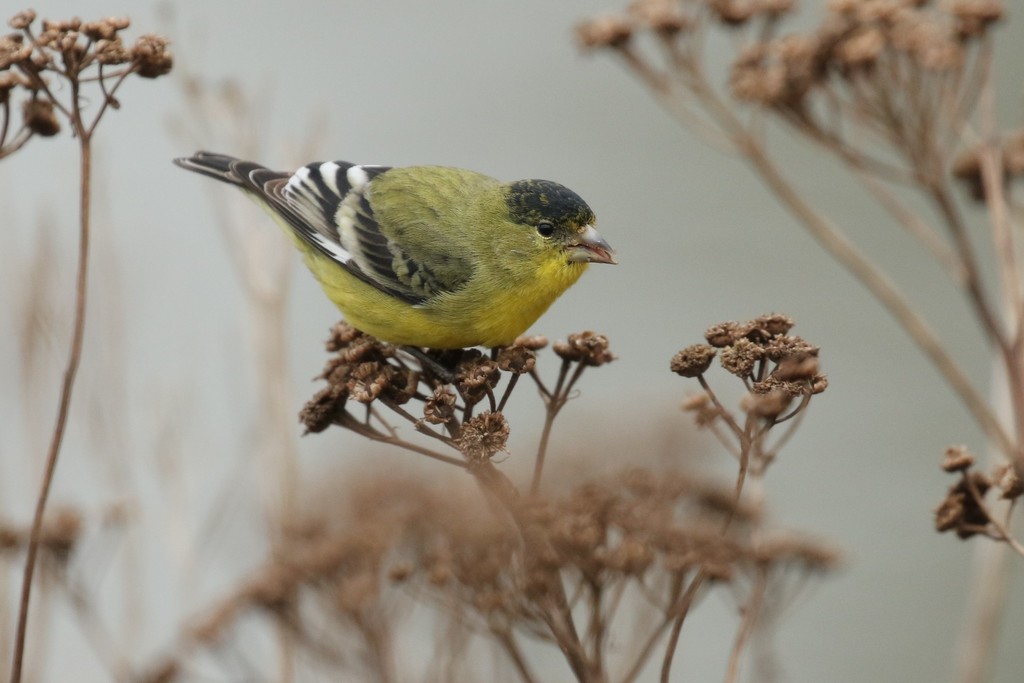
Lesser Goldfinch
Live sightings near you, the range map, bar charts of when it is seen, and Macaulay Library photos and recordings.
Lesser Goldfinch
Spinus psaltria
The lesser goldfinch (Spinus psaltria) is a small finch in the genus Spinus native to the Americas.
As is the case for most species in the genus Spinus, lesser goldfinch males have a black forehead, which females lack. Males in this species vary strikingly in the color of their back across their range, from green in western North America to black in the eastern Rocky Mountains and Texas south to northern South America; this variation has resulted in five subspecies being recognized.
From the article Lesser goldfinch on Wikipedia (CC BY-SA), quoted section by section
Description
This species is not only the smallest North American Spinus finch, it may be the smallest true finch in the world. Some sources list more subtropical Spinus species as slightly smaller on average, including the Andean siskin (Spinus spinescens). This species ranges from 9 to 12 cm (3.5 to 4.7 in) in length and can weigh from 8 to 11.5 g (0.28 to 0.41 oz). Among standard measurements, the wing chord is 5.5 to 7 cm (2.2 to 2.8 in), the tail is 3.9 to 4.7 cm (1.5 to 1.9 in), the bill is 0.9 to 1.1 cm (0.35 to 0.43 in) and the tarsus is 1.1 to 1.2 cm (0.43 to 0.47 in). There is a slight northwest-southeast cline in size, with the largest birds from Mexico and further south being up to one-fifth larger than the smallest from the extreme northwest of its range; this effect is more pronounced in females. There is also considerable variation in the amount of black on the head and back in males and thus five subspecies have been proposed. But this variation, too, seems to be simple and clinal changes in allele frequency and thus the "subspecies" might be better considered color morphs or geographic forms. Males are easily recognized by their bright yellow underparts and big white patches in the tail (outer rectrices) and on the wings (the base of the primaries). …
Range & habitat
This goldfinch ranges from the southwestern United States to as far north as the Columbia River in Washington and south to Venezuela and Peru. It seasonally migrates out of parts of its U.S. range, but is resident year-round in others, and has rapidly expanded across much of the Pacific Northwest in recent decades as a year-round resident. The lesser goldfinch often occurs in flocks or at least loose associations. It utilizes almost any habitat with trees or shrubs except for dense forest, and is common and conspicuous in many areas, often coming near houses. It is common at feeders in the Southwest United States and will come almost anywhere with thistle sock feeders. Flocks of at least six birds will often be seen at feeders. It feeds mostly on tree buds and weed seeds; geophagy has been observed in this species. The nesting season is in summer in the temperate parts of its range; in the tropics it apparently breeds all-year round, perhaps less often in September and October. It lays three to six bluish white eggs in a cup nest made of fine plant materials such as lichens, rootlets, and strips of bark, placed in a bush or at low or middle levels in a tree, around 4 to 8 ft (1.2 to 2.4 m) or higher off the ground. …
Wikipedia: “Distribution and habitat”
Listen
Looking for field recordings…
Where it lives
Recorded sightings
—
geo-referenced records in GBIF, from museums, herbaria and field observers.
Drag the globe to turn it. Dots are where records exist, not a range map; darker means more records.
In the stacks
Searching the stacks…
Every page naming Spinus psaltria in the Biodiversity Heritage Library →
This page is assembled live from iNaturalist, GBIF, Wikipedia, the Source Library and the Internet Archive. It is not yet part of the hand-edited codex. iNaturalist taxon 145308.