- Animals
- ›Chordates
- ›Vertebrates
- ›Mammals
- ›Therians
- ›Marsupials
- ›Kangaroos, Possums, Wombats, and Allies
- ›Wombats and Koalas
- ›Wombats
- ›Lasiorhinus
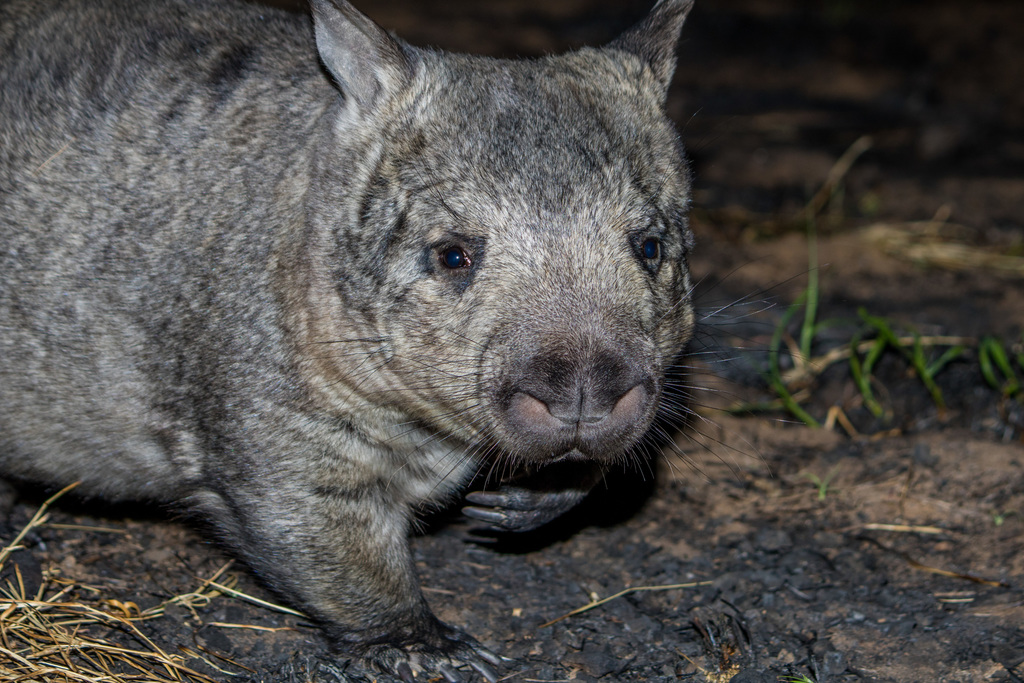
Northern Hairy-nosed Wombat
Lasiorhinus krefftii
The northern hairy-nosed wombat (Lasiorhinus krefftii) or yaminon is one of three extant species of Australian marsupials known as wombats. It is one of the rarest land mammals in the world and is critically endangered. Its historical range previously extended across New South Wales, Victoria, and Queensland, and as recently as 100 years ago it was considered extinct.
In the 1930s, 30 individuals were discovered in a 3 km2 (1.2 sq mi) range within the 32 km2 (12 sq mi) Epping Forest National Park in Queensland. In 2002, with the species threatened by wild dogs, the Queensland Government built a 20-kilometre (12 mi)-long predator-proof fence around all wombat habitat at Epping Forest National Park. Insurance populations have since been translocated to two other locations to ensure that the species survives threats such as fire, flood, or disease.
From the article Northern hairy-nosed wombat on Wikipedia (CC BY-SA), quoted section by section
Description
In general, all species of wombat are heavily built, with large heads and short, powerful legs. They have strong claws to dig their burrows, where they live much of the time. It usually takes about a day for an individual to dig a burrow. Northern hairy-nosed wombats have bodies covered in soft, grey fur. The fur on their noses sets them apart from the common wombat. They have longer, more pointed ears and a much broader muzzle than the other two species. Individuals can be 35 cm high, up to 1 m long and weigh up to 40 kg. The species exhibits sexual dimorphism, with females being somewhat larger than males due to the presence of an extra layer of fat. They are slightly larger than the common wombat and able to breed somewhat faster, giving birth to two young every three years on average. The northern hairy-nosed wombat's nose is very important in its survival because it has very poor eyesight, so it must detect its food in the dark through smell. Examination of the wombat's digestive tract shows that the elastic properties of the ends of their large intestines are capable of turning liquid excrement into cubical scat.
Range & habitat
Northern hairy-nosed wombats require deep sandy soils in which to dig their burrows, and a year-round supply of grass, which is their primary food. These areas usually occur in open eucalypt woodlands. At Epping Forest National Park, northern hairy-nosed wombats construct their burrows in deep, sandy soils on levée banks which were deposited by a creek that no longer flows through the area. They forage in areas of heavy clay soils adjacent to the sandy soils, but do not dig burrows in these areas, which become waterlogged in the wet seasons. In the park, burrows are often associated with native Lysiphyllum hookeri trees. This tree has a spreading growth form, and its roots probably provide stability for the extensive burrows dug by the wombats. By the 1980s the range of the northern hairy-nosed wombat had become restricted to a single site of about 300 hectares (740 acres) in the Epping National Forest in east-central Queensland, 120 kilometres (75 mi) north-west of Clermont. Insurance populations have been established at two locations near St George, at the 130 ha (320 acres) Richard Underwood Nature Refuge in 2009, and in the 2,800 ha (6,900 acres) Powrunna State Forest in 2024, with plans for a fourth site by 2041.
Wikipedia: “Distribution and habitat”
What it does
The northern hairy-nosed wombat is nocturnal, living underground in networks of burrows. They avoid coming above ground during harsh weather, as their burrows maintain a constant humidity and temperature. They have been known to share burrows with up to 10 individuals, equally divided by sex. Young are usually born during the wet season, between November and April. When rain is abundant, 50–80% of the females in the population will breed, giving birth to one offspring at a time. Juveniles stay in their mothers' pouches for 8 to 9 months, and are weaned at 12 months of age. The fat reserves and low metabolic rate of this species permit northern hairy-nosed wombats to go without food for several days when food is scarce. Even when they do feed every day, it is only for 6 hours a day in the winter and 2 hours in the summer, significantly less than a similar-sized kangaroo, which feeds for at least 18 hours a day. Their diet consists of native grasses: black speargrass (Heteropogon contortus), bottle washer grasses (Enneapogon spp.), golden beard grass (Chrysopogon fallax), and three-awned grass (Aristida spp.), as well as various types of roots. Their teeth continue to grow beyond the juvenile period, and are worn down by the abrasive grasses they eat. Its habitat has become infested with African buffel grass, a grass species introduced for cattle grazing. …
Wikipedia: “Behaviour”
Listen
Looking for field recordings…
Where it lives
Recorded sightings
—
geo-referenced records in GBIF, from museums, herbaria and field observers.
Drag the globe to turn it. Dots are where records exist, not a range map; darker means more records.
In the stacks
Searching the stacks…
Every page naming Lasiorhinus krefftii in the Biodiversity Heritage Library →
This page is assembled live from iNaturalist, GBIF, Wikipedia, the Source Library and the Internet Archive. It is not yet part of the hand-edited codex. iNaturalist taxon 43003.