- Animals
- ›Chordates
- ›Vertebrates
- ›Mammals
- ›Therians
- ›Marsupials
- ›Kangaroos, Possums, Wombats, and Allies
- ›Macropods
- ›Kangaroos, Wallabies and Allies
- ›Kangaroos, Wallabies, Pademelons, and Dorcopsises
- ›Kangaroos and Wallabies
- ›Macropus
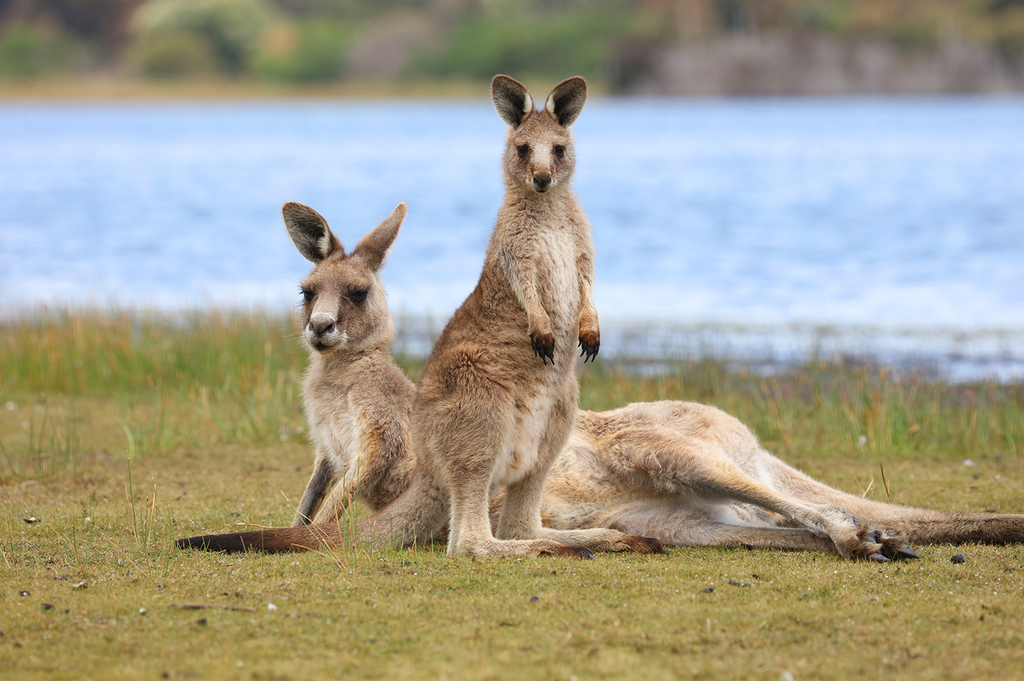
Eastern Grey Kangaroo
Macropus giganteus
The eastern grey kangaroo (Macropus giganteus) is a marsupial found in the eastern third of Australia, with a population of several million. It is also known as the great grey kangaroo and the forester kangaroo. Although a big eastern grey male can typically weigh up to 69 kg (152 lb) and have a length of well over 2 m (6 ft 7 in), the scientific name, Macropus giganteus (gigantic large-foot), is misleading: the red kangaroo of the semi-arid inland is larger,...
From the article Eastern grey kangaroo on Wikipedia (CC BY-SA), quoted section by section
Description
The eastern grey kangaroo is the second largest and heaviest living marsupial and native land mammal in Australia. An adult male will commonly weigh around 50 to 66 kg (110 to 146 lb) whereas females commonly weigh around 17 to 40 kg (37 to 88 lb). They have a powerful tail that is over 1 m (3 ft 3 in) long in adult males. One of these, shot in eastern Tasmania weighed 82 kg (181 lb), with a 2.64 m (8 ft 8 in) total length from nose to tail (possibly along the curves). The largest known specimen, examined by Lydekker, had a weight of 91 kg (201 lb) and measured 2.92 m (9 ft 7 in) along the curves. When the skin of this specimen was measured it had a "flat" length of 2.49 m (8 ft 2 in). The eastern grey is easy to recognise: its soft grey coat is distinctive, and it is usually found in moister, more fertile areas than the red. Red kangaroos, though sometimes grey-blue in colour, have a totally different face than eastern grey kangaroos. Red kangaroos have distinctive markings in black and white beside their muzzles and along the sides of their face. Eastern grey kangaroos do not have these markings, and their eyes seem large and wide open. Where their ranges overlap, it is much more difficult to distinguish between eastern grey and western grey kangaroos, which are closely related. …
Range & habitat
Although the red is better known, the eastern grey is the kangaroo most often encountered in Australia, due to its adaptability. Few Australians visit the arid interior of the continent, while many live in and around the major cities of the southern and eastern coast, from where it is usually only a short drive to the remaining pockets of near-city bushland where kangaroos can be found without much difficulty. The eastern grey prefers open grassland with areas of bush for daytime shelter and mainly inhabits the wetter parts of Australia. It also inhabits coastal areas, woodlands, sub-tropical forests, mountain forests, and inland scrubs.
Wikipedia: “Distribution and habitat”
What it does
Like all kangaroos, it is mainly nocturnal and crepuscular, and is mostly seen early in the morning, or as the light starts to fade in the evening. In the middle of the day, kangaroos rest in the cover of the woodlands and eat there but then come out in the open to feed on the grasslands in large numbers. The eastern grey kangaroo mainly graze a wide variety of grasses and forbs compared to other species (e.g. the red kangaroo) that also include significant amounts of shrubs in their diet. Eastern grey kangaroos are gregarious and form open-membership groups. The groups contain an average of three individuals. Smaller groups join to graze in preferred foraging areas, and to rest in large groups around the middle of the day. They exist in a dominance hierarchy and the dominant individuals gain access to better sources of food and areas of shade. However, kangaroos are not territorial. Eastern grey kangaroos adjust their behaviour in relation to the risk of predation with reproductive females, individuals on the periphery of the group and individuals in groups far from cover being the most vigilant. Vigilance in individual kangaroos does not seem to significantly decrease when the size of the group increases. However, there is a tendency for the proportion of individuals on the periphery of the group to decline as group size increases. …
Wikipedia: “Behaviour”
Listen
Looking for field recordings…
Where it lives
Recorded sightings
—
geo-referenced records in GBIF, from museums, herbaria and field observers.
Drag the globe to turn it. Dots are where records exist, not a range map; darker means more records.
In the stacks
Searching the stacks…
Every page naming Macropus giganteus in the Biodiversity Heritage Library →
This page is assembled live from iNaturalist, GBIF, Wikipedia, the Source Library and the Internet Archive. It is not yet part of the hand-edited codex. iNaturalist taxon 42888.