- Animals
- ›Chordates
- ›Vertebrates
- ›Mammals
- ›Therians
- ›Placental Mammals
- ›Primates, Rodents, and Allies
- ›Primates
- ›Monkeys, Apes, and Tarsiers
- ›Monkeys and Apes
- ›Apes and Old World Monkeys
- ›Old World Monkeys
- ›Cercopithecines
- ›Guenons, Vervet Monkeys, and Talapoins
- ›Cercopithecus
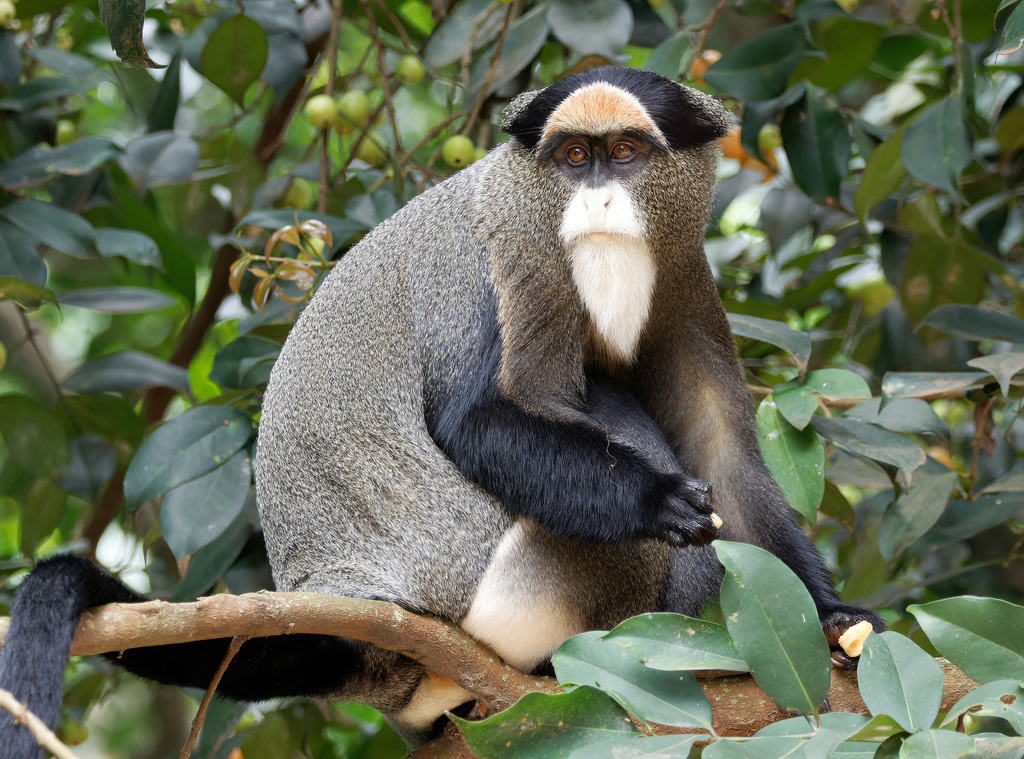
De Brazza's Monkey
Cercopithecus neglectus
De Brazza's monkey (Cercopithecus neglectus) is an Old World monkey endemic to the riverine and swamp forests of central Africa. The largest species in the guenon family, it is one of the most widespread arboreal African primates. Aside from size, it can be differentiated from other Cercopithecus monkeys by its orange diadem and white beard. Due to its cryptic nature, the species is not well documented in all of its habitats but has shown unique traits, such as pair-bonding and aggressive behavior towards other guenons.
From the article De Brazza's monkey on Wikipedia (CC BY-SA), quoted section by section
Description
The De Brazza's monkey is the most sexually dimorphic species of guenon; males weigh around 7 kilograms (15 lb), while females weigh around 4 kilograms (8.8 lb). Adults have grey agouti fur with a reddish-brown back, black limbs and tail, and a white rump. Both sexes have cheek pouches they use to carry food while they forage. Males have a distinct blue scrotum, while females have a red perianal region and visible nipples. Juveniles lack the darker colors on the extremities that is characteristic of adults, but retain the white stripes and red rump, while infants are a uniform brown agouti with only a small beard. The white muzzle and beard, along with an orange crescent on its forehead and white stripes on its thighs distinguish it from other guenons. Due to this distinctive appearance, the monkey is sometimes referred to as the "Ayatollah Monkey" after the similarly-bearded Grand Ayatollah Ruhollah Khomeini.
Range & habitat
De Brazza's monkeys range across the swamps, bamboo and dry mountain forests of Angola, Cameroon, Central African Republic, Congo, Democratic Republic of the Congo, Equatorial Guinea, Ethiopia, Gabon, Kenya, South Sudan, Nigeria and Uganda and possibly Tanzania though reports have not been confirmed. Troops are found almost exclusively near water, rarely venturing farther than 1 km (0.62 mi) away from a river or tributary. As a result, they can sometimes be seen swimming. The monkeys prefer dense forest and vegetation, only venturing into more open forest to feed. They are mainly arboreal, but descend to the ground to feed on herbaceous plants. Due to its cryptic nature, there is no accurate population estimate for the species over its entire range.
Wikipedia: “Distribution and habitat”
What it does
The diet of De Brazza's monkeys consists mostly of herbaceous plants found on the forest floor, and fruits when available. These are supplemented with insects, seeds, and other food sources when primary foods are scarce.
Wikipedia: “Diet”
In human culture
Locally known as swamp monkeys, these primates are named after the Italian naturalist and explorer Jacques Savorgnan de Brazza. Their scientific species name, neglectus, which means to pay no attention to, was given to them because of their ability to hide from both humans and predators.
Wikipedia: “Etymology”
Listen
Looking for field recordings…
Where it lives
Recorded sightings
—
geo-referenced records in GBIF, from museums, herbaria and field observers.
Drag the globe to turn it. Dots are where records exist, not a range map; darker means more records.
In the stacks
Searching the stacks…
Every page naming Cercopithecus neglectus in the Biodiversity Heritage Library →
This page is assembled live from iNaturalist, GBIF, Wikipedia, the Source Library and the Internet Archive. It is not yet part of the hand-edited codex. iNaturalist taxon 43473.