- Animals
- ›Chordates
- ›Vertebrates
- ›Mammals
- ›Therians
- ›Placental Mammals
- ›Primates, Rodents, and Allies
- ›Primates
- ›Monkeys, Apes, and Tarsiers
- ›Monkeys and Apes
- ›Apes and Old World Monkeys
- ›Old World Monkeys
- ›Colobines
- ›Langurs, Surilis, and Lutungs
- ›Pygathrix
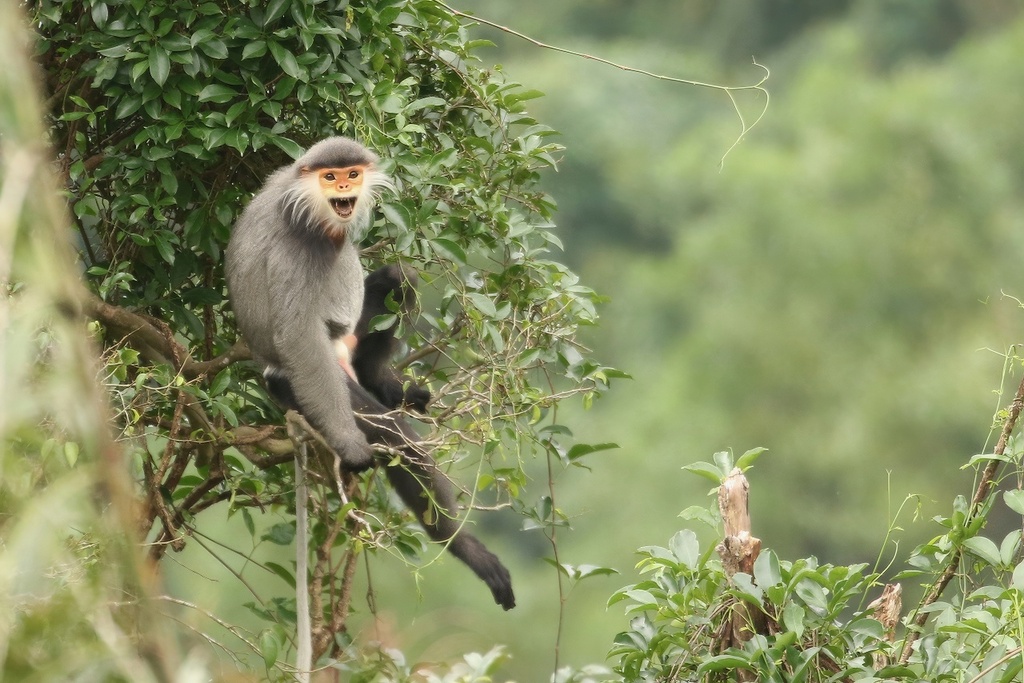
Grey-shanked Douc Langur
Pygathrix cinerea
The grey-shanked douc langur (Pygathrix cinerea) is a douc species native to the Vietnamese provinces of Quảng Nam, Quảng Ngãi, Bình Định, Kon Tum, and Gia Lai. The total population was estimated at 550 to 700 individuals in 2004. In 2016, Dr. Benjamin Rawson, Country Director of Fauna & Flora International's Vietnam Programme, announced a discovery of an additional population including more than 500 individuals found in Central Vietnam, bringing the total population up to approximately 1000 individuals.
From the article Gray-shanked douc on Wikipedia (CC BY-SA), quoted section by section
What it does
Grey-shanked doucs are diurnal and primarily arboreal. They move about through trees by jumping and brachiating. In the past they have been found in groups as large as fifty individuals but those numbers have been greatly reduced to 4 to 15 individuals. Males are the dominant gender and dominance hierarchies have been observed while in captivity. The grey-shanked douc langur communicates using touch, visual communication, and sound. Growls are used to show aggression. They can be used as a threat or warning toward other individuals. A soft, twitter sound is used when being submissive. Grey-shanked doucs also engage in grooming to remove parasites and to establish and strengthen bonds between group members. This is usually done before resting for the night. Group members will also spar with each other. Sparring is a type of aggressive behavior in which participants will slap, pull, and grab each other. Visual communication includes facial expressions and various postures. Facial expressions include grimacing, which is used to show submissiveness, play face, which is used to play with another group member, and staring which suggests either curiosity or aggression. Facial expressions are also used during courtship. …
Wikipedia: “Behavior”
Listen
Looking for field recordings…
Where it lives
Recorded sightings
—
geo-referenced records in GBIF, from museums, herbaria and field observers.
Drag the globe to turn it. Dots are where records exist, not a range map; darker means more records.
In the stacks
Searching the stacks…
Every page naming Pygathrix cinerea in the Biodiversity Heritage Library →
This page is assembled live from iNaturalist, GBIF, Wikipedia, the Source Library and the Internet Archive. It is not yet part of the hand-edited codex. iNaturalist taxon 74991.