- Animals
- ›Chordates
- ›Vertebrates
- ›Mammals
- ›Therians
- ›Placental Mammals
- ›Primates, Rodents, and Allies
- ›Primates
- ›Monkeys, Apes, and Tarsiers
- ›Monkeys and Apes
- ›Apes and Old World Monkeys
- ›Old World Monkeys
- ›Colobines
- ›Langurs, Surilis, and Lutungs
- ›Trachypithecus
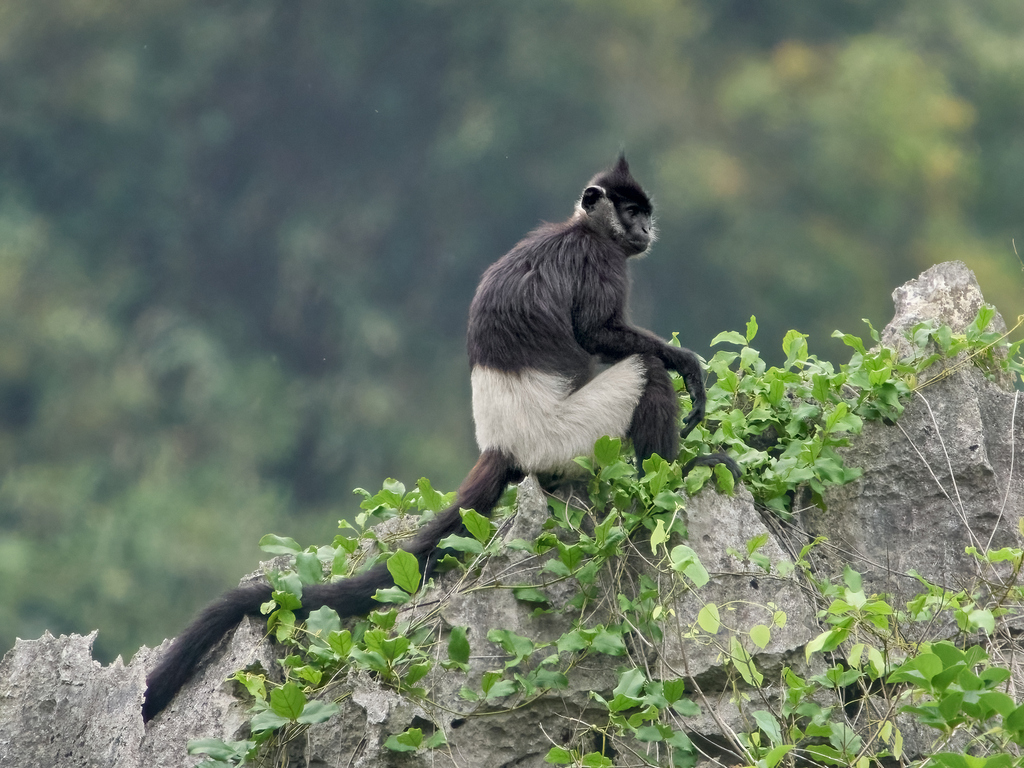
Delacour's Lutung
Trachypithecus delacouri
The Delacour's langur, or Delacour's lutung, (Trachypithecus delacouri) is a critically endangered species of lutung endemic to northern Vietnam. It is considered to be one of the world's most endangered primate species. It is named for French-American ornithologist Jean Théodore Delacour.
From the article Delacour's langur on Wikipedia (CC BY-SA), quoted section by section
Range & habitat
Delacour's langur is endemic to Vietnam, where it is found only in an area around 6,000 km2 (2,300 sq mi) in the capital Hanoi and provinces of Ninh Bình, Hà Nam, Hòa Bình, Thanh Hóa in the north of the country. The largest surviving population is thought to live in Van Long Nature Reserve in Ninh Bình, where the it inhabits open forest up to elevations of 328 m (1,076 ft) in terrain dominated by limestone karst.
Wikipedia: “Distribution and habitat”
What it does
Delacour's langurs are diurnal, spending daylight hours exploring their home range and often sleeping on open rock surfaces or in limestone caves at night. They are folivorous, with about 78% of the diet reportedly consisting of foliage, although they also eat fruit, seeds, and flowers. The monkeys have been reported to eat leaves from a wide range of different plant species, indicating that their apparent dependence on limestone habitats is not related to their diet. In previous decades, Delacour's langurs were reported to live in troops of up to 30 individuals, often including a mix of males and females, although single-male groups are more common, and some small all-male groups have also been reported. In more recent years, the typical group size seems to be much smaller, with only about four to 16 members each. Males defend the troop's territory from outsiders, often standing watch on rocky outcrops. When potential rivals are spotted, the males in a troop initially try to intimidate them with loud hoots and visual displays, resorting to chasing and fighting if this fails. Within the group, social bonds are maintained by grooming and play. Despite living in forested habitats, Delacour's langurs are primarily terrestrial, only occasionally venturing into the trees. …
Wikipedia: “Behaviour”
Listen
Looking for field recordings…
Where it lives
Recorded sightings
—
geo-referenced records in GBIF, from museums, herbaria and field observers.
Drag the globe to turn it. Dots are where records exist, not a range map; darker means more records.
In the stacks
Searching the stacks…
Every page naming Trachypithecus delacouri in the Biodiversity Heritage Library →
This page is assembled live from iNaturalist, GBIF, Wikipedia, the Source Library and the Internet Archive. It is not yet part of the hand-edited codex. iNaturalist taxon 75185.