- Animals
- ›Chordates
- ›Vertebrates
- ›Mammals
- ›Therians
- ›Placental Mammals
- ›Primates, Rodents, and Allies
- ›Primates
- ›Monkeys, Apes, and Tarsiers
- ›Monkeys and Apes
- ›Apes and Old World Monkeys
- ›Old World Monkeys
- ›Colobines
- ›Colobuses
- ›Piliocolobus
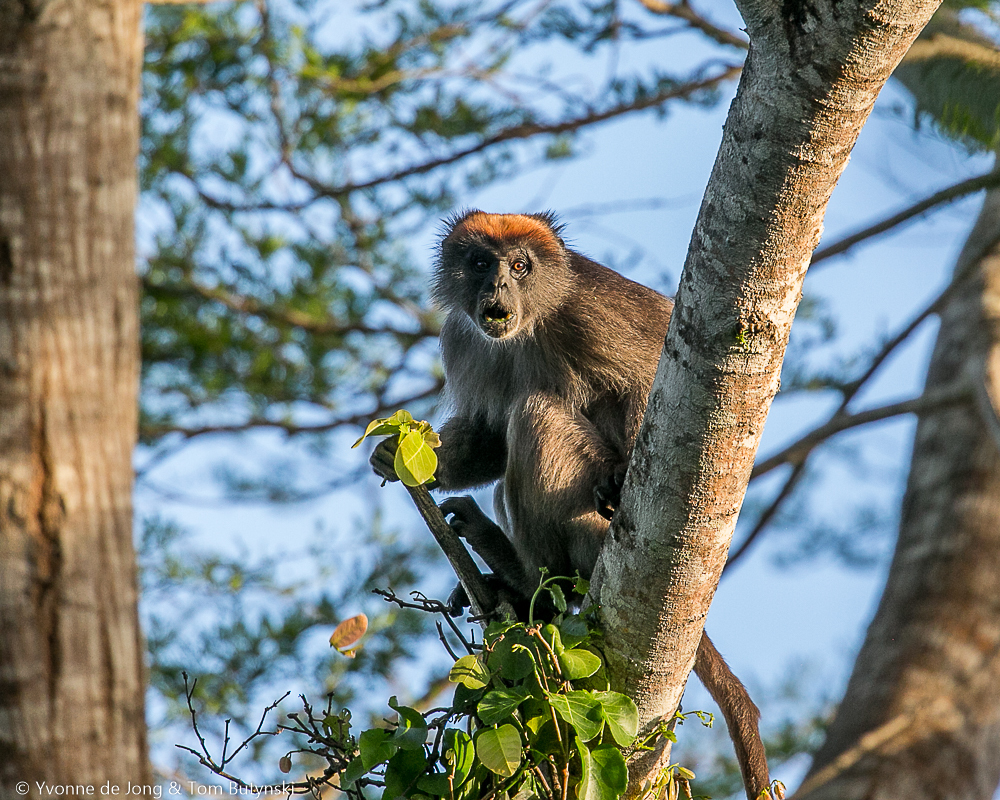
Tana River Red Colobus
Piliocolobus rufomitratus
The Tana River red colobus (Piliocolobus rufomitratus), also called the eastern red colobus, is a highly endangered species of primate in the family Cercopithecidae. It is endemic to a narrow zone of gallery forest near the Tana River in southeastern Kenya.
From the article Tana River red colobus on Wikipedia (CC BY-SA), quoted section by section
Range & habitat
The Tana River red colobus monkey gets its name from where it resides, along forests along the floodplain in the lower Tana River in eastern Kenya, the country's longest river. The river is roughly 1,000 km long. When the river is in a flood, the floodplain measures from one to six km in width, and about 60 to 100 m in width when not in a flood. Floods occur roughly once a year, with a major flood occurring every three years. Although the floodplain is mostly grassy, there are places with bushland, woodland, and forests.
Climate. The lower Tana River is generally hot and dry, with temperatures ranging from 86 to 100 °F (30 to 38 °C). The hottest months generally occur during January and February while the coldest months are May through July. The average annual rainfall is between 500 and 600 mm, with the wettest months being March and April and the driest being November and December.
Vegetation. The main vegetation that appears along the lower Tana River includes grassland, wooded grassland, bushland, deciduous woodland and lowland evergreen forest. Due to human disturbances as well as floods, patchy distributions of forests have resulted. A study was done in 1988 to determine what was causing the drastic decline of the crested mangabey and the Tana River red colobus. The forest was found to be regenerating and causing a new kind of vegetation to appeal to newer species. …
Wikipedia: “Habitat”
What it does
Colobus monkeys eat mostly leaves from a limited number of tree species. They choose mature leaf species that are high in nitrogen and low in fiber. They supplement this bulky cellulose diet with occasional unripe fruit, moss and seeds. Human food is of no interest to these leaf specialists. Their stomachs are large and have three chambers, and carry a specific bacterium which helps to ferment and digest the leaves. They eat about two to three kilograms of leaves a day. Sometimes they eat soil, clay and charcoal to help digest toxins and toxic leaves. Because of the poor nutritional quality of their food, they must browse intensively for many hours each day looking for food, and spend much of the remainder of the day resting to aid digestion.
Wikipedia: “Diet”
At the table
The Tana River red colobus is located only in a very small section of the world. Its current endangerment is caused by habitat loss and persecution by humans. Tropical forests are constantly being cut down, causing the destruction of habitat for the red colobus. Cultivation of the land and the creation of levees and dykes have had the most devastating impact. Both human creations involve partial or complete forest clearing, resulting in further devastation of forest patches. Both the Tana River red colobus and the Tana River mangabey have been put in a dangerous situation due to deforestation and destruction created by an increasing human population. Forest is cleared primarily for agriculture; in the last 20 years approximately 50% of the unique forest has been lost. A survey conducted in 1987 concluded that since 1975 there has been approximately an 80% decline in the numbers of Tana River Colobus monkeys. Habitat disturbances, changing farming practices, and the altering course of the river were found to be the main reasons for endangerment. Another developing threat to the Tana River red colobus is the introduction of parasitic diseases to their habitats. The presence of parasites in the monkeys was noticeably higher than other primates.
Wikipedia: “Causes of endangerment”
Listen
Looking for field recordings…
Where it lives
Recorded sightings
—
geo-referenced records in GBIF, from museums, herbaria and field observers.
Drag the globe to turn it. Dots are where records exist, not a range map; darker means more records.
In the stacks
Searching the stacks…
Every page naming Piliocolobus rufomitratus in the Biodiversity Heritage Library →
This page is assembled live from iNaturalist, GBIF, Wikipedia, the Source Library and the Internet Archive. It is not yet part of the hand-edited codex. iNaturalist taxon 520070.