- Animals
- ›Chordates
- ›Vertebrates
- ›Mammals
- ›Therians
- ›Placental Mammals
- ›Primates, Rodents, and Allies
- ›Primates
- ›Monkeys, Apes, and Tarsiers
- ›Monkeys and Apes
- ›Apes and Old World Monkeys
- ›Old World Monkeys
- ›Colobines
- ›Colobuses
- ›Piliocolobus
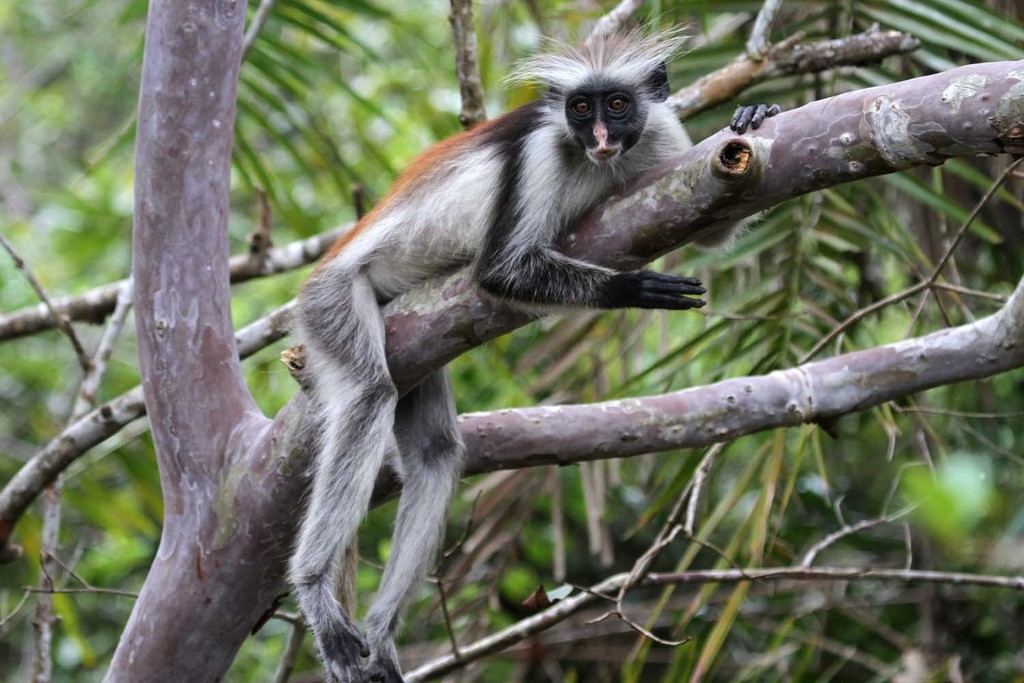
Zanzibar Red Colobus Monkey
Piliocolobus kirkii
The Zanzibar red colobus (Piliocolobus kirkii) is a species of red colobus monkey endemic to Unguja, the main island of the Zanzibar Archipelago, off the coast of Tanzania. It is also known as Kirk's red colobus after Sir John Kirk, the British Resident of Zanzibar who first brought it to the attention of zoological science. It is now classified as an endangered species and in the mid-1990s was adopted as the flagship species for conservation in Zanzibar. The population is still decreasing, and conservationists are attempting to work with the local government to devise a proper, effective strategy to protect the population and habitat. Challenges include the species' habitat, which is limited to the archipelago. The species has been reclassified three times; it was previously in the genus Colobus, then in the genus Procolobus, and later in the genus Piliocolobus.
From the article Zanzibar red colobus on Wikipedia (CC BY-SA), quoted section by section
Range & habitat
The Zanzibar red colobus is found in three forests of the Zanzibar archipelago. It displays a wide habit tolerance, but it is mainly an arboreal species and prefers drier areas over wet ones. Its habitats include coastal thickets and coastal rag scrub, but it can also be found in agricultural areas and in mangrove swamps; the latter provides food year-round. When found in agricultural areas, the monkey is more used to humans and comes closer to the ground. About 1,600 to 3,000 individuals remain, and currently, 50% of the monkeys found on the islands live outside protected zones. The largest and most significant area of protection and habitat for the monkey is in Jozani National Park, which provides 25 km2 (9.7 sq mi) of land reserve. It is located on the main island and the populations here have been greatly studied in regards to both their ecology and behavior. Even so, many groups have been found in shambas (Swahili for "farmland") in close proximity to the park. In these shambas adjacent to the park, higher densities of the red colobus have been reported living here in more cohesive groups, compared to inside the park reserve. The incidence of some of these monkeys living permanently outside the zone of the protected park reserve can increase the endangerment of the groups.
Wikipedia: “Habitat”
What it does
The groups consist of up to four adult males and many adult females; typically yielding a 1:2 ratio of males to females. Young of varying ages are also incorporated in the group. The number of monkeys in a group can range from 30 to 50 individuals. The species is a very social animal, and can often be observed playing and grooming during the rest periods between meals. Unlike females, in a group, males actually maintain close bonds, acting together in defense of their group and even in grooming each other.
Feeding. Feeding is also a group activity. It begins to feed in the morning, and is more active during the cooler parts of the day. Loud calls from males indicate the group is ready to move to another tree to feed. This monkey is mainly a foliovore, and on average, half of the leaves consumed are young leaves. They also eat leaf shoots, seeds, flowers, and unripe fruit. It has also been found eating bark, dead wood, and soil. It is one of the few species that do not eat ripe fruits; it has a sacculated stomach with four chambers specific for breaking down plant materials, however it cannot digest the sugars contained in mature fruits. …
Wikipedia: “Behavior”
In human culture
The Zanzibar red colobus, Piliocolobus kirkii, population on Zanzibar, represents a population of red colobus that is believed to have been isolated on the island after sea levels rose toward the end of the Pleistocene epoch. Furthermore, it is suggested through mitochondrial analysis, that phylogenetic groups within the red colobus have been genetically isolated from another since the Pliocene. Examining cranial morphology has shown that P. kirkii has diverged from mainland Piliocolobus to its own species. It has experienced an acceleration in morphological evolution of size which is suggested to be the result of insularity on the island and environmental pressures such as competition, habitat, predation and/or resource availability. There has been no evidence for population bottlenecks in the species. The smaller cranium of P. kirkii in contrast to the mainland colobus monkey, is consistent with Foster's rule (also known as the island rule) in which the original (larger) animal becomes smaller over time when there are limited resources. Males tend to have pedomorphic traits which include a shorter face, large orbits and an enlarged neurocranium. It is not certain how long ago and where this evolutionary change occurred. Through molecular analyses, it is indicated that P. kirkii is more closely related to the Udzungwa red colobus (P. …
Wikipedia: “Evolutionary history and taxonomy”
Listen
Looking for field recordings…
Where it lives
Recorded sightings
—
geo-referenced records in GBIF, from museums, herbaria and field observers.
Drag the globe to turn it. Dots are where records exist, not a range map; darker means more records.
In the stacks
Searching the stacks…
Every page naming Piliocolobus kirkii in the Biodiversity Heritage Library →
This page is assembled live from iNaturalist, GBIF, Wikipedia, the Source Library and the Internet Archive. It is not yet part of the hand-edited codex. iNaturalist taxon 326032.