- Plants
- ›Vascular Plants
- ›flowering plants
- ›Dicots
- ›Legumes, Milkworts, and Allies
- ›Legumes
- ›Acacias, Mimosas, Mesquites, and Allies
- ›Vachellia
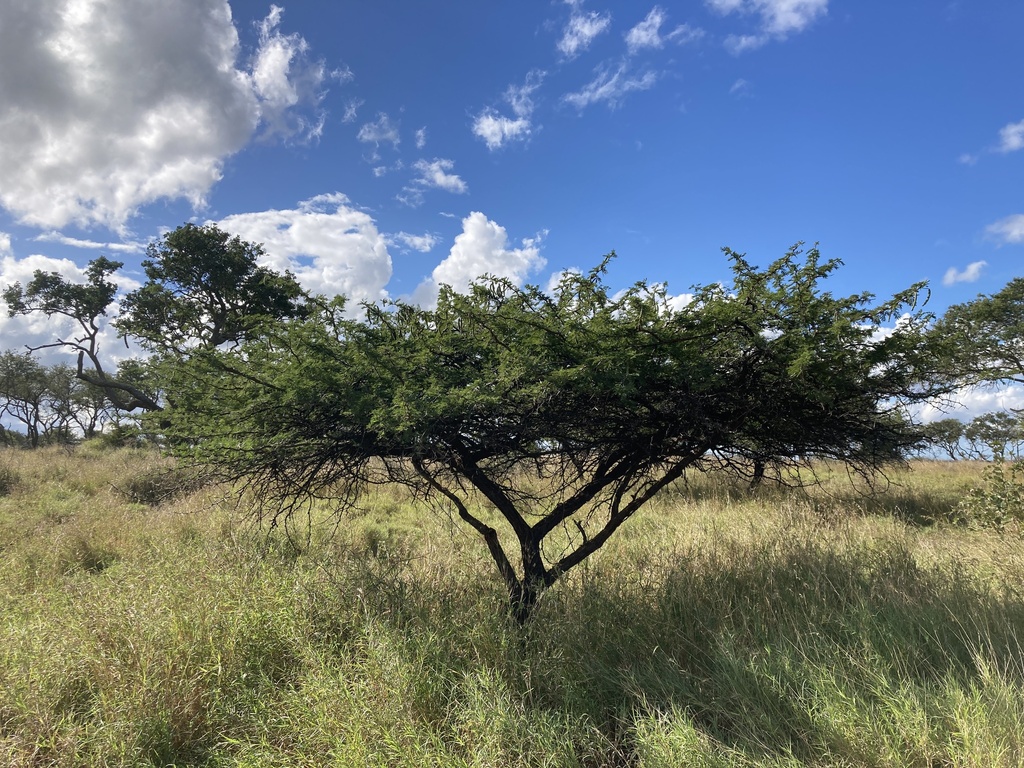
Egyptian acacia
Vachellia nilotica
Vachellia nilotica (commonly known as gum arabic tree, babul, thorn mimosa, Egyptian acacia or thorny acacia) is a tree in the family Fabaceae. It is native to Africa, the Middle East and the Indian subcontinent. It is also currently an invasive species of significant concern in Australia.
From the article Vachellia nilotica on Wikipedia (CC BY-SA), quoted section by section
Description
Acacia nilotica or Vachellia nilotica is a tree 5–20 m (16–66 ft) high with a dense spheric crown, stems and branches usually dark to black coloured, fissured bark, grey-pinkish slash, exuding a reddish low quality gum. The tree has thin, straight, light, grey spines in axillary pairs, usually in 3 to 12 pairs, 5 to 7.5 cm (3 in) long in young trees, mature trees commonly without thorns. The leaves are bipinnate, with 3–6 pairs of pinnulae and 10–30 pairs of leaflets each, tomentose, rachis with a gland at the bottom of the last pair of pinnulae. Flowers in globulous heads 1.2–1.5 cm in diameter of a bright golden-yellow color, set up either axillary or whorly on peduncles 2–3 cm long located at the end of the branches. Pods are strongly constricted, hairy, white-grey, thick and softly tomentose. Its seeds number approximately 8000/kg.
Range & habitat
Acacia nilotica or Vachellia nilotica is native to Egypt, across the Maghreb and Sahel, south to Mozambique and KwaZulu-Natal, South Africa, and east through the Arabian Peninsula to the Indian subcontinent and Burma. It has become widely naturalised outside its native range including Zanzibar and Australia. It is spread by livestock.
Wikipedia: “Distribution”
At the table
In India it is used as an ingredient in various dishes. The Maasai people eat both the inner bark (phloem) and the fruit pulp boiled in water. The East african tribes living on the savanna use this plant medicinally to treat sore throat, cough, chest pains etc. In Northern Nigeria it is called bagaruwa in Hausa. Medicinal uses include soaking the tender bark in water to be taken against dysentery and pile. The fruits are ground together with the seeds and taken with honey as treatment against stomach ulcers.
Wikipedia: “Food and medicine”
In medicine
Two new antiprotozoal diterpenes have been isolated from the root bark of Acacia nilotica.
Wikipedia: “Phytochemistry”
Where it lives
Recorded sightings
—
geo-referenced records in GBIF, from museums, herbaria and field observers.
Drag the globe to turn it. Dots are where records exist, not a range map; darker means more records.
In the stacks
Searching the stacks…
Every page naming Vachellia nilotica in the Biodiversity Heritage Library →
This page is assembled live from iNaturalist, GBIF, Wikipedia, the Source Library and the Internet Archive. It is not yet part of the hand-edited codex. iNaturalist taxon 557826.