- Plants
- ›Vascular Plants
- ›flowering plants
- ›Dicots
- ›myrtles, evening primroses, and allies
- ›bushwillow family
- ›Combretum
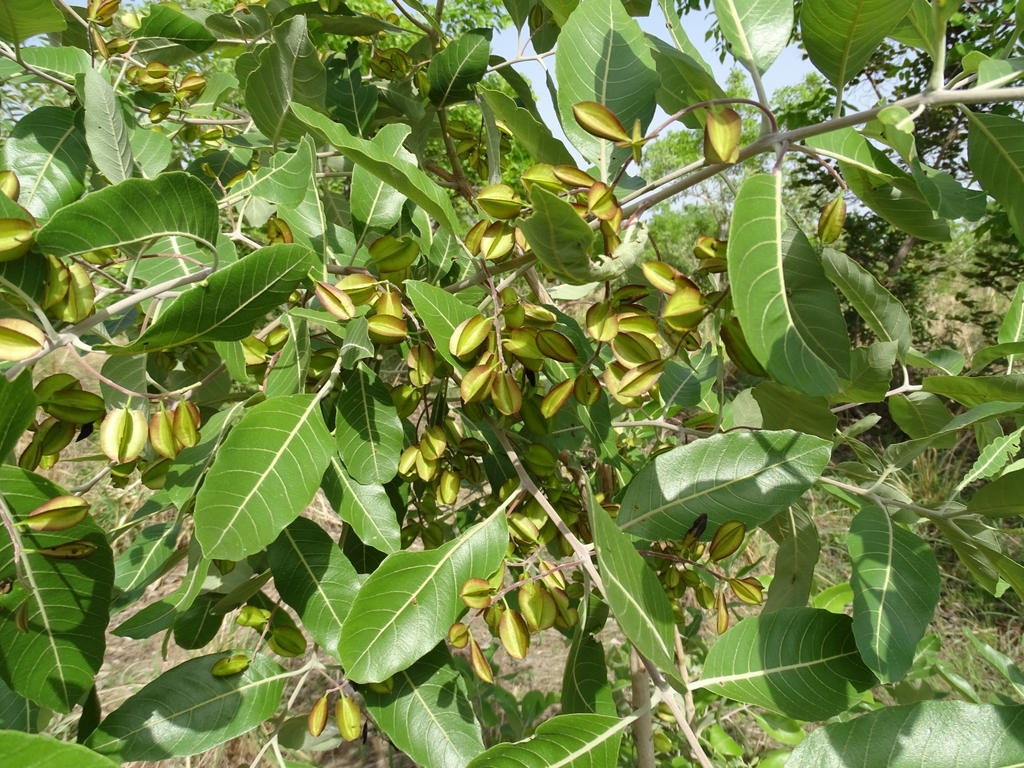
Combretum glutinosum
Combretum glutinosum is a shrub species of the genus Combretum, found in the Sahel belt in parts of Senegal, Burkina Faso, Ghana, Mali, the Gambia, Niger, Nigeria and Cameroon, across to parts of Sudan. It is known as dooki in Pulaar, Kantakara in Hausa, rat (or ratt) in Wolof, jambakatan kè in Mandinka, and yay (or nguuƭ) in Serer. Its synonyms are Combretum cordofanum Engl. & Diels, C. passargei Engl. & Diels, C. leonense Engl. & Diels.
From the article Combretum glutinosum on Wikipedia (CC BY-SA), quoted section by section
Range & habitat
Combretum glutinosum tends to grow in savanna type forests, in several soil types but is best suited to sandy and free draining soils. It is drought resistant and grows in areas of annual rainfall of 200–700 millimetres (7.9–27.6 in). Its growth is fast and profuse.
Wikipedia: “Habitat”
At the table
The bark, leaves and roots are used by the people inhabiting Sahel Africa to produce yellow dye. The yellowish wood is "hard and extremely durable," and is used for building frames and tools, as well as fuel. The brownish or brownish yellow dyes are used in the textile industry and also in leather tanning and to dye mats. The plant is foraged by cattle, giraffes and other animals, and its young leaves are sometimes eaten as a vegetable by humans, sometimes with taro. The plant is in growing demand for the manufacture of bogolan textiles both in the local and international fashion world.
Cultural A special textile known as the "mud cloth", "bògòlanfini" or "bogolan" is manufactured locally. It contains plant tannins mixed with iron salts present in the fermented mud. Bogolan is a specialized art form established by Mande women, in particularly those from Bamanan, Bobo, Dogon, Malinke, Minianka, and Senoufo groups.
Medicinal The plants bark, leaves and roots are extracted for traditional medicinal uses for treating various ailments from influenza, and rheumatism, to sexual issues such as impotence and syphilis. It is commonly brewed as a tea in tropical West Africa to relieve stomach issues, and to treat malaria in a decoction with a number of other leaves obtained in the bush. …
Wikipedia: “Uses”
Where it lives
Recorded sightings
—
geo-referenced records in GBIF, from museums, herbaria and field observers.
Drag the globe to turn it. Dots are where records exist, not a range map; darker means more records.
In the stacks
Searching the stacks…
Every page naming Combretum glutinosum in the Biodiversity Heritage Library →
This page is assembled live from iNaturalist, GBIF, Wikipedia, the Source Library and the Internet Archive. It is not yet part of the hand-edited codex. iNaturalist taxon 505858.