- Plants
- ›Vascular Plants
- ›flowering plants
- ›Dicots
- ›Mints, Plantains, Olives, and Allies
- ›pedalium family
- ›Sesamum
Sesame
Sesamum indicum
Sesame (; Sesamum indicum) is a plant in the genus Sesamum, also called benne. Numerous wild relatives occur in Africa and a smaller number in India. It is widely naturalized in tropical regions around the world and is cultivated for its edible seeds, which grow in pods. World production in 2024 was 6.7 million tonnes (7.4 million short tons), with India, Myanmar, and Sudan as the largest producers.
Sesame seed is one of the oldest oilseed crops known, domesticated well over 3,000 years ago. Sesamum has many other species, most being wild and native to sub-Saharan Africa. S. indicum, the cultivated type, originated in India. It tolerates drought conditions well, growing where other crops fail. Sesame has one of the highest oil contents of any seed. With a rich, nutty flavor, it is a common ingredient in cuisines around the world. Sesame allergies are common relative to other foods.
From the article Sesame on Wikipedia (CC BY-SA), quoted section by section
Description
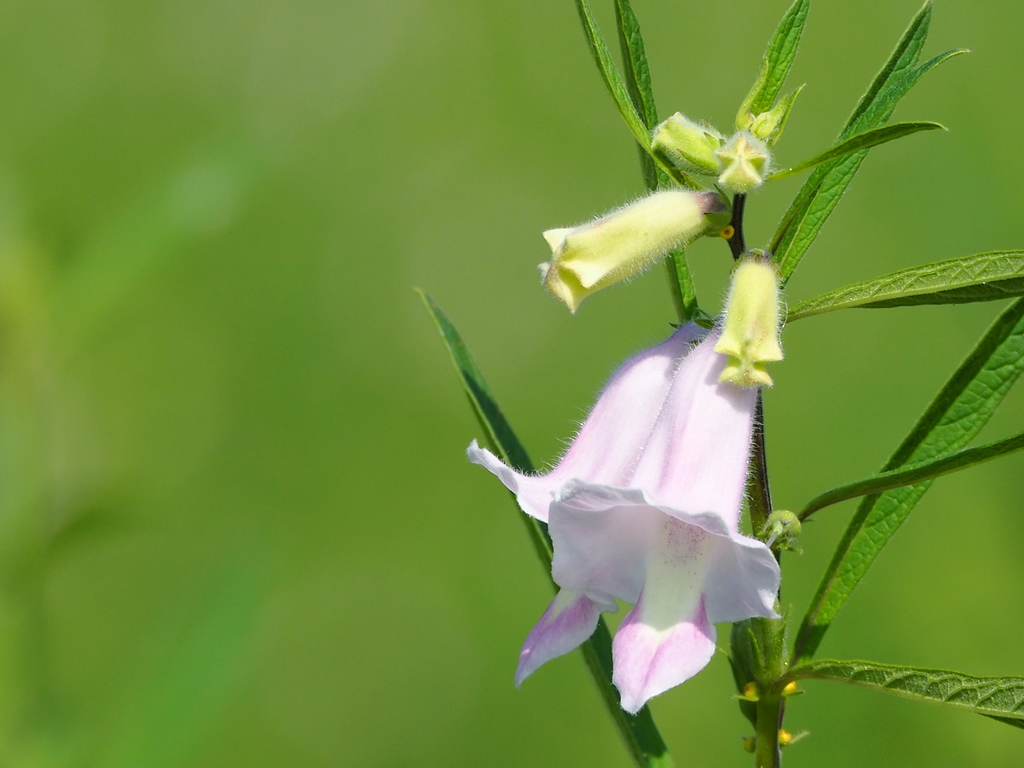
Sesame is a perennial plant growing 50 to 100 cm (1 ft 8 in to 3 ft 3 in) tall, with opposite leaves 4 to 14 cm (2 to 6 in) long with an entire margin; they are broad lanceolate, to 5 cm (2.0 in) broad, at the base of the plant, narrowing to just 1 cm (0.39 in) broad on the flowering stem. The flowers are tubular, 2.5 to 3 cm (0.98 to 1.18 in) long. The flowers vary in colour, from white to pink or purple. The fruit is a capsule, normally pubescent. The length of the fruit capsule varies from 2 to 3 cm (0.79 to 1.18 in), its width varies between 0.6 and 1.2 cm (0.24 and 0.47 in); there are four locules. The seeds are either white or black. Sesame seeds are small. Their sizes vary widely by cultivar. Typically, the seeds are 3 to 4 mm (0.12 to 0.16 in). The seeds are ovate, slightly flattened, and somewhat thinner at the eye of the seed (hilum) than at the opposite end. The mass of 100 seeds sampled from a market in Ibadan, Nigeria is 0.203 grams (0.007 oz).
At the table
Sesame seed is a common ingredient in many cuisines. Sesame seeds were brought into 17th-century colonial America by enslaved West Africans. The whole plant was used in West African cuisine. The seeds thickened soups and puddings, or were roasted and infused to produce a coffee-like drink. Oil from the seeds substituted for butter, and served as a shortening for cakes. The leaves on mature plants, which are rich in mucilage, can be used as a laxative as well as a treatment for dysentery and cholera. After arriving in North America, the plant was grown by slaves as a subsistence staple to supplement their weekly rations. In Caribbean cuisine, sugar and white sesame seeds are combined into a bar resembling peanut brittle and sold in stores and street corners, like Bahamian Benny cakes. In Japan, whole seeds are found in many salads and baked snacks, and tan and black sesame seed varieties are roasted and used to make the flavouring gomashio. Ground black sesame and rice form zhimahu, a Chinese dessert and breakfast dish. The seeds and oil are used extensively in India, where sesame seeds mixed with heated jaggery, sugar, or palm sugar are made into balls and bars similar to peanut brittle or nut clusters and eaten as snacks, such as chikki. Sesame is a common ingredient in Middle Eastern cuisine. The seeds are made into tahini paste and sweet halva. …
Wikipedia: “Culinary use”
How it is grown
Sesame varieties have adapted to many soil types. The high-yielding crops do best on fertile, well-drained, soils with a neutral pH. However, these have a low tolerance for soils with high salt and water-logged conditions. Commercial sesame crops require 90 to 120 frost-free days. Warm conditions above 23 °C (73 °F) favor growth and yields. While sesame crops can grow in poor soils, the best yields come from properly fertilized farms. Flowering depends on photoperiod and cultivar. The photoperiod also affects the seed's oil content: increased photoperiod increases oil content. The oil content of the seed is inversely proportional to its protein content. Sesame is drought-tolerant, in part due to its extensive root system. However, it requires adequate moisture for germination and early growth. While the crop survives drought and the presence of excess water, the yields are significantly lower in either condition. Moisture levels before planting and flowering affect yield the most. Most commercial cultivars of sesame are intolerant of waterlogging. Rainfall late in the season prolongs growth and increases loss to dehiscence, when the seedpod shatters, scattering the seed. Wind can also cause shattering at harvest.
Wikipedia: “Cultivation”
In human culture
The word "sesame" is from Latin sesamum and Greek σήσαμον: sēsamon; which in turn are derived from ancient Semitic languages such as Akkadian šamaššamu. From these roots, words with the generalized meaning "oil, liquid fat" were derived. The specific epithet indicum means of India. The word "benne" was first recorded in English in 1769; it comes from the African American creole Gullah benne, which in turn derives from Malinke bĕne.
Wikipedia: “Etymology”
Where it lives
Recorded sightings
—
geo-referenced records in GBIF, from museums, herbaria and field observers.
Drag the globe to turn it. Dots are where records exist, not a range map; darker means more records.
In the old herbals & bestiaries

Sancai Tuhui (Vol. 105)
王圻, 王思義 · 1609 · p.74

Sancai Tuhui (Vol. 105)
王圻, 王思義 · 1609 · p.90

農業全書 11巻. [2]
Miyazaki Yasusada · 1697 · p.48

Zhiwu Mingshi Tukao (Vol. 1)
吳其濬 · 1848 · p.22

Introductio Generalis in Rem Herbariam
Augustus Quirinus Rivinus · 1690 · p.199

Garden of Health
1507 · p.329

Commentaries on the Six Books of Dioscorides
Pietro Andrea Mattioli · 1560 · p.375

Commentaries on the Six Books of Dioscorides
Pietro Andrea Mattioli · 1560 · p.375

Commentaries on the Six Books of Pedanius Dioscorides on Medical Matter
Pietro Andrea Mattioli · 1565 · p.579

Six Groups of the History of Plants
Rembert Dodoens · 1583 · p.543

Medical and Philosophical Garden
Joachim Camerarius · 1588 · p.388

The Plants of Egypt
Prospero Alpini · 1592 · p.96
In the stacks
Searching the stacks…
Every page naming Sesamum indicum in the Biodiversity Heritage Library →
This page is assembled live from iNaturalist, GBIF, Wikipedia, the Source Library and the Internet Archive. It is not yet part of the hand-edited codex. iNaturalist taxon 285850.