- Plants
- ›Vascular Plants
- ›flowering plants
- ›Dicots
- ›Legumes, Milkworts, and Allies
- ›Legumes
- ›Faboideae
- ›Phaseoleae
- ›Phaseolinae
- ›Vigna
Cowpea
Vigna unguiculata
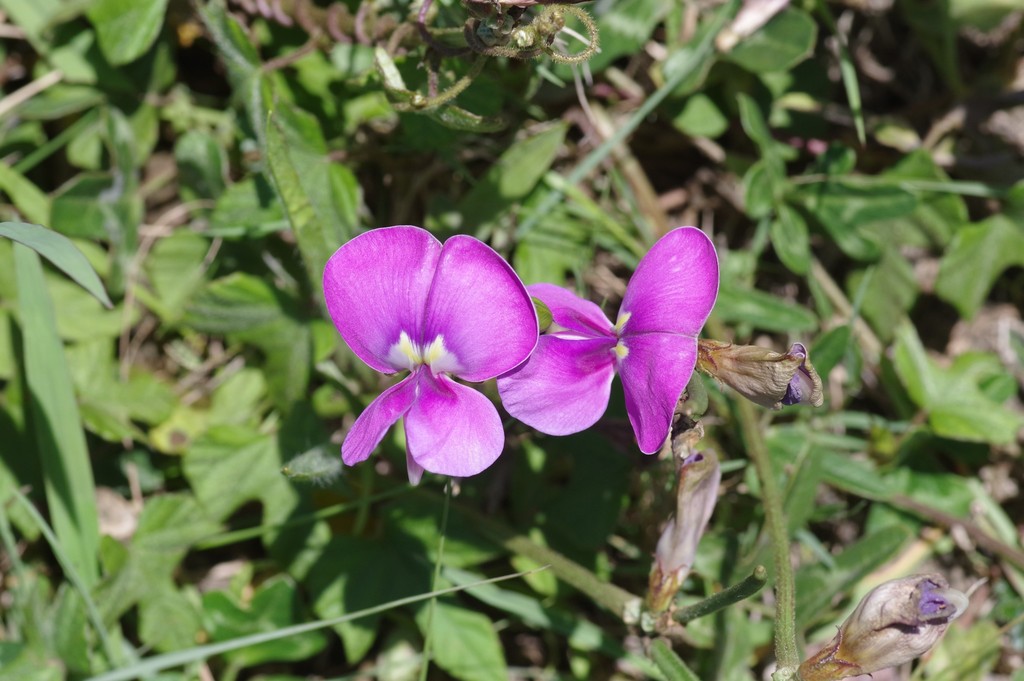
The cowpea (Vigna unguiculata) is an annual herbaceous legume from the genus Vigna. It can be erect, semierect (trailing), or climbing. A high level of morphological diversity is found within the species with large variations in the size, shape, and structure of the plant. Four subspecies are recognised, three of which are cultivated.
Its tolerance for sandy soil and low rainfall have made it an important crop in the semiarid regions across Africa and Asia. It was domesticated in Africa and is one of the oldest crops to be farmed. A second domestication event probably occurred in Asia, before they spread into Europe and the Americas.
From the article Cowpea on Wikipedia (CC BY-SA), quoted section by section
Description
A large morphological diversity is found within the crop, and the growth conditions and grower preferences for each variety vary from region to region. However, as the plant is primarily self-pollinating, its genetic diversity within varieties is relatively low. Cowpeas can either be short and bushy (as short as 20 cm or 8 in) or act like a vine by climbing supports or trailing along the ground (to a height of 2 m or 6 ft 7 in). The taproot can penetrate to a depth of 2.4 m (7 ft 10 in) after eight weeks. The size and shape of the leaves vary greatly, making this an important feature for classifying and distinguishing cowpea varieties. Another distinguishing feature of cowpeas is the long 20–50 cm (8–20 in) peduncles, which hold the flowers and seed pods. One peduncle can support four or more seed pods. Flower colour varies through different shades of purple, pink, yellow, and white and blue. Seeds and seed pods from wild cowpeas are very small, whereas cultivated varieties can have pods between 10 and 110 cm (4 and 43 in) long. A pod can contain six to 13 seeds that are usually kidney-shaped, although the seeds become more spherical the more restricted they are within the pod. Their texture and colour are very diverse. They can have a smooth or rough coat and be speckled, mottled, or blotchy. Colours include white, cream, green, red, brown, and black, or various combinations.
At the table
Cowpea seeds provide a rich source of proteins and food energy, as well as minerals and vitamins. This complements the mainly cereal diet in countries that grow cowpeas as a major food crop. A seed can consist of 25% protein and has very low fat content. Cowpea starch is digested more slowly than the starch from cereals, which is more beneficial to human health. The grain is a rich source of folic acid, an important vitamin that helps prevent neural tube defects in unborn babies. The cowpea has often been referred to as "poor man's meat" due to the high levels of protein found in the seeds and leaves. However, it does contain some antinutritional elements, notable phytic acid and protease inhibitors, which reduce the nutritional value of the crop. Methods such as fermentation, soaking, germination, debranning, and autoclaving are used to combat the antinutritional properties of the cowpea by increasing the bioavailability of nutrients within the crop. Although little research has been conducted on the nutritional value of the leaves and immature pods, what is available suggests that the leaves have a similar nutritional value to black nightshade and sweet potato leaves, while the green pods have less antinutritional factors than the dried seeds.
Wikipedia: “Nutrition”
How it is grown
Cowpeas thrive in poor dry conditions, growing well in soils up to 85% sand. This makes them a particularly important crop in arid, semidesert regions where not many other crops will grow. As well as an important source of food for humans in poor, arid regions, the crop can also be used as feed for livestock. Its nitrogen-fixing ability means that as well as functioning as a sole crop, the cowpea can be effectively intercropped with sorghum, millet, maize, cassava, or cotton.
The optimum temperature for cowpea growth is 30 °C (86 °F), making it only available as a summer crop for most of the world. It grows best in regions with an annual rainfall between 400 and 700 mm (16 and 28 in). The ideal soils are sandy and it has better tolerance for infertile and acid soil than most other crops. Generally, 133,000 seeds are planted per hectare (54,000/acre) for the erect varieties and 60,000 per hectare (24,000/acre) for the climbing and trailing varieties. The seeds can be harvested after about 100 days or the whole plant used as forage after about 120 days. Leaves can be picked from 4 weeks after planting. These characteristics, along with its low fertilisation requirements, make the cowpea an ideal crop for resource-poor farmers living in the Sahel region of West Africa. …
Wikipedia: “Cultivation”
In human culture
Compared to most other important crops, little is known about the domestication, dispersal, and cultivation history of the cowpea. Although there is no archaeological evidence for early cowpea cultivation, the centre of diversity of the cultivated cowpea is West Africa, leading an early consensus that this is the likely centre of origin and place of early domestication. New research using molecular markers has suggested that domestication may have instead occurred in East Africa and currently both theories carry equal weight. Recent archaeobotanical data from East Africa has indicated that cowpea did not spread as a single, uniform crop package. Data from this study showed that its integration came in multiple waves with migrating populations. While the date that cultivation began may be uncertain, it is still considered one of the oldest domesticated crops. Remains of charred cowpeas from rock shelters in Central Ghana have been dated to the 2nd millennium BC. In 2300 BC, the cowpea is believed to have made its way into Southeast Asia, where secondary domestication events may have occurred. From there they traveled north to the Mediterranean, where they were used by the Greeks and Romans. The first written references to the cowpea were in 300 BC and they probably reached Central and North America during the slave trade through the 17th to early 19th centuries.
Wikipedia: “History”
Where it lives
Recorded sightings
—
geo-referenced records in GBIF, from museums, herbaria and field observers.
Drag the globe to turn it. Dots are where records exist, not a range map; darker means more records.
In the old herbals & bestiaries


In the stacks
Searching the stacks…
Every page naming Vigna unguiculata in the Biodiversity Heritage Library →
This page is assembled live from iNaturalist, GBIF, Wikipedia, the Source Library and the Internet Archive. It is not yet part of the hand-edited codex. iNaturalist taxon 122898.