- Plants
- ›Vascular Plants
- ›flowering plants
- ›monocots
- ›grasses, sedges, cattails, and allies
- ›grasses
- ›rices, veldtgrasses, and allies
- ›rices and allies
- ›Oryzinae
- ›Oryza
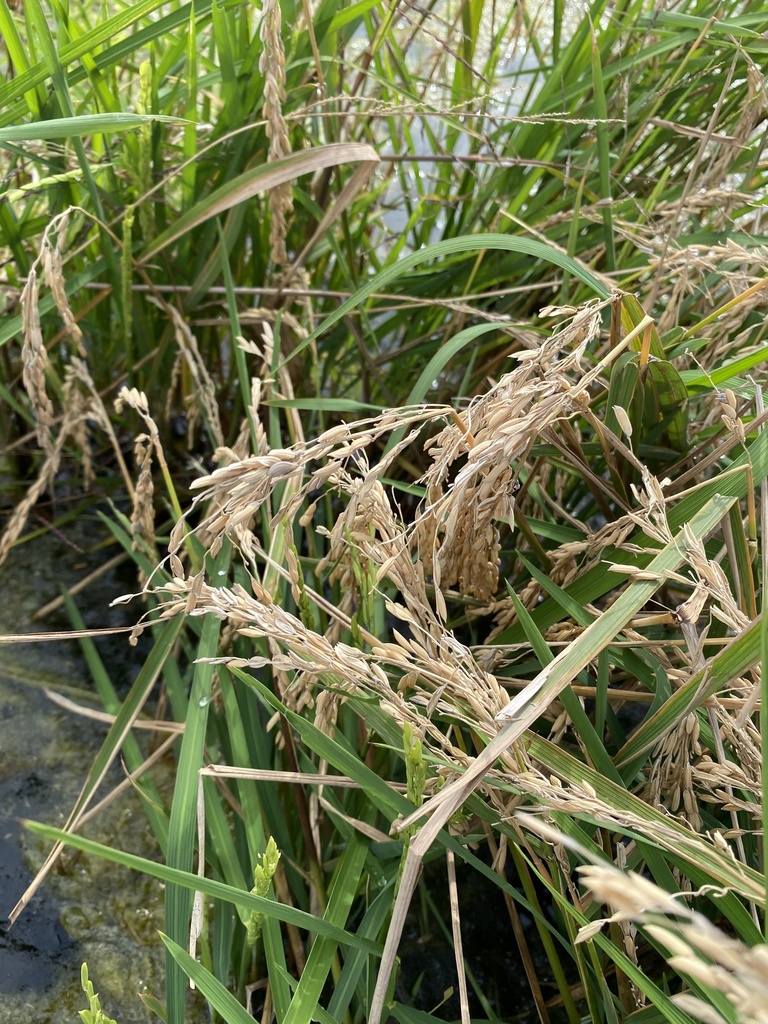
African rice
Oryza glaberrima
Oryza glaberrima, commonly known as African rice, is one of the two domesticated rice species.
The species was first domesticated and grown in West Africa around 3,000 years ago. In agriculture, it makes up an estimated 20% of rice grown commercially in West Africa, having largely been replaced by higher-yielding O. sativa (Asian rice). The number of O. glaberrima varieties grown is declining. Crossbreeding African and Asian rice is difficult, but there exist some crosses.
From the article Oryza glaberrima on Wikipedia (CC BY-SA), quoted section by section
Description
African rice is a tall rice plant, usually under 120 centimetres (47 in) but up to 5 metres (16 feet) for floating varieties, which may also branch and root from higher stem nodes. Generally, African rice has small, pear-shaped grain, reddish bran and green to black hulls, straight, simply-branched panicles, and short, rounded ligules. There are, however, exceptions, and it can be hard to distinguish from Asian rice. For complete certainty, a genetic test can be used. The grains are brittle.
Range & habitat
Native range is: Benin, Burkina, Cameroon, Chad, Gambia, Guinea, Guinea-Bissau, Ivory Coast, Mali, Niger, Nigeria, Senegal, Togo; subsequently introduced into: China, Hainan, Indian Subcontinent/West Himalaya.
Wikipedia: “Distribution”
At the table
Multiple varieties of African rice are often grown so that the harvest is staggered. In this way, the harvest can be eaten fresh. Freshly harvested rice is moist, and can be puffed in fire, and eaten. Fried rice has a brownish color when fried; this is because of the husk which is green in color and turns brown when heated. African rice can be prepared in much the same way as Asian rice, but has a distinct nutty flavor, for which it is favored in West Africa. African rice grains are often reddish in colour; some varieties are strongly aromatic, other, like Carolina Gold, are not at all aromatic. African rice is also used in local traditional medicine.
Wikipedia: “Uses”
How it is grown
In agriculture, O. glaberrima makes up an estimated 20% of rice grown commercially in West Africa, having largely been replaced by the other domesticated species, higher-yielding O. sativa (Asian rice). The number of O. glaberrima varieties grown is declining. African rice is comparatively hardy, pest-resistant, low-labour, and suited to a larger variety of African conditions. Overall, O. glaberrima is considered a much more desirable and healthier choice in places like Nigeria by West African farmers, where it is used to make Ofada rice because of its high nutrition content, despite being less popular than O. sativa cultivars (as of 2019).
History. It is highly likely that humans have independently domesticated two different rice species. African rice is very genetically similar to wild African rice (O. barthii), as Asian rice (O. sativa) is to wild Asian rice (O. rufipogon), and these two divisions have wide genetic differences between them. O. barthii still grows wild in Africa, in a wide variety of open habitats. The Sahara was formerly wetter, with massive paleolakes in what is now the Western Sahara. As the climate dried, the wild rice retreated and probably became increasingly domesticated as it relied on humans for irrigation. …
Wikipedia: “Cultivation”
In human culture
It is also grown for cultural reasons; for instance, it is sacred to followers of Awasena (a traditional African religion) among the Jola people, and is a heritage variety in the U.S.
Wikipedia: “In culture”
Where it lives
Recorded sightings
—
geo-referenced records in GBIF, from museums, herbaria and field observers.
Drag the globe to turn it. Dots are where records exist, not a range map; darker means more records.
In the stacks
Searching the stacks…
Every page naming Oryza glaberrima in the Biodiversity Heritage Library →
This page is assembled live from iNaturalist, GBIF, Wikipedia, the Source Library and the Internet Archive. It is not yet part of the hand-edited codex. iNaturalist taxon 507020.