On eBird ↗
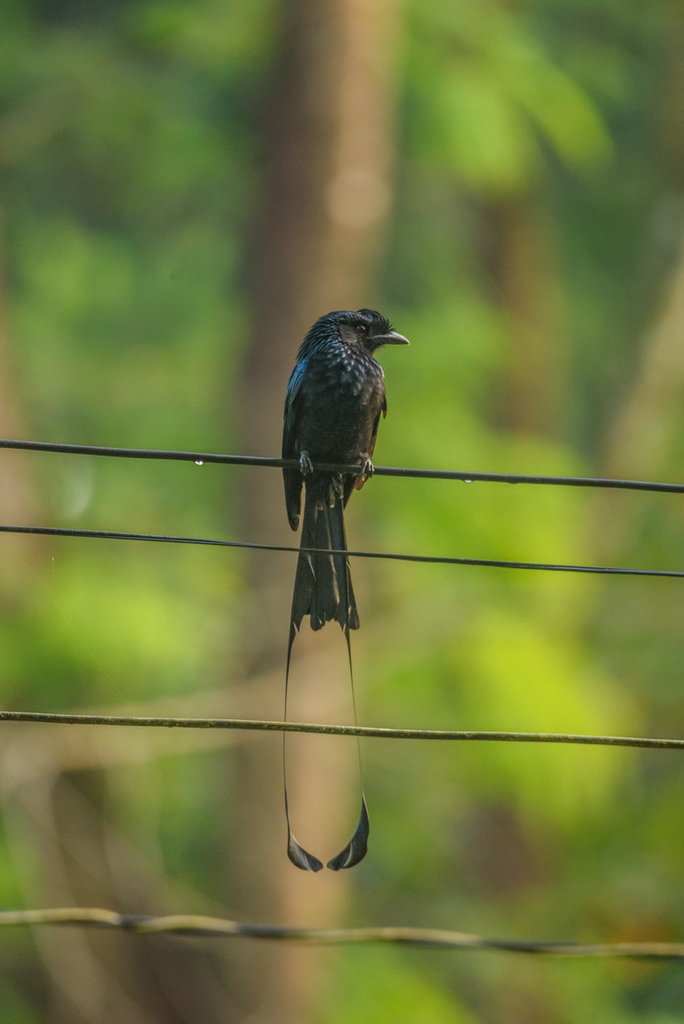
Greater Racket-tailed Drongo
Live sightings near you, the range map, bar charts of when it is seen, and Macaulay Library photos and recordings.
Greater Racket-tailed Drongo
Dicrurus paradiseus
The greater racket-tailed drongo (Dicrurus paradiseus) is a medium-sized Asian bird which is distinctive in having elongated outer tail feathers with webbing restricted to the tips. They are placed along with other drongos in the family Dicruridae. They are conspicuous in the forest habitats often perching in the open and by attracting attention with a wide range of loud calls that include perfect imitations of many other birds. One hypothesis suggested is that these vocal imitations may help in the formation of mixed-species foraging flocks, a feature seen in forest bird communities where many insect feeders forage together. These drongos will sometimes steal insect prey caught or disturbed by other foragers in the flock and another idea is that vocal mimicry helps them in diverting the attention of smaller birds to aid their piracy. They are diurnal but are active well before dawn and late at dusk. Owing to their widespread distribution and distinctive regional variation, they have become iconic examples of speciation by isolation and genetic drift.
From the article Greater racket-tailed drongo on Wikipedia (CC BY-SA), quoted section by section
Description
In most of its range in Asia, this is the largest of the drongo species and is readily identifiable by the distinctive tail rackets and the crest of curled feathers that begin in front of the face above the beak and along the crown to varying extents according to the subspecies. The tail with twirled rackets is distinctive and in flight it can appear as if two large bees were chasing a black bird. In the eastern Himalayas the species can be confused with the lesser racket-tailed drongo, however the latter has flat rackets with the crest nearly absent.
This widespread species includes populations that have distinct variations and several subspecies have been named. The nominate form is found in southern India, mainly in forested areas of the Western Ghats and the adjoining hill forests of peninsular India. The subspecies in Sri Lanka is ceylonicus and is similar to the nominate form but slightly smaller. The subspecies found along the Himalayas is grandis and is the largest and has long glossy neck hackles. The Andaman Islands form otiosus has shorter neck hackles and the crest is highly reduced while the Nicobars Island form nicobariensis has a longer frontal crest and with smaller neck hackles than otiosus. The Sri Lanka drongo (D. …
Range & habitat
The distribution range of this species extends from the western Himalayas to the eastern Himalayas and Mishmi Hills in the foothills below 1,200 m (3,900 ft). They are found in the hills of peninsular India and the Western Ghats. Continuing into the west to the islands of Borneo and Java in the east through the mainland and islands.
Wikipedia: “Distribution and habitat”
What it does
Like other drongos, these feed mainly on insects but also eat fruit and visit flowering trees for nectar. Having short legs, they sit upright and are often perched on high and exposed branches. They are aggressive and will sometimes mob larger birds especially when nesting. They are often active at dusk.
Their calls are extremely varied and include monotonously repeated whistles, metallic and nasal sounds as well as more complex notes and imitations of other birds. They begin calling from as early as 4 am in moonlight often with a metallic tunk-tunk-tunk series. They have an ability to accurately mimic alarm calls of other birds that are learnt through interactions in mixed-species flocks. This is quite unusual, as avian vocal mimicry has hitherto been believed to be ignorant of the original context of the imitated vocalization. Grey parrots are known to use imitated human speech in correct context, but do not show this behavior in nature. This drongo's context-sensitive use of other species' alarm calls is thus analogous to a human learning useful short phrases and exclamations in a number of foreign languages. A special alarm note is raised in the presence of shikras that has been transcribed as a loud kwei-kwei-kwei...shee-cuckoo-sheecuckoo-sheecuckoo-why!. They have been said to imitate raptor calls so as to alarm other birds and steal prey from them in the ensuing panic. …
Wikipedia: “Behaviour and ecology”
In human culture
The common whistle note that is made leads to its local name in many parts of India of kothwal (which means a "policeman" or "guard", who used a whistle that produced a similar note), a name also applied to the black drongo and in other places as the Bhimraj or Bhringaraj. In Mizo language of northeast India, it is called Vakul and the Mizo people use the tail feathers in ceremonies. Prior to the 1950s it was often kept in captivity by people in parts of India. It was said to be very hardy and like a crow, accommodating a varied diet. Edward H. Schafer considered the greater racket-tailed drongo as the basis for the divine kalaviṅka birds mentioned in Chinese and Japanese Buddhist texts.
Wikipedia: “In culture”
Listen
Looking for field recordings…
Where it lives
Recorded sightings
—
geo-referenced records in GBIF, from museums, herbaria and field observers.
Drag the globe to turn it. Dots are where records exist, not a range map; darker means more records.
In the stacks
Searching the stacks…
Every page naming Dicrurus paradiseus in the Biodiversity Heritage Library →
This page is assembled live from iNaturalist, GBIF, Wikipedia, the Source Library and the Internet Archive. It is not yet part of the hand-edited codex. iNaturalist taxon 204502.