On eBird ↗
Green Hylia
Live sightings near you, the range map, bar charts of when it is seen, and Macaulay Library photos and recordings.
Green Hylia
Hylia prasina
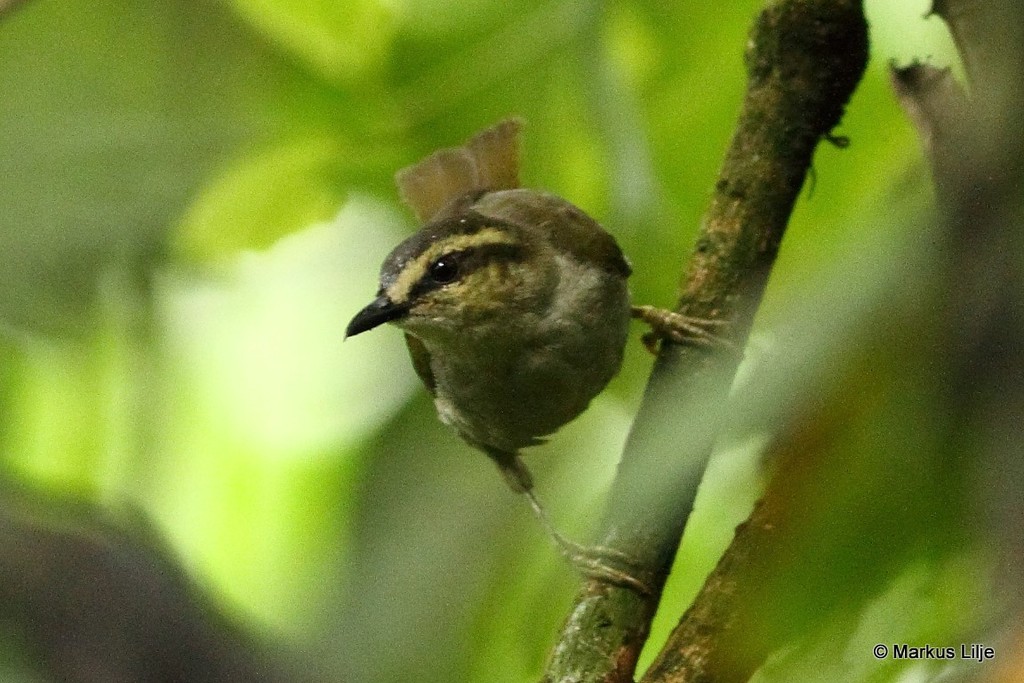
The green hylia (Hylia prasina) is a monotypic genus widespread in tropical Africa, where it mostly inhabits the understory and mid-stratum of moist forest. It is a canopy insectivore which had been tentatively placed within the family of Cettiidae warblers, but in 2019 its assignment to a new family, the Hyliidae, was strongly supported.
From the article Green hylia on Wikipedia (CC BY-SA), quoted section by section
Description
The green hylia has dark brown irises, a black bill and olive green feet. This species is small, weighing approximately 14 g. There is no noticeable difference in colour between the sexes, however males are generally larger. There are two subspecies, H. p. prasina and H. p. poensis, which differ in the colouring under the throat. H. p. prasina has an olive green chin and throat and olive-grey underbelly while H. p. poensis has a white-grey throat and underbelly.
Vocalisation. The green hylia uses several different calls, the most common being clear whistles (kee kee) or dry scolding rattles (trrit trrrit). It is known for its recognisable, pure, two-note song. Alarm calls used to warn of nearby predators are short as this makes it difficult for predators to locate exactly where the call is coming from. When played imitation recordings, males reacted more strongly to longer notes. Analyses of green hylia songs indicated that a build-up of reverberations at the same frequency will lead to longer and louder note tails. This means that dense vegetation can alter birdsong transmissions to allow for a longer and louder signal, using the same amount of energy for vocalisation. The strengthening of the green hylia's song could be beneficial to the species for defending territory or attracting mates. …
Range & habitat
The green hylia occurs in a wide range throughout most of tropical Africa. The subspecies H. p. poensis can only be found on islands in the Gulf of Guinea. H. p. prasina is much more widely distributed throughout the Guineo-Congolian forest and is found from western Gambia to western Kenya. The green hylia is a common forest generalist, occurring at forest edges and gaps between vegetation as well as forest interiors. Its preferred habitat is mostly intact, semideciduous moist forest. Green hylia habitat includes plant species such as Elaeis guinensis, Celtis zenkeri, Cola gigantea, Acalypha ornata, Markhamia platycalyx, Coffea canephora, Albizia sp., Fagara macrophylla, Funtumia elastica, Pycnanthes angolensis, Musanga cecropioides and Xylopia aethiopica. Liana and Scleria species provide suitable habitat as they tangle amongst other vegetation, providing nesting materials and a supply of food. Analysis of carbon sources in green hylia food, indicating the origin of the consumed insects, showed that carbon present derived exclusively from C3 plants, which are mostly forest plants, and not C4 plants as might be found in farmland crops, even when these areas border forest habitats.
Wikipedia: “Habitat and distribution”
What it does
The green hylia is a foliage-gleaning insectivore of the canopy and forest understory, usually foraging at a height of about 10 metres. Its diet includes insects, ants or butterflies which are accessible in its feeding area, on the underside of leaves or amongst forest litter. The species is considered a forest generalist as it is capable of surviving in a wide range of environmental conditions. The green hylia is usually observed alone or in a mating pair. Mating pairs roost together in their nest. The eggs are white and otherwise not very distinctive. The nest is built a few feet from the ground in a suitable location, such as the vertical forks of young palm trees. The nest is oval and domed in shape with a 20 mm circular opening at the side of the top. Nests are crumbly and friable, the bulk being made up of loose tufts of plant matter which are not fragmented, interwoven or compacted. The outside is covered by a fine layer of fibrous strips topped with the occasional leaf skeleton. The nest measures 150 mm from top to bottom and 90 mm side to side and front to back. It differs from that of other sunbirds in that it is positioned in forks of vegetation and not suspended in the air.
Wikipedia: “Ecology”
Listen
Looking for field recordings…
Where it lives
Recorded sightings
—
geo-referenced records in GBIF, from museums, herbaria and field observers.
Drag the globe to turn it. Dots are where records exist, not a range map; darker means more records.
In the stacks
Searching the stacks…
Every page naming Hylia prasina in the Biodiversity Heritage Library →
This page is assembled live from iNaturalist, GBIF, Wikipedia, the Source Library and the Internet Archive. It is not yet part of the hand-edited codex. iNaturalist taxon 15545.