On eBird ↗
Western House-Martin
Live sightings near you, the range map, bar charts of when it is seen, and Macaulay Library photos and recordings.
Western House Martin
Delichon urbicum
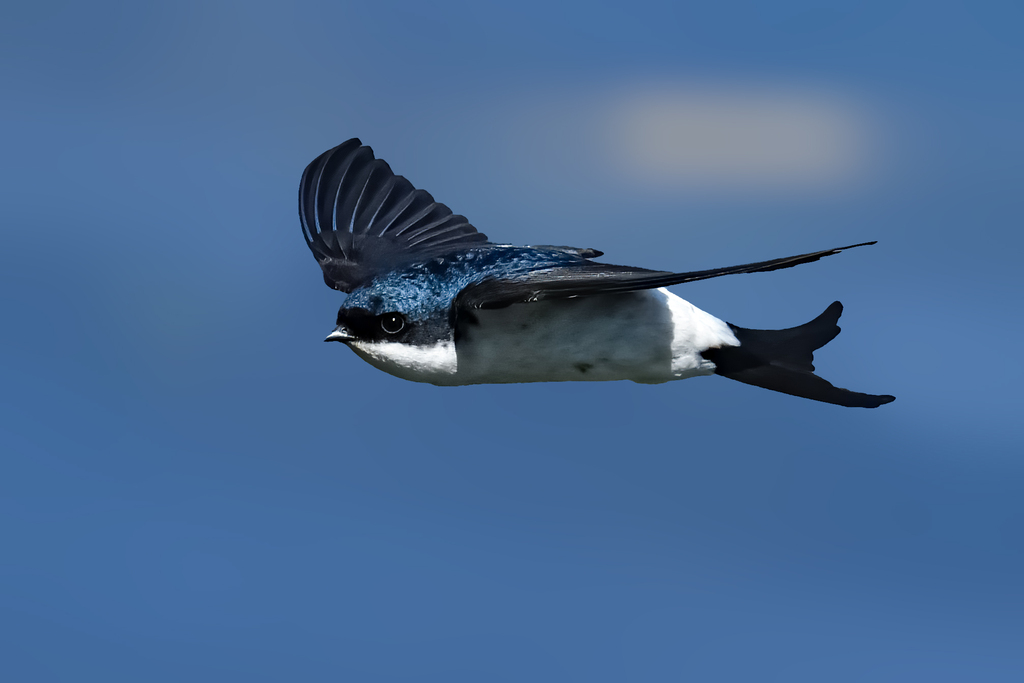
The western house martin (Delichon urbicum), sometimes called the common house martin, northern house martin or, particularly in Europe, just house martin, is a migratory passerine bird of the swallow family which breeds in Europe, north Africa and west-central Asia; and winters in sub-Saharan Africa and southwestern Asia. It feeds on insects which are caught in flight, and it migrates to climates where flying insects are plentiful. It has a blue head and upperparts, white rump and pure white underparts, and is found in both open country and near human habitation. It is similar in appearance to the two other martin species of the genus Delichon, which are both endemic to eastern and southern Asia. It has two accepted subspecies.
Both the scientific and colloquial name of the bird are related to its use of human-made structures. It builds a closed cup nest from mud pellets under eaves or similar locations on buildings usually in colonies.
From the article Western house martin on Wikipedia (CC BY-SA), quoted section by section
Description
The adult western house martin is 13 cm (5 in) long, with a wingspan of 26–29 cm (10–11+1⁄2 in) and a weight averaging 18.3 g (21⁄32 oz). It is steel-blue above with a white rump, and white underparts, including the underwings; even its short legs have white downy feathering. It has brown eyes and a small black bill, and its toes and exposed parts of the legs are pink. The sexes are similar, but the juvenile bird is sooty black, and some of its wing coverts and quills have white tips and edgings. D. u. lagopodum differs from the nominate race in that its white rump extends much further onto the tail, and the fork of its tail is intermediate in depth between that of D. u. urbicum and that of the Asian house martin. The white rump and underparts of the western house martin, very noticeable in flight, prevent confusion with other widespread Palaeoarctic swallows such as the barn swallow (Hirundo rustica), sand martin (Riparia riparia) or red-rumped swallow (Cecropis daurica). In Africa, confusion with grey-rumped swallow (Pseudhirundo griseopyga) is possible, but that species has a grey rump, off-white underparts and long, deeply forked tail. …
Range & habitat
The western house martin breeds across temperate Eurosiberia east to central Mongolia and the Yenisei River, and in Morocco, Tunisia and northern Algeria, and migrates on a broad front to winter in sub-Saharan Africa. The preferred habitat of the western house martin is open country with low vegetation, such as pasture, meadows and farmland, and preferably near water, although it is also found in mountains up to at least 2,200 m (7,200 ft) elevation. It is much more urban than the barn swallow, and will nest even in city centres if the air is clean enough. It is more likely to be found near trees than other Eurasian swallows, since they provide insect food and also roosting sites. This species does not normally use the reed-bed roosts favoured by migrating barn swallows. It uses similar open habitats on the wintering grounds, but the western house martin is less conspicuous than wintering barn swallows, tending to fly higher and be more nomadic. In the tropical parts of its wintering range, like East Africa, it appears to be mainly found in the higher areas. The western house martin is a migrant which moves on a broad front (i.e., European birds are not funnelled through the short sea crossings used by large soaring birds, but cross the Mediterranean and Sahara). While migrating they feed in the air on insects, and they usually travel in daylight. …
Wikipedia: “Distribution and habitat”
What it does
The western house martin is similar in habits to other aerial insectivores, including other swallows and martins and the unrelated swifts, and catches insects in flight. In the breeding areas, flies and aphids make up much of the diet, and in Europe, the house martin takes a larger proportion of aphids and small flies than the barn swallow. As with that species, hymenopterans, especially flying ants, are important food items in the wintering area. This species hunts at an average height of 21 m (69 ft) during the breeding season, but lower in wet conditions. The hunting grounds are typically within 450 m (1,480 ft) of the nest, with a preference for open ground or water, the latter especially in poor weather, but the martins will also follow the plough or large animals to catch disturbed insects. On the wintering grounds, hunting takes place at a greater height of over 50 m (160 ft).
Wikipedia: “Diet”
In human culture
This species lacks the wealth of literary references associated with its relative, the barn swallow, although it is possible that some of the older mentions for that bird might equally well refer to the house martin. William Shakespeare was clearly describing the house martin when Banquo brings the nests and birds to the attention of Duncan at Macbeth's castle, Inverness: "This guest of summer, The temple-haunting martlet, does approve By his loved mansionry that the heaven's breath Smells wooingly here. No jutty, frieze, Buttress, nor coign of vantage, but this bird Hath made his pendant bed and procreant cradle; Where they most breed and haunt, I have observed
The air is delicate." (Macbeth, Act I, scene VI). There are old legends, with no basis in fact, that house martins would wall-up house sparrows by closing the entrance of the mud nest with the intruder inside, or that they would gather en masse to kill a sparrow. The martlet, often believed to refer to the house martin, or possibly a swallow, was a heraldic bird with short tufts of feathers in the place of legs. It was the cadency mark of the fourth son of a noble family, and features in many coats of arms, including the Plantagenets. The lack of feet signified its inability to land, which explained its link to a younger son, also landless. It also represented swiftness.
Wikipedia: “In literature and culture”
Listen
Looking for field recordings…
Where it lives
Recorded sightings
—
geo-referenced records in GBIF, from museums, herbaria and field observers.
Drag the globe to turn it. Dots are where records exist, not a range map; darker means more records.
In the stacks
Searching the stacks…
Every page naming Delichon urbicum in the Biodiversity Heritage Library →
This page is assembled live from iNaturalist, GBIF, Wikipedia, the Source Library and the Internet Archive. It is not yet part of the hand-edited codex. iNaturalist taxon 64705.