On eBird ↗
Violaceous Euphonia
Live sightings near you, the range map, bar charts of when it is seen, and Macaulay Library photos and recordings.
Violaceous Euphonia
Euphonia violacea
The violaceous euphonia (Euphonia violacea) is a small passerine bird in the true finch family. It is a resident breeder from Trinidad, Tobago and eastern Venezuela south to Paraguay and northeastern Argentina. The bird's range in northern Brazil is the lower portion of the Amazon Basin and the adjacent Tocantins River drainage, with its northwestern limits from Brazil and the Guyanas, the eastern banks of the Orinoco River drainage in central Venezuela.
From the article Violaceous euphonia on Wikipedia (CC BY-SA), quoted section by section
Description
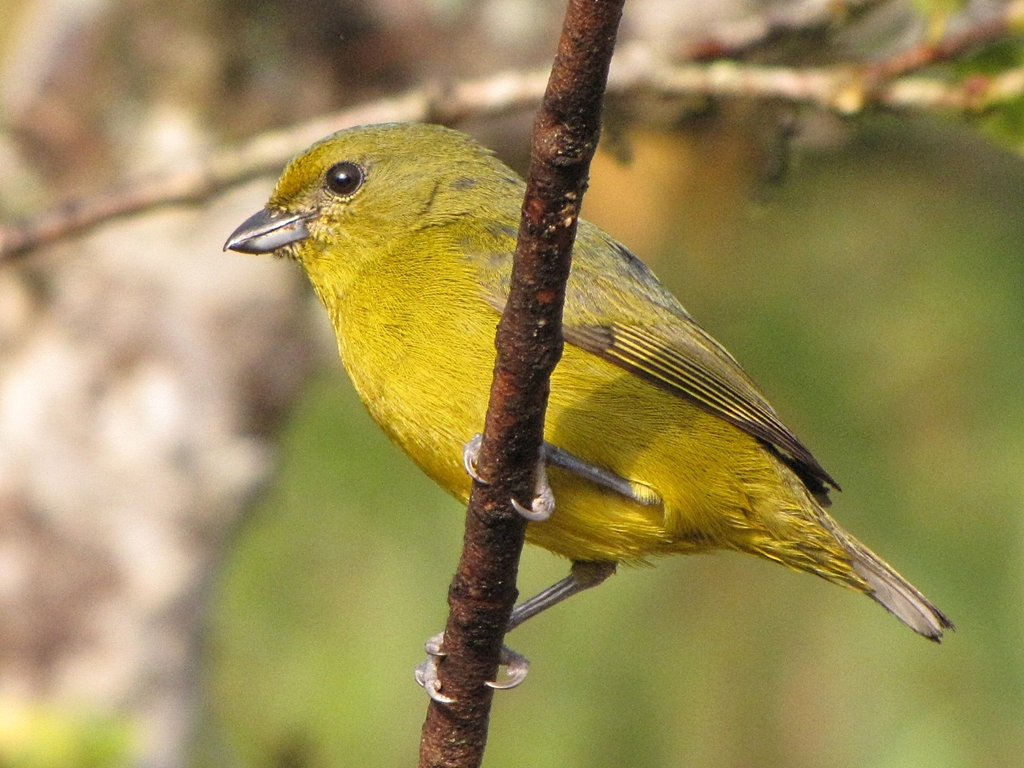
Adult violaceous euphonias are 11.4 cm long and weigh 14 g. The male has glossy blue-black upperparts and a deep golden yellow forehead and underparts. The female and immature are olive green above and greenish yellow below.
Range & habitat
It is a resident breeder from Trinidad, Tobago and eastern Venezuela south to Paraguay and northeastern Argentina. The bird's range in northern Brazil is the lower portion of the Amazon Basin and the adjacent Tocantins River drainage, with its northwestern limits from Brazil and the Guyanas, the eastern banks of the Orinoco River drainage in central Venezuela. It occurs in forests, second growth and plantations of cocoa and citrus fruit. The ball nest is built on a bank, tree stump or cavity and the normal clutch is four, sometimes three, red-blotched white eggs, which are incubated by the female.
Wikipedia: “Distribution and habitat”
What it does
These are social birds which eat mainly small fruit and only rarely take insects. The fruits are mostly mistletoes, epiphytic cacti and Cecropia fruit which are suited for them because of their simple digestive tract. Along with insects, it has been seen to consume terrestrial snails in Brazil. The violaceous euphonia's song is a varied mix of musical notes, squeaks, chattering and imitation. Members of the genus Euphonia are prized as cage birds and several are threatened by trapping, but this species benefits from its relatively inaccessible habitat.
Wikipedia: “Behaviour”
Listen
Looking for field recordings…
Where it lives
Recorded sightings
—
geo-referenced records in GBIF, from museums, herbaria and field observers.
Drag the globe to turn it. Dots are where records exist, not a range map; darker means more records.
In the stacks
Searching the stacks…
Every page naming Euphonia violacea in the Biodiversity Heritage Library →
This page is assembled live from iNaturalist, GBIF, Wikipedia, the Source Library and the Internet Archive. It is not yet part of the hand-edited codex. iNaturalist taxon 9290.