- Animals
- ›Chordates
- ›Vertebrates
- ›Mammals
- ›Therians
- ›Marsupials
- ›Kangaroos, Possums, Wombats, and Allies
- ›Macropods
- ›Kangaroos, Wallabies and Allies
- ›Kangaroos, Wallabies, Pademelons, and Dorcopsises
- ›Kangaroos and Wallabies
- ›Lagorchestes
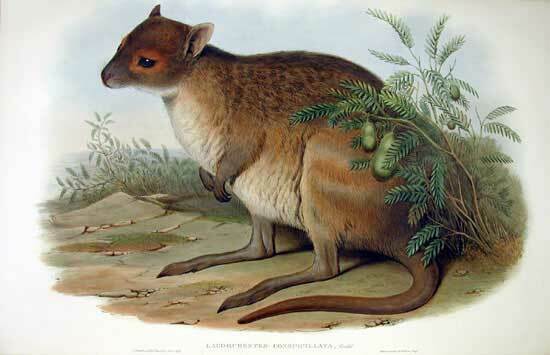
Central Hare Wallaby
Lagorchestes asomatus
The Lake Mackay hare-wallaby (Lagorchestes asomatus), also known as the central hare-wallaby or kuluwarri, is an extinct species of macropod formerly found in central Australia. Very little is known about it.
From the article Lake Mackay hare-wallaby on Wikipedia (CC BY-SA), quoted section by section
What it does
The Lake Mackay hare-wallaby created shelter using Triodia, known commonly as spinifex. They allegedly sheltered in shallow depressions below clumps of spinifex, created grass-lined nests, and sometimes dug short burrows similar to those of the Rufous hare-wallaby. They were referred to as "stupid" and "deaf" by the Aborigines, because when hunted they would not leave their shelter, therefore making them easy prey.
Wikipedia: “Behavior”
In human culture
The Lake Mackay hare-wallaby is known only from a single animal collected by explorer/geologist Michael Terry in 1932 between Mount Farewell and the northern end of Lake Mackay in the Northern Territory. Only the skull was kept, and this is the only physical evidence scientists have today for the Lake Mackay hare-wallaby's existence; however, there are records of anecdotal evidence given by Aboriginal Australians.
Wikipedia: “History”
Listen
Looking for field recordings…
Where it lives
Recorded sightings
—
geo-referenced records in GBIF, from museums, herbaria and field observers.
Drag the globe to turn it. Dots are where records exist, not a range map; darker means more records.
In the stacks
Searching the stacks…
Every page naming Lagorchestes asomatus in the Biodiversity Heritage Library →
This page is assembled live from iNaturalist, GBIF, Wikipedia, the Source Library and the Internet Archive. It is not yet part of the hand-edited codex. iNaturalist taxon 42953.