- Animals
- ›Chordates
- ›Vertebrates
- ›Mammals
- ›Therians
- ›Marsupials
- ›Kangaroos, Possums, Wombats, and Allies
- ›Macropods
- ›Kangaroos, Wallabies and Allies
- ›Kangaroos, Wallabies, Pademelons, and Dorcopsises
- ›Kangaroos and Wallabies
- ›Lagorchestes
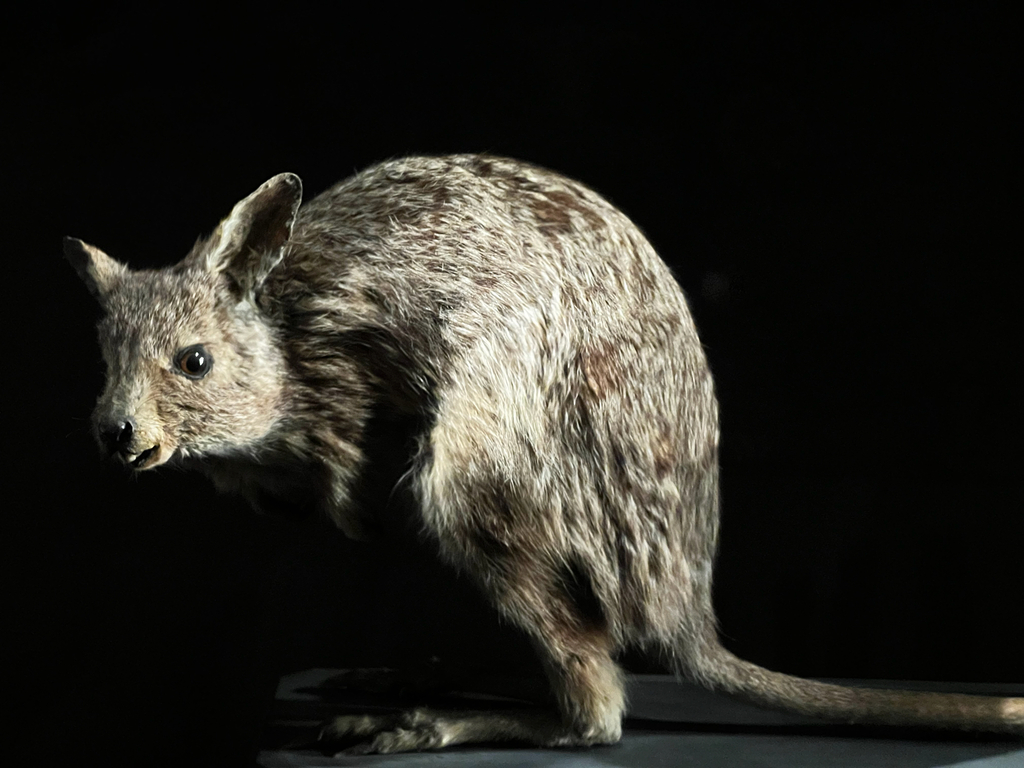
Eastern Hare Wallaby
Lagorchestes leporides
The eastern hare-wallaby (Lagorchestes leporides), once also known as the common hare wallaby, is an extinct species of wallaby that was native to southeastern Australia. It was first described by John Gould in 1841.
From the article Eastern hare-wallaby on Wikipedia (CC BY-SA), quoted section by section
Description
The eastern hare-wallaby was a small macropod, slightly larger and more slender than its surviving relative the rufous hare-wallaby. It had a body length of about 50 centimeters and a 33 centimeter long tail. Its fur colour varied from black through brown to yellow with a greyish-white belly.
What it does
Very little is known about this wallaby. It was a strictly nocturnal animal which led a solitary lifestyle. During the day it sat still in a well-formed 'seat', usually in the shelter of a saltbush or a tussock. If approached too closely, it would bound off at great speed. One wallaby was chased by dogs for 500 metres and suddenly doubled back and came back within 6 metres of John Gould and leapt over his head; it could jump 1.8 metres high.
Wikipedia: “Ecology and behaviour”
Listen
Looking for field recordings…
Where it lives
Recorded sightings
—
geo-referenced records in GBIF, from museums, herbaria and field observers.
Drag the globe to turn it. Dots are where records exist, not a range map; darker means more records.
In the stacks
Searching the stacks…
Every page naming Lagorchestes leporides in the Biodiversity Heritage Library →
This page is assembled live from iNaturalist, GBIF, Wikipedia, the Source Library and the Internet Archive. It is not yet part of the hand-edited codex. iNaturalist taxon 42952.