- Animals
- ›Chordates
- ›Vertebrates
- ›Mammals
- ›Therians
- ›Marsupials
- ›Kangaroos, Possums, Wombats, and Allies
- ›Macropods
- ›Kangaroos, Wallabies and Allies
- ›Kangaroos, Wallabies, Pademelons, and Dorcopsises
- ›Kangaroos and Wallabies
- ›Lagorchestes
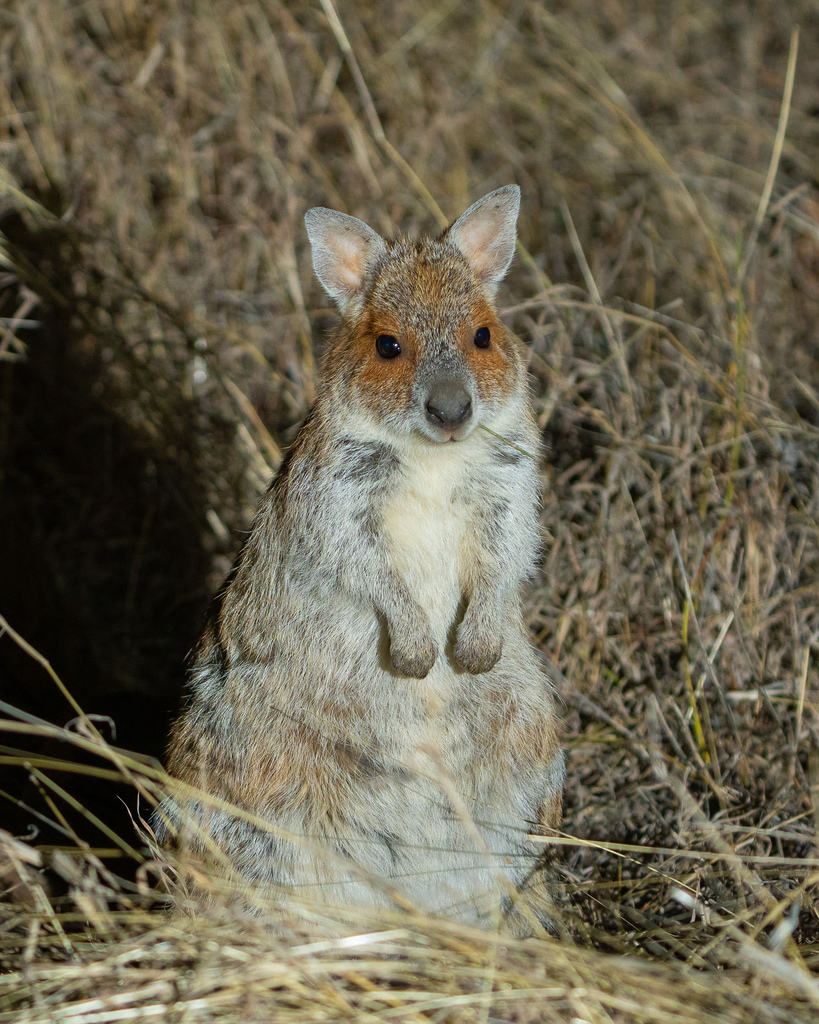
Spectacled Hare Wallaby
Lagorchestes conspicillatus
The spectacled hare-wallaby (Lagorchestes conspicillatus) is a species of macropod (hence a marsupial) found in Australia and New Guinea. In Australia, a small sub-population is found on Barrow Island, while the mainland type is widespread, though in decline, across northern regions of the country.
From the article Spectacled hare-wallaby on Wikipedia (CC BY-SA), quoted section by section
Description
A species of Lagorchestes, hare-wallaby are small members of the family Macropodidae. The spectacled hare-wallaby is found across northern Australia in tropical tussock or spinifex habitats. It can be found from Queensland to Western Australia. In 1997, it was discovered in the savanna country of southwest Papua New Guinea, in the upper Bensbach River area. It is a solitary, nocturnal herbivore, and is considerably larger than its relatives. It is coloured grey-brown with golden tips and an orange circle around its eye, from which it gets its name. It builds its nests among the tough vegetation. When disturbed it hops off in a zigzag manner. The young are produced singly at any time of the year and become sexually mature at about a year old.
In human culture
The Bininj people of western Arnhem Land call this animal wularla in the Kunwinjku language.
Wikipedia: “In Aboriginal language and culture”
Listen
Looking for field recordings…
Where it lives
Recorded sightings
—
geo-referenced records in GBIF, from museums, herbaria and field observers.
Drag the globe to turn it. Dots are where records exist, not a range map; darker means more records.
In the stacks
Searching the stacks…
Every page naming Lagorchestes conspicillatus in the Biodiversity Heritage Library →
This page is assembled live from iNaturalist, GBIF, Wikipedia, the Source Library and the Internet Archive. It is not yet part of the hand-edited codex. iNaturalist taxon 42950.