- Animals
- ›Chordates
- ›Vertebrates
- ›Mammals
- ›Therians
- ›Marsupials
- ›Kangaroos, Possums, Wombats, and Allies
- ›Macropods
- ›Kangaroos, Wallabies and Allies
- ›Kangaroos, Wallabies, Pademelons, and Dorcopsises
- ›Kangaroos and Wallabies
- ›Onychogalea
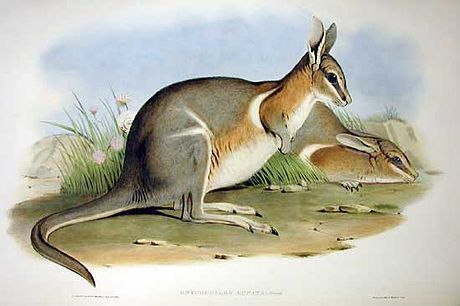
Crescent Nail-tail Wallaby
Onychogalea lunata
The crescent nail-tail wallaby, also known as the worong (Onychogalea lunata), is a small extinct species of marsupial that grazed on grasses in the scrub and woodlands of southwestern and central Australia. They were common in Western Australia before they disappeared in the early 20th century and persisted in the central deserts until at least the 1950s. The pelage was soft and silky and an ashen grey colouring overall, highlighted in part with rufous tones. There were light and dark patches of fur across the body, the moon-like crescents inspiring their names, and had attractive stripes on the face. Like the two remaining species of the genus, the northern Onychogalea unguifera and rare O. fraenata (bridled nailtail), it had a horny spur at the tip of its tail. The species was compared to a hare or rabbit, in its habits, appearance and taste, and weighed around 3.5 kilograms.
The species was extremely timid and would flee to a hollow log if disturbed at their daytime resting places, a small patch of sand cleared near a large shrub or tree. They ran with their short forelimbs awkwardly held toward the chest.
From the article Crescent nail-tail wallaby on Wikipedia (CC BY-SA), quoted section by section
Description
A species of Onychogalea, presumed to be extinct. They were one of the three known species of the genus, named for their distinctive tails that possessed a nail or claw-like tip. The animal was distinguished by a whitish crescent shaped mark that extends from the shoulder behind the arm, through the flank, and terminated in a point above the leg. A distinctly contrasting striping extends along the length of the hind limb, from the thigh to the hip and in a line to the knee. The weight of the species was around 3.5 kilograms, smaller than others of the genus. The head and body length combined was from 370 to 510 millimetres, greater than the tail length of 150 to 330 mm. The upper-parts of the pelage were an ash-grey colour, broken by the light crescent markings and a short blackish crest of hair along the top of tail. A less distinct blackish mark at either side of the muzzle reached from the nose to the eye. Oldfield Thomas gave a diagnosis of the three species, distinguishing their superficial characters and tabulating a close comparison of their cranial measurements. This species was regarded by Thomas as more closely allied to Onychogalea fraenata, both in size and skull morphology. …
Range & habitat
A species with a wide distribution at the time of colonisation, it then contracted from the coast and is now presumably extinct. The distribution range covered a large area of the continent, from the northwestern coast through the central and southerly regions that extended toward New South Wales. They occupied a wide range of habitat in arid and semi-arid environments dominated by a variety of shrublands and woodlands. The habitat of the species was in a variety of vegetation types, although commonly associated with low scrub or thickets that were very dense. A common tree of the local environment was sheoak, Allocasuarina species, or the stinkwood Jacksonia furcellata. Their abode is comparable to a European hare, a simple clearing or "squat", and they resided in areas so densely vegetated that they were often unnoticed and unobtainable by hunters. While the species was found in denser habitat than the tammar Macropus eugenii, a similar macropod, they were often found in the same locations. The species was regarded as common, if not abundant, until its rapid decline. At the beginning of the 20th century Guy Shortridge was able to assemble a series of 23 specimens collected in the Wheatbelt region of Western Australia. …
Wikipedia: “Distribution and habitat”
What it does
The habits of O. lunata are poorly known, with information being restricted in the few reported observations and records of Aboriginal informants from the central desert regions. Observers often reported that the species was exceptionally timid and would seek refuge at the slightest indication of a human presence. John Gilbert's report to Gould in the early 1840s was quoted in his Mammals of Australia,
"[t]he Waurong is found in the gum forests [eucalypt woodlands] of the interior of Western Australia, where there are patches of thick scrub and dense thickets, in the open glades intervening between which it is occasionally seen sunning itself, but at the slightest alarm immediately betakes itself to the shelter of the thick scrub; the dogs sometimes succeed in driving it out to the open spots, when, like the Kangaroo rats, it runs to the nearest hollow log, and is then easily captured. I remarked, that when sitting quietly cleaning itself, there was a constant twitching of the tail in an upward direction; an action which I have never seen performed by any other Kangaroo. I was not sufficiently near to ascertain whether this motion of the tail had any connection with the claw or nail at its extremity, but I think it not improbable. …
Wikipedia: “Behaviour”
Listen
Looking for field recordings…
Where it lives
Recorded sightings
—
geo-referenced records in GBIF, from museums, herbaria and field observers.
Drag the globe to turn it. Dots are where records exist, not a range map; darker means more records.
In the stacks
Searching the stacks…
Every page naming Onychogalea lunata in the Biodiversity Heritage Library →
This page is assembled live from iNaturalist, GBIF, Wikipedia, the Source Library and the Internet Archive. It is not yet part of the hand-edited codex. iNaturalist taxon 42958.