- Animals
- ›Chordates
- ›Vertebrates
- ›Mammals
- ›Therians
- ›Marsupials
- ›Kangaroos, Possums, Wombats, and Allies
- ›Macropods
- ›Kangaroos, Wallabies and Allies
- ›Kangaroos, Wallabies, Pademelons, and Dorcopsises
- ›Kangaroos and Wallabies
- ›Onychogalea
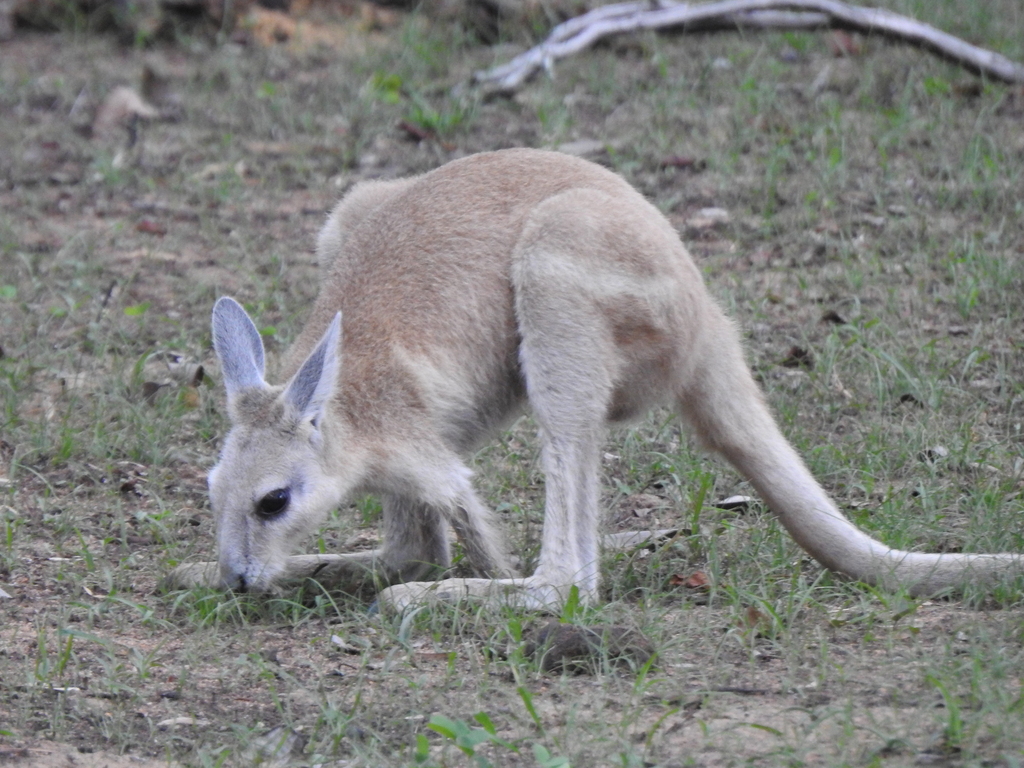
Northern Nail-tail Wallaby
Onychogalea unguifera
The northern or sandy nail-tail wallaby (Onychogalea unguifera) is a species of macropod found across northern Australia on arid and sparsely wooded plains. The largest species of the genus Onychogalea, it is a solitary and nocturnal herbivorous browser that selects its food from a wide variety of grasses and succulent plant material. Distinguished by a slender and long-limbed form that resembles the typical and well known kangaroos, although their standing height is shorter, around half of one metre, and their weight is less than nine kilograms. As with some medium to large kangaroo species, such as Osphranter rufus, they have an unusual pentapedal motion at slow speeds by stiffening the tail for a fifth limb. When fleeing a disturbance, they hop rapidly with the tail curled back and repeatedly utter the sound "wuluhwuluh". Their exceptionally long tail has a broad fingernail-like protuberance beneath a dark crest of hair at its end, a peculiarity of the genus that is much broader than the other species. The name unguifera, meaning claw, is a reference to this extraordinary attribute, the purpose of which is unknown.
Like the other species of the genus, they retire for the day in a shallow depression, but if disturbed they flee rapidly to find refuge in a hollow tree or thicket. Unlike the rare bridled nail-tail wallaby (O. fraenata), once widespread and currently rare, the northern nail-tail wallaby is not a threatened species. The other member of the genus Onychogalea, the crescent nail-tail wallaby (O.
From the article Northern nail-tail wallaby on Wikipedia (CC BY-SA), quoted section by section
Description
The largest of a small group of macropods, the genus Onychogalea. known as nail-tail wallabies, which possess similar incisors and a dark growth resembling a fingernail or horny spur beneath a crest of fur at the end of the tail. This claw-like feature of the tail is unique amongst the marsupials and an exceptional characteristic for any mammal, and this species bears the most prominent and developed tail nail of the genus. Speculation on the purpose of the horny end includes its use as a defensive weapon, delivering a blow inflicted from the very long tail, or that it is an ancestral relic of a disused function. A hopping marsupial resembling the larger kangaroo species, the form of the body is light and elegant. The northern species is taller and heavier than other nailtails, but with limbs, tail and other features that are proportionally longer. They hop with their arms held in a stiff manner, so that these move in a circular motion, fleeing with their heads held low and long tail curled upward. The curled posture of the tail, usual in macropods in motion, is exaggerated to nearly form a semi-circle. The length of the head and body combined is 500 to 700 millimetres (20 to 28 in), exceeded by the tail measuring from 600 to 740 mm (24 to 29 in) and an average length of 650 mm (26 in). …
Range & habitat
An endemic species of northern Australia that favours a diverse range of arid habitat and may be common at some locations in its broad distribution range. They occur in the northern parts of the continent, generally inland from the coastline, from the east at Cape York Peninsula, through the Top End and through the Kimberley region to the northwestern coast. The areas occupied by Onychogalea unguifera are patchily distributed within the large range, sometimes locally common or abundant at favoured sites, and this has not known to have been greatly altered since the later 20th century. The habitat occupied by O. unguifera is most often areas dominated by tussocks of tough grasses or low shrubby plant species, vegetation interspersed with occasional trees over arid landscapes, and especially associated with the meeting of clay soils at sandy loams. The marsupial is also recorded at dense stands of Melaleuca species. The conservation status of the species was assessed for the IUCN Red List in 2015 as least concern. …
Wikipedia: “Distribution and habitat”
What it does
This marsupial is a nocturnal and usually solitary grazer and forager. The species is selective in its choice of the most palatable grasses or herbaceous and succulent plants, and is known to also consume some fruits. They reside during the day beneath trees or shrubs in a shallow depression scraped into the sand. The species may seek to avoid discovery or seek refuge beneath a low shrubbery or by lying amongst some tall grass. The slow gait of O. unguifera has a characteristic usually associated with mid-sized to large species of Macropus and, like the pentapedal motion of the red kangaroo, uses all four limbs and the large tail to move forward in a "five-legged" manner. This form of locomotion has been attributed to variety of macropods, with contrary opinions on which actually use their large tails to pivot the hind legs forward, but video analysis of their movements confirms this species use of the unusual gait. A specimen captured in northern Queensland was successfully held in captivity, as a pet, at a Victorian garden in the early 20th century. The animal was friendly when active and recognised its custodian, who supplemented its forage with vegetation outside its enclosed area.
Wikipedia: “Behaviour”
Listen
Looking for field recordings…
Where it lives
Recorded sightings
—
geo-referenced records in GBIF, from museums, herbaria and field observers.
Drag the globe to turn it. Dots are where records exist, not a range map; darker means more records.
In the stacks
Searching the stacks…
Every page naming Onychogalea unguifera in the Biodiversity Heritage Library →
This page is assembled live from iNaturalist, GBIF, Wikipedia, the Source Library and the Internet Archive. It is not yet part of the hand-edited codex. iNaturalist taxon 42957.