- Animals
- ›Chordates
- ›Vertebrates
- ›Mammals
- ›Therians
- ›Marsupials
- ›Kangaroos, Possums, Wombats, and Allies
- ›Macropods
- ›Kangaroos, Wallabies and Allies
- ›Kangaroos, Wallabies, Pademelons, and Dorcopsises
- ›Tree Kangaroos and Allies
- ›Petrogale
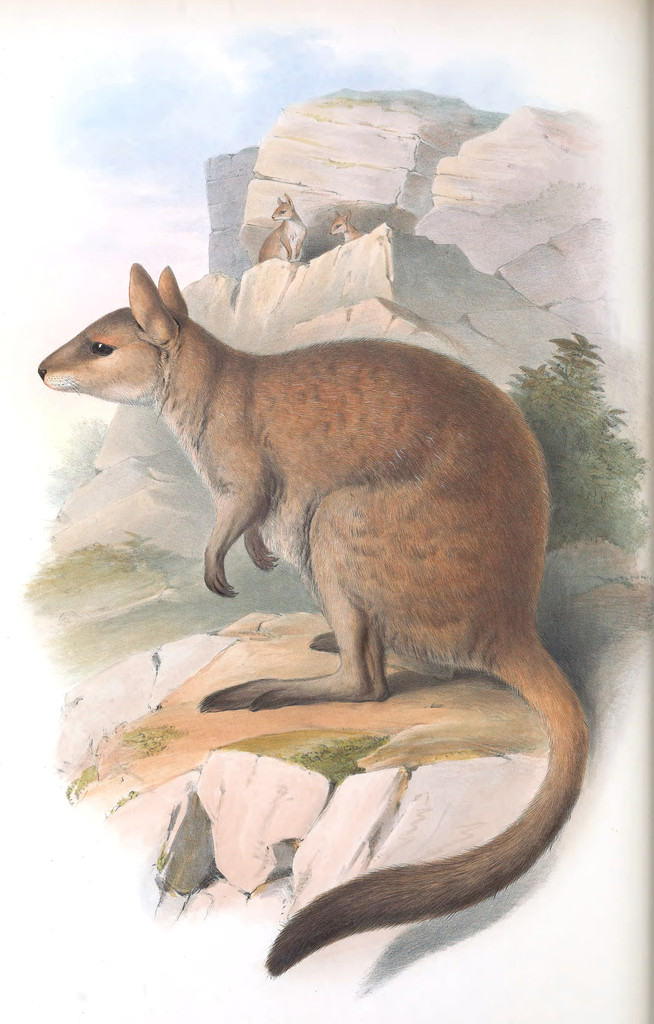
Nabarlek
Petrogale concinna
The nabarlek (Petrogale concinna) is a small species of macropod found in northern Australia. They are a shy and nocturnal animal that resides in rocky hollows and forages in the surrounding area. Their diet is grasses, sedges, and ferns found in and around their scrub covered refuges. They are distinguished by a reddish tinge to the mostly grey fur and a distinct stripe at the cheek. They move with great speed and agility when observed, with a forward leaning posture and a bushy tail that arches over the back.
From the article Nabarlek on Wikipedia (CC BY-SA), quoted section by section
Description
A species of Petrogale, the rock wallabies, distinguished by its small size. The pelage is a grey colour, with reddish highlights at the fore-arm, legs and hind parts. The tail is also reddish grey, with a bushy end of coarser hair that begins two thirds along its length, the total length may be from 260 to 335 millimetres. The cheek is marked with a whitish stripe from the eye to the nostrils, a lighter tone that contrasts with the blackish parts of the snout. Another darker stripe is found below the eye and down the neck, the region beneath the fore-arm is also blackish. The head and body length combined in 310 to 365 mm, the smallest of the genus but for P. burbidgei. The measurement of the hindfoot is 95 to 105 mm, the ear from base to tip is 41 to 45 mm. The weight range is from 1.2 to 1.6 kilograms. The dentition of P. cocinna is unique amongst the marsupial species, with the supernumerary molars being continually replaced. These teeth emerge in a regular size and shape, with each row containing four to six molars and another that is yet to erupt. The early loss of the premolar appears to allow this regeneration to continue throughout their life. Nabarlek is often found with the similar P. brachyotis, whose coloration is more variable, and a young individual may be indistinguishable from this species in field observations.
Range & habitat
The nabarlek is found in three distinct and geographically remote populations, one in Arnhem Land which includes Groote Eylandt, a larger island in the Gulf of Carpentaria, and another population between the Mary and Victoria Rivers at the Top End of the continent. The population in the northwest Kimberley region is confined to the coastal areas and on some of the islands in the Bonaparte Archipelago, these are Borda, Long, Hidden and Augustus Islands. The habitat is usually scrubby vegetation over sandstone formations, granitic outcrops, breakaways of laterite, boulder piles and rocky slopes.
Wikipedia: “Distribution and habitat”
What it does
Nabarlek move quickly with a distinctive horizontal posture, the tail curled toward the middle of the back with raised hairs in the tufty end. The species has a timid disposition, although is somewhat gregarious in associations with others. Their feeding and other activities is usually nocturnal, and they may range beyond their refuge to forage. The species will range several hundred metres from its secure position, foraging in the surrounding black soil terrain, this contrasts with the less venturous behaviour of the short-eared P. brachyotis. The discrete and cautious nature of narbarlek makes capture of specimens difficult, they are regarded as 'trap-shy' in attempts to survey their population.
Wikipedia: “Behaviour”
In human culture
The name comes from the Kunwinjku language of West Arnhem Land. The animal has also lent its name to the music rock group from the area, Nabarlek and Gwendolyne Stevens' uranium mine.
Wikipedia: “Etymology”
Listen
Looking for field recordings…
Where it lives
Recorded sightings
—
geo-referenced records in GBIF, from museums, herbaria and field observers.
Drag the globe to turn it. Dots are where records exist, not a range map; darker means more records.
In the stacks
Searching the stacks…
Every page naming Petrogale concinna in the Biodiversity Heritage Library →
This page is assembled live from iNaturalist, GBIF, Wikipedia, the Source Library and the Internet Archive. It is not yet part of the hand-edited codex. iNaturalist taxon 42928.