- Animals
- ›Chordates
- ›Vertebrates
- ›Mammals
- ›Therians
- ›Marsupials
- ›Kangaroos, Possums, Wombats, and Allies
- ›Macropods
- ›Kangaroos, Wallabies and Allies
- ›Kangaroos, Wallabies, Pademelons, and Dorcopsises
- ›Tree Kangaroos and Allies
- ›Petrogale
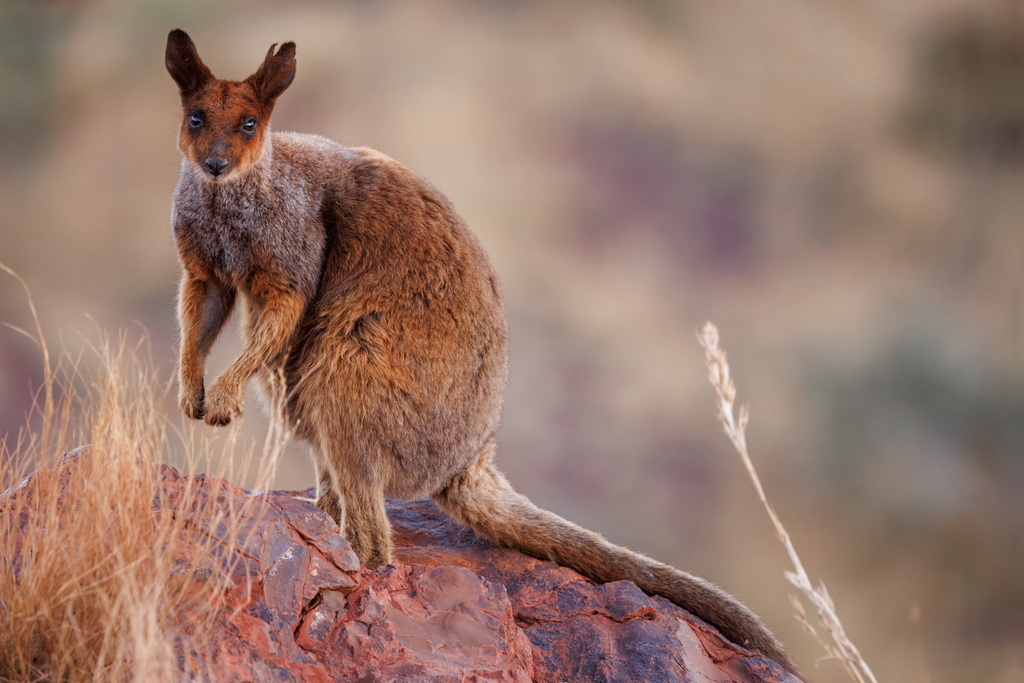
Rothschild's Rock Wallaby
Petrogale rothschildi
Rothschild's rock-wallaby (Petrogale rothschildi) – sometimes known as the Roebourne rock-wallaby, is a species of macropod found in Western Australia, in the Pilbara district and the Dampier Archipelago. It is not currently considered to be threatened, but is at risk from the red fox (Vulpes vulpes).
Rothschild's rock-wallaby is one of the largest rock-wallabies. It is predominantly golden-brown in colour with a greyish wash down its neck, which often has a purple appearance. It is mainly a nocturnal grass-eater usually found around rocky ground.
From the article Rothschild's rock-wallaby on Wikipedia (CC BY-SA), quoted section by section
Description
Described as one of the most appealing species of Petrogale, the rock wallabies, it is also one of the largest of the genus. The fur colour at the upperside is a golden shade of brown, becoming greyish at the shoulders and rear of the neck. The top of the head and muzzle is dark brown, contrasting the paler grey-buff at the lower muzzle that extends below the eyes to the upper surface of the ear. The pelage sometimes has a purplish hue, most evident at the shoulder and head. The head and body length combined is 470–600 millimetres, with a long tail recorded as 550–700 mm; the colour of the tail becomes dark brown for around a third of its length. The length of the ear from its point to the base is 56 mm. The weight range of Petrogale rothschildi is 3.7–6.6 kilograms. The population found at the islands of the Dampier Archipelago are smaller than those on the mainland, the weight range is from 2.6 to 3.5 kilograms.
Range & habitat
The species seeks shelter during the day in the cooler temperatures provided by the crevices and caves of its favoured habitat. They are highly secretive in their behaviour and use the rocky terrain to remain hidden or inaccessible to predators. Rothchild's rock-wallaby occurs at hummocks of vegetation covering scree slopes, around boulder piles and on cliff faces. They feed nocturnally beyond their daytime refuge, venturing out to seek green vegetation such as grasses on the surrounding sand plains. P. rothschildi requires access to water and foraging areas close to its refuge. The diet includes buffel grass, herbaceous plants and fruits of native Ficus species and prickly pear is consumed by the introduced population at West Lewis Island. The range of diurnal refuge for the species is most frequently at caves, crevices or the collapse of cliffs, but it extends to include records of occupancy at features such as displaced rock piles and rail embankments created by the region's iron ore mining operations.
Wikipedia: “Behaviour and habitat”
Listen
Looking for field recordings…
Where it lives
Recorded sightings
—
geo-referenced records in GBIF, from museums, herbaria and field observers.
Drag the globe to turn it. Dots are where records exist, not a range map; darker means more records.
In the stacks
Searching the stacks…
Every page naming Petrogale rothschildi in the Biodiversity Heritage Library →
This page is assembled live from iNaturalist, GBIF, Wikipedia, the Source Library and the Internet Archive. It is not yet part of the hand-edited codex. iNaturalist taxon 42918.