- Animals
- ›Chordates
- ›Vertebrates
- ›Mammals
- ›Therians
- ›Marsupials
- ›Kangaroos, Possums, Wombats, and Allies
- ›Macropods
- ›Kangaroos, Wallabies and Allies
- ›Kangaroos, Wallabies, Pademelons, and Dorcopsises
- ›Tree Kangaroos and Allies
- ›Petrogale
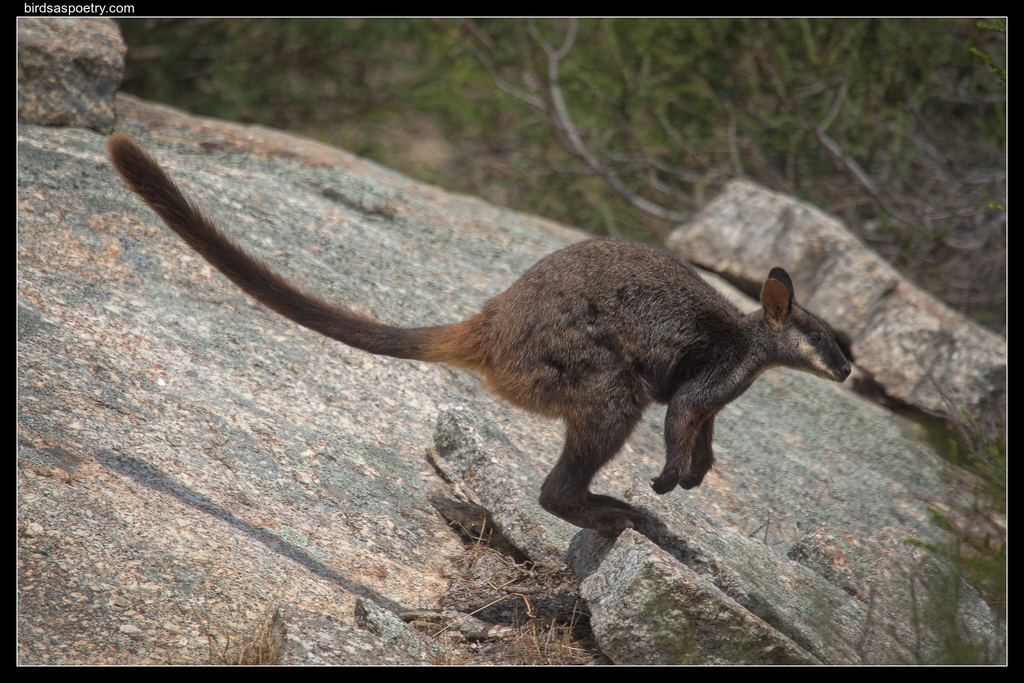
Brush-tailed Rock Wallaby
Petrogale penicillata
The brush-tailed rock-wallaby or small-eared rock-wallaby (Petrogale penicillata) is a kind of wallaby, one of several rock-wallabies in the genus Petrogale. It inhabits rock piles and cliff lines along the Great Dividing Range from about 100 km north-west of Brisbane to northern Victoria, in vegetation ranging from rainforest to dry sclerophyll forests. Populations have declined seriously in the south and west of its range, but it remains locally common in northern New South Wales and southern Queensland. However, due to a large bushfire event in South-East Australia around 70% of all the wallaby's habitat has been lost as of January 2020.
In 2018, the southern brush-tailed rock wallaby was declared as the official mammal emblem of the Australian Capital Territory (ACT), although it has not been seen in the wild in the ACT since 1959.
From the article Brush-tailed rock-wallaby on Wikipedia (CC BY-SA), quoted section by section
Description
A species of Petrogale, rock wallabies have a dense and shaggy pelage that is rufous or grey brown. The tail is 500 to 700 millimetres long, exceeding the 510 to 580 mm combined length of the head and body. The colour of the tail is brown or black, the fur becoming bushy towards its shaggy, brush-like end. The weight range is from 5 to 8 kilograms. The upper parts of this wallaby's pelage is either entirely rufous-brown, or a grey brown over the back and shoulders with brown fur at the thigh and rump. The paler under parts may feature a white blazon on the chest. Very dark fur covers the lower parts of the limbs, paws and feet, and on the sides beneath the fore limbs of the animal; a whitish stripe may appear along the side of the body.
The coloration of the species in the northern parts of population is paler and fur is shorter in length. The black-footed and flanked species Petrogale lateralis, which occurs in central Australia, is distinguished by its larger size and the shorter and darker fur of the tail and hind parts. Herbert's rock-wallaby (P. …
Range & habitat
Found along the Great Dividing Range in fragmented populations that remain after its historical contraction in range from the east and south. The southern edge of the range is the Grampians, and no further west than the Warrumbungles range in New South Wales. The northernmost groups have remained less affected by ecological changes, these are found in southeast Queensland. Petrogale penicillata shelters during the day in rocky habitat, within vegetation or cavities of preferably complex terrain that allows them to find cooler temperatures and to elude or remain inaccessible to predators. Their great agility while hopping and climbing provides opportunities at ledges, cliff-faces, overhangs, caves and crevices.
Wikipedia: “Distribution and habitat”
What it does
The species is able to negotiate difficult rocky terrain with great agility, their compact yet powerful build is assisted by counter-balancing the long tail and feet suited to holding the animal at precarious edges and on inclined surfaces. The species favours north facing refuges, and while largely nocturnal in venturing out from shelter they will bask in winter sun for short periods. Procreation is founded on breeding females utilising a single male for insemination, with births that occur throughout the year. Groups in cooler latitudes or higher altitudes may tend to reproduce in a period between February and May. The females of the colony cohere as maternal groups, with male progeny moving to other groups within the colony or migrating to another location. Individual foraging territories for the species are around 15 hectares, perhaps more for males.
Wikipedia: “Behaviour”
Listen
Looking for field recordings…
Where it lives
Recorded sightings
—
geo-referenced records in GBIF, from museums, herbaria and field observers.
Drag the globe to turn it. Dots are where records exist, not a range map; darker means more records.
In the stacks
Searching the stacks…
Every page naming Petrogale penicillata in the Biodiversity Heritage Library →
This page is assembled live from iNaturalist, GBIF, Wikipedia, the Source Library and the Internet Archive. It is not yet part of the hand-edited codex. iNaturalist taxon 42937.