- Animals
- ›Chordates
- ›Vertebrates
- ›Mammals
- ›Therians
- ›Marsupials
- ›Kangaroos, Possums, Wombats, and Allies
- ›Macropods
- ›Kangaroos, Wallabies and Allies
- ›Kangaroos, Wallabies, Pademelons, and Dorcopsises
- ›Tree Kangaroos and Allies
- ›Petrogale
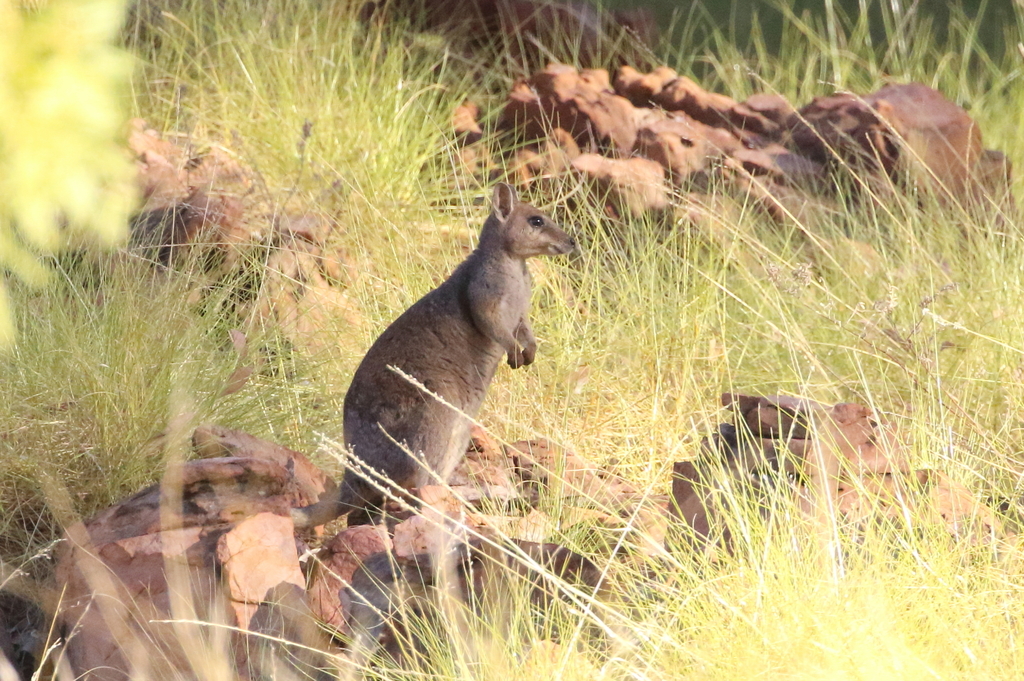
Western Short-eared Rock Wallaby
Petrogale brachyotis
The short-eared rock-wallaby (Petrogale brachyotis) is a species of rock-wallaby found in northern Australia, in the northernmost parts of the Northern Territory and Western Australia. It is much larger than its three closest relatives, the eastern short-eared rock-wallaby (Petrogale wilkinsi), the nabarlek (Petrogale concinna) and the monjon (Petrogale burbidgei).
From the article Short-eared rock-wallaby on Wikipedia (CC BY-SA), quoted section by section
Description
A species of Petrogale, known as rock-wallabies, that varies in its size and coloration and has been recognised as a species group. Referred to as the brachyotis species group of the genus, they exist in an area that has made study difficult, although examination of specimens in 2014 separated one species and identified other cryptic taxa within the population. Prior to its revision, the generalised description for the species Petrogale brachyotis (sensu lato) incorporated variations later recognised as distinctive characters. The grey-brown coloration of the fur is interspersed with silver hair that highlights the overall coloration. the underside is pale grey. The length of the head and body combined is from 415 to 550 millimetres (16.3 to 21.7 in), and they weigh 2.2 to 5.5 kilograms (4.9 to 12.1 lb). The tail is relatively short for the genus, 320 to 550 mm (13 to 22 in), a dark brown to blackish tuft of fur appears at the terminus and the colour is otherwise cinnamon brown. The ears are also relatively small, less than half the length of the head, measuring from 40 to 48 mm (1.6 to 1.9 in). The cinnamon colour also appears at the legs, broken by a buff or whitish stripe at the thigh that extends over the flank and over the shoulder, where a darker patch appears below the forelimb. …
Range & habitat
Petrogale brachyotis has a patchy occurrence within a wide distribution range, extending west from the border of Queensland and the Northern Territory through the Top End to the Windjana Gorge in northwestern Australia. The range inland is limited to areas of rainfall above the 600 mm isohyet. They are also found as island populations in the Gulf of Carpentaria. The favoured habitat is monsoonal rainforest and open grasslands, where they inhabit cliffs, hills and valleys that provide refuge and forage.
Wikipedia: “Distribution and habitat”
What it does
The short-eared rock-wallaby is a gregarious vegetarian, found in rocky hills and gorges. It is variable in its appearance but is generally grey-brown with white areas around its face and legs. It is not considered threatened.
Wikipedia: “Behaviour”
In human culture
Speakers of Kunwinjku in West Arnhem Land call the wallaby badbong, and people would traditionally travel with spears into the escarpment to hunt them. According to Kunwinjku elder Reverend Peterson Nganjmirra they would trap badbong in rocky country by setting fire to "spinifex" (actually Triodia spp.).
Wikipedia: “In Aboriginal language and culture”
Listen
Looking for field recordings…
Where it lives
Recorded sightings
—
geo-referenced records in GBIF, from museums, herbaria and field observers.
Drag the globe to turn it. Dots are where records exist, not a range map; darker means more records.
In the stacks
Searching the stacks…
Every page naming Petrogale brachyotis in the Biodiversity Heritage Library →
This page is assembled live from iNaturalist, GBIF, Wikipedia, the Source Library and the Internet Archive. It is not yet part of the hand-edited codex. iNaturalist taxon 937706.