- Animals
- ›Chordates
- ›Vertebrates
- ›Mammals
- ›Therians
- ›Marsupials
- ›Kangaroos, Possums, Wombats, and Allies
- ›Macropods
- ›Potoroos and Bettongs
- ›Potoroos
- ›Potorous
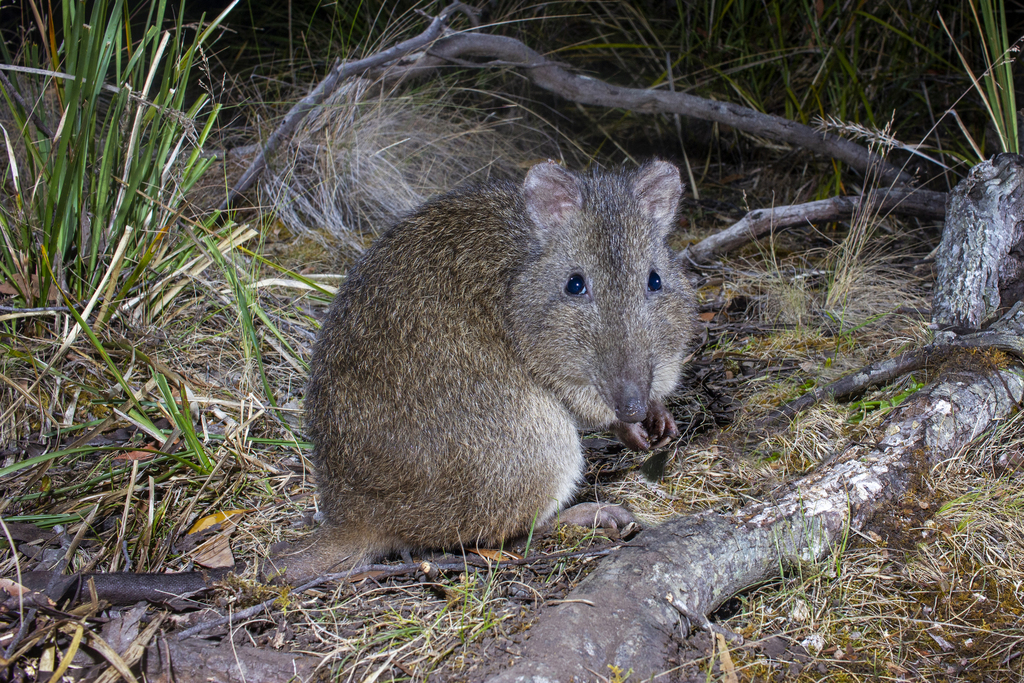
Long-nosed Potoroo
Potorous tridactylus
The long-nosed potoroo (Potorous tridactylus) is a small, hopping mammal native to forests and shrubland of southeastern Australia and Tasmania. A member of the potoroo and bettong family (Potoroidae), it lives alone and digs at night for fungi, roots, or small insects. It is also a marsupial (like kangaroos) and carries its young in a pouch. The long-nosed potoroo is threatened by habitat loss and introduced species such as cats or foxes. There are two subspecies: P. t. tridactylus on mainland Australia, and P. t. apicalis on Tasmania, with lighter fur.
At first glance, the long-nosed potoroo with its pointed nose and grey-brown fur looks very much like a bandicoot — that is, until it hops away with its front feet tucked into its chest, revealing its close relationship with the kangaroo family. The long-nosed potoroo exhibits many morphological specializations such as an elongated pointed rostral region (nose), erect ears, large eyes, claws for digging, and long robust hind legs. It is only a small marsupial, with a body length between 34 and 38 cm (13–15 in), and a semi-prehensile tail length of 15 to 24 cm (5.9–9.4 in).
From the article Long-nosed potoroo on Wikipedia (CC BY-SA), quoted section by section
Range & habitat
The long-nosed potoroo is found in a variety of microhabitats located in the Southern Highlands of New South Wales and South-Western Victoria on the Australian mainland, and in Tasmania. Its bones have been found in a number of cave deposits, indicating it was once more widespread than it is today. This species prefers a range of vegetation types, from subtropical and warm temperate rainforest, through tall open forest with dense understorey, to dense coastal heaths. Its main requirement is thick groundcover, which it needs for protection and nesting material. It also prefers light soils that are easy to dig in for the underground roots and fungi that it eats. Home-range sizes of the long-nosed potoroo vary considerably; the largest recorded was 34.4 hectares (85 acres). In Tasmania, large overlapping home ranges of 5–20 hectares (12–49 acres) have been recorded, with males typically acquiring more land than females. Home ranges in Victoria, however, are much smaller.
Wikipedia: “Habitat and distribution”
What it does
Generally, the long-nosed potoroo is solitary and has only been observed in brief encounters for mating and when with young. There have also been reports of several males and females feeding in loose aggregations. These mammals are non-territorial and frequently have overlapping home ranges. The male's home range can overlap many females', but the female's home range is usually exclusive, allowing the female access to the male year round. Breeding, however, usually occurs from late winter to early summer. Females are polyestrous and can have up to two reproductive sessions per year. The long-nosed potoroo is nocturnal, spending much of its time within the shelter of understorey vegetation. It uses long, slightly curved claws on its front feet to dig up its food. It is an omnivore and eats underground fruiting bodies of fungi, roots, fruit, flowers, seeds, and insects and their larvae. Fungi are the main dietary component, and are a very important resource in the potoroo's diet, with at least 50 species consumed depending on seasonal variation. During the fall and winter months, potoroos primarily consume fungi and seeds, while in the spring and summer months, the amount of arthropods, plant tissue, fruits, and flowers consumed increases. The long-nosed potoroo sniffs the ground with a side to side motion near the vicinity of food. …
Wikipedia: “Life history and behaviour”
Listen
Looking for field recordings…
Where it lives
Recorded sightings
—
geo-referenced records in GBIF, from museums, herbaria and field observers.
Drag the globe to turn it. Dots are where records exist, not a range map; darker means more records.
In the stacks
Searching the stacks…
Every page naming Potorous tridactylus in the Biodiversity Heritage Library →
This page is assembled live from iNaturalist, GBIF, Wikipedia, the Source Library and the Internet Archive. It is not yet part of the hand-edited codex. iNaturalist taxon 42988.