- Animals
- ›Chordates
- ›Vertebrates
- ›Mammals
- ›Therians
- ›Marsupials
- ›Opossums
- ›Opossums
- ›Large American Opossums, Mouse Opossums, and Allies
- ›Large New World Opossums
- ›Lutreolina
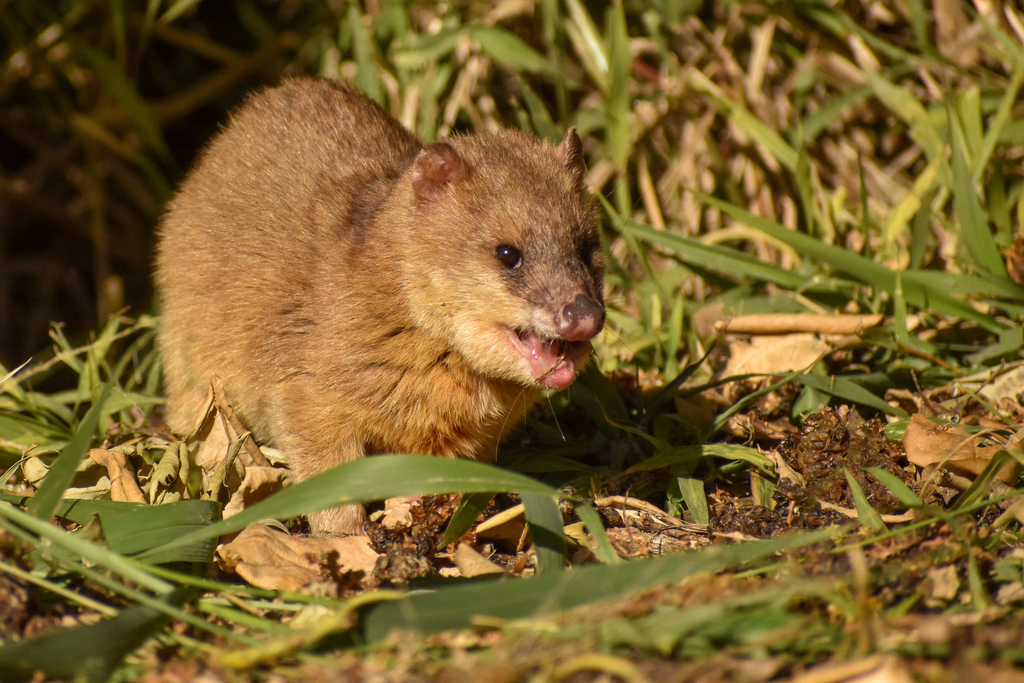
Little Water Opossum
Lutreolina crassicaudata
The big lutrine opossum (Lutreolina crassicaudata), also called little water opossum, thick-tailed opossum and coligrueso, is a long-tailed, otter-like mammal native to grasslands of South America. It generally lives near water and is active at night, dawn or dusk. It eats mice, insects and crabs. Like all opossums, it is a marsupial and carries its young in a pouch.
From the article Big lutrine opossum on Wikipedia (CC BY-SA), quoted section by section
Description
The big lutrine opossum ("lutrine" means "otter-like" and "crass" meaning "thick, fat" and "cauda" meaning "tail") is a very peculiar opossum, having a long weasel-like body, short legs, small rounded ears, and dense reddish or yellowish fur. Nocturnal and crepuscular, they generally live in grasslands and savannas near water. They are terrestrial but are excellent swimmers and climbers.
Range & habitat
The big lutrine opossum is distributed in Brazil, Argentina, Bolivia, Uruguay, Paraguay, Colombia and Guyana. Populations in the two last countries are isolated from the populations of all the other countries. It can be found in grasslands, savanna grassland, and gallery woodlands with permanent water bodies, in marshy or riparian habitats.
Wikipedia: “Distribution and habitat”
What it does
The big lutrine opossum builds tight nests made of grass and reeds or utilize abandoned armadillo or viscacha burrows.
Diet. With a skull adapted for carnivory, the big lutrine opossum is carnivorous and insectivorous feeding on small rodents and lagomorphs, birds, insects, small crustaceans. It is considered to be the most carnivorous of all the members of the order Didelphimorphia. It preys on venomous snakes. Captive individuals have been observed eating butterfish mixed with meat, frogs, earthworms, shrimp and mice. Big lutrine opossums living close to urban areas scavenge through garbage, but this behavior is isolated and likely occurs due to necessity because there is less available prey in urban areas.
Reproduction. Breeding begins in September and carries on until April followed by approximately five months of anestrous, or time without estrus. Big lutrine opossums have two breeding periods per year resulting in litters of 7–11 offspring. Like most marsupials, litters are born into a pouch and are fed via lactation until the offspring is developed enough to leave the pouch. Gestation lasts approximately two weeks and young are weaned off mother's milk at around three months. The first litter is born in September and the second in December or January. …
Wikipedia: “Behavior and ecology”
Listen
Looking for field recordings…
Where it lives
Recorded sightings
—
geo-referenced records in GBIF, from museums, herbaria and field observers.
Drag the globe to turn it. Dots are where records exist, not a range map; darker means more records.
In the stacks
Searching the stacks…
Every page naming Lutreolina crassicaudata in the Biodiversity Heritage Library →
This page is assembled live from iNaturalist, GBIF, Wikipedia, the Source Library and the Internet Archive. It is not yet part of the hand-edited codex. iNaturalist taxon 852377.