- Animals
- ›Chordates
- ›Vertebrates
- ›Mammals
- ›Therians
- ›Placental Mammals
- ›Primates, Rodents, and Allies
- ›Rodents
- ›Squirrels, Dormice, and Mountain Beavers
- ›Squirrels
- ›Ground and African Tree Squirrels
- ›Holarctic Ground Squirrels
- ›Marmota
- ›Marmota
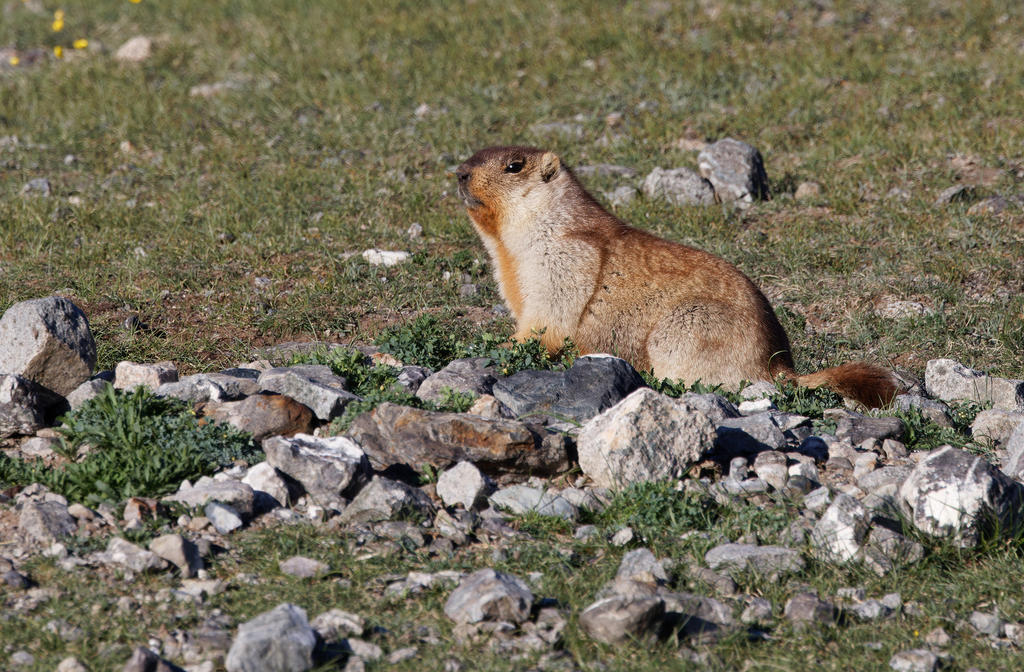
Tarbagan Marmot
Marmota sibirica
The tarbagan marmot (Marmota sibirica) is a species of rodent in the family Sciuridae. It is found in China (Inner Mongolia and Heilongjiang), northern and western Mongolia, and Russia (southwest Siberia, Tuva, Transbaikalia). In the Mongolian Altai Mountains, its range overlaps with that of the gray marmot. The species was classified as endangered by the IUCN in 2008.
Two subspecies are recognized, M. s. sibirica and M. s. caliginosus.
From the article Tarbagan marmot on Wikipedia (CC BY-SA), quoted section by section
Description
The tarbagan marmot is medium-sized compared to other marmots, with a 0.25 head-to-body ratio. During the summer, its hair is between 11–20 mm and grows up to 30 mm during winter months. Its fur has two separate slate bands, followed by a white band, and its cheeks are yellow. Its zygomatic arches are slightly expanded compared to other marmot species. Populations in western Mongolia tend to have wider skulls compared to other tarbagan marmots. Males tend to weigh more than females and are larger, both having an average weight of 6–8 kg. The tarabagan marmot is one of the two only marmot species to inhabit lowland areas, the other being the groundhog. The tarbagan marmot is herbivorous, like all other marmots, and consumes steppe grasses. It is mainly found throughout Mongolia, with its range extending west to the Altai Mountains, east to Inner Mongolia, north to Transbaikal, and south to the Dzungarian Basin, in the Gobi Desert.
Wikipedia: “Description and ecology”
In human culture
The word "tarbagan" comes from Russian тарбаган (tarbagan), which originates from Proto-Mongolic and denotes specific rodent species; it is related to "targa", the word for beaver in the Ulch and Nanai languages. Other names for the tarbagan marmot include Siberian marmot and Mongolian marmot.
Wikipedia: “Etymology”
Listen
Looking for field recordings…
Where it lives
Recorded sightings
—
geo-referenced records in GBIF, from museums, herbaria and field observers.
Drag the globe to turn it. Dots are where records exist, not a range map; darker means more records.
In the stacks
Searching the stacks…
Every page naming Marmota sibirica in the Biodiversity Heritage Library →
This page is assembled live from iNaturalist, GBIF, Wikipedia, the Source Library and the Internet Archive. It is not yet part of the hand-edited codex. iNaturalist taxon 46080.