- Animals
- ›Chordates
- ›Vertebrates
- ›Mammals
- ›Therians
- ›Placental Mammals
- ›Primates, Rodents, and Allies
- ›Primates
- ›Monkeys, Apes, and Tarsiers
- ›Monkeys and Apes
- ›Apes and Old World Monkeys
- ›Old World Monkeys
- ›Cercopithecines
- ›Baboons, Macaques, and Mangabeys
- ›Macaca
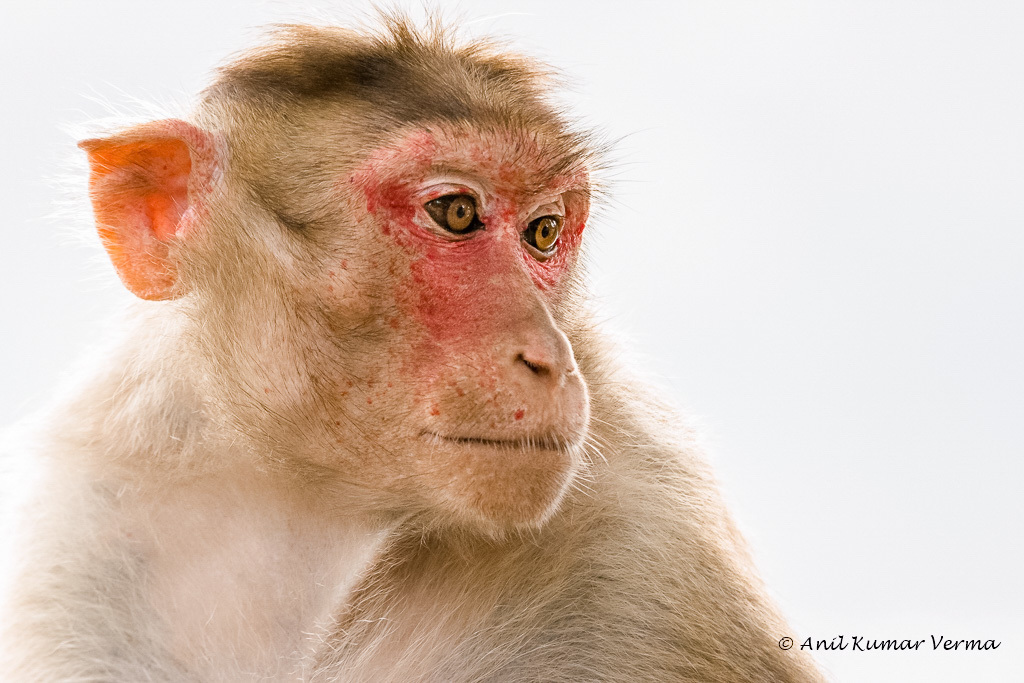
Bonnet Macaque
Macaca radiata
The bonnet macaque (Macaca radiata), also known as zati, is a species of macaque endemic to southern India. Its distribution is limited by the Indian Ocean on three sides and the Godavari and Tapti rivers, along with that of the rhesus macaque, its related competitor to the north. Land use changes in the last few decades have resulted in changes in its distribution boundaries with the rhesus macaque, raising concern for its conservation status in the wild.
The bonnet macaque is diurnal, arboreal, and terrestrial. It can live up to 35 years in captivity.
From the article Bonnet macaque on Wikipedia (CC BY-SA), quoted section by section
Description
Males have a head-body length of 51.5–60 cm (20.3–23.6 in) with a 51–69 cm (20–27 in) tail while females are 34.5–52.5 cm (13.6–20.7 in) with a 48–63.5 cm (18.9–25.0 in) tail. Males weigh 5.4–11.6 kg (12–26 lb) and females 2.9–5.5 kg (6.4–12.1 lb). Bonnet macaques have a cap-shaped whorl on the top of their heads that spreads outward from the center. The fur on their bodies can be either be dark brown or yellow. Despite these colors, the ears of the bonnet macaque are black. Females generally have redder faces when they are gestating or lactating. Forest-dwelling bonnets are generally smaller than the bonnets that thrive in forests.
Range & habitat
The bonnet macaque is a diurnal and arboreal species that resides in trees. It defends its marked territory in the trees that it settles in, primarily fig trees near human civilizations or tall trees with enough leaves to feed on. Bonnets are native to and distributed throughout the Indian peninsula. It has been estimated that the population of bonnet macaques in India (where they are native to) is approximately 170,000. It is believed that 81,000 bonnets live in Karnataka, 64,000 in Andhra Pradesh, 16,000 in Tamil Nadu and finally 11,000 live in Kerala. The bonnet macaque is found primarily in southern India and occupies a wide range of habitats which include forests and human-dominated environments. Environments of the species include forests, roadsides, temples, villages, and urban settings. When compared with more habitat-specialized primates, this species displays a higher tolerance for habitat modification as well as the presence of humans.
Wikipedia: “Distribution and habitat”
What it does
The bonnet macaque has a very wide range of gestures and behaviors, which can be easily differentiated. Lip-smacking is one of the most common affiliative behaviors, where one individual may open and close its mouth in rapid succession, with its tongue between its teeth and its lips pressing against each other, giving an audible sound. A grimace is the most common gesture of fear or submission that a subordinate shows to a dominant individual during aggressive encounters. It consists of pulling back its upper lip, showing its upper teeth. It also has distinct alarm calls for predators such as pythons and leopards.
Communication. Bonnet macaques that are living in the presence of humans show flexible and conditional signaling behaviors. Research conducted in southern India focused on communicative behaviors produced during interactions that were goal-oriented, specifically involving the gain of food. Several features differentiate these signals from incidental behavior such as directing signals toward a specific recipient, using signals only when the recipient is attentive, repeating signals when the first initial attempt was unsuccessful, and continuing the signal until the individual has received a response in return. These communicative gestures involve combinations of gestures, body orientation, and eye behavior. Furthermore, signaling behavior. …
Wikipedia: “Behavior”
In human culture
The name "bonnet macaque" has been derived from the species unique and distinctive head pattern. This pattern of hair growth radiates from the center of its crown, creating a visual resemblance of a "bonnet" or a "cap" on the head of the species.
Wikipedia: “Etymology”
Listen
Looking for field recordings…
Where it lives
Recorded sightings
—
geo-referenced records in GBIF, from museums, herbaria and field observers.
Drag the globe to turn it. Dots are where records exist, not a range map; darker means more records.
In the old herbals & bestiaries

In the stacks
Searching the stacks…
Every page naming Macaca radiata in the Biodiversity Heritage Library →
This page is assembled live from iNaturalist, GBIF, Wikipedia, the Source Library and the Internet Archive. It is not yet part of the hand-edited codex. iNaturalist taxon 43448.