- Animals
- ›Chordates
- ›Vertebrates
- ›Mammals
- ›Therians
- ›Placental Mammals
- ›Primates, Rodents, and Allies
- ›Primates
- ›Monkeys, Apes, and Tarsiers
- ›Monkeys and Apes
- ›Apes and Old World Monkeys
- ›Old World Monkeys
- ›Cercopithecines
- ›Baboons, Macaques, and Mangabeys
- ›Macaca
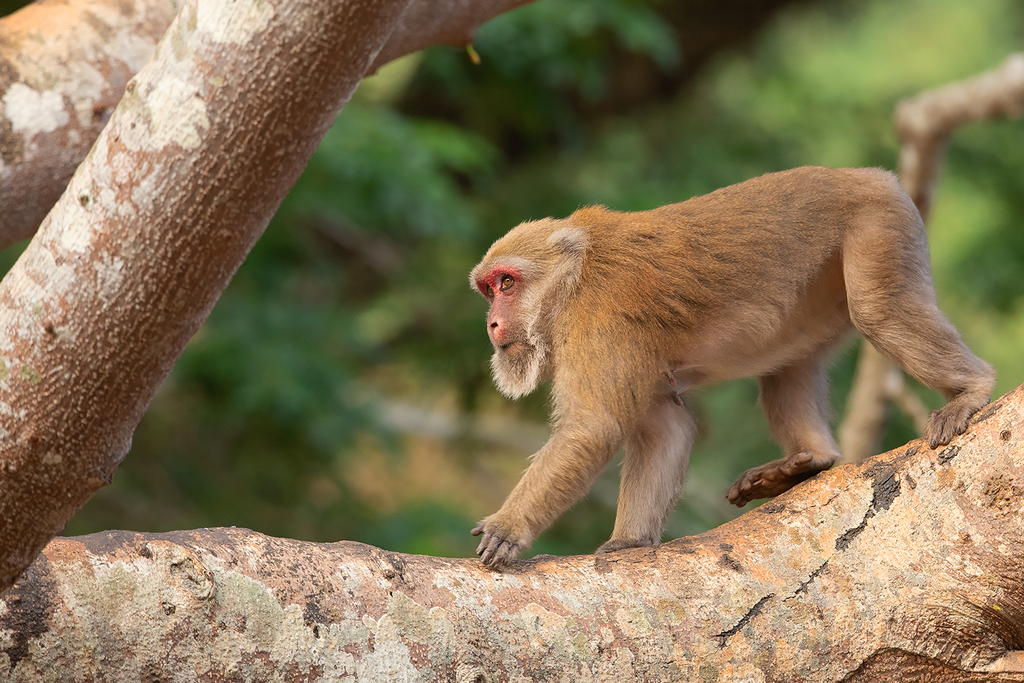
Assam Macaque
Macaca assamensis
The Assam macaque (Macaca assamensis) or Assamese macaque is a macaque of the Old World monkey family native to South and Southeast Asia. Since 2008, it has been listed as Near Threatened on the IUCN Red List, as it is experiencing significant declines due to poaching, habitat degradation, and fragmentation.
From the article Assam macaque on Wikipedia (CC BY-SA), quoted section by section
Description
The Assam macaque has a yellowish-grey to dark brown pelage. The facial skin is dark brownish to purplish. The head has a dark fringe of hair on the cheeks directed backwards to the ears. The hair on the crown is parted in the middle. The shoulders, head and arms tend to be paler than the hindquarters, which are greyish. The tail is well-haired and short. Head-to-body-length measures 51 to 73.5 cm (20.1 to 28.9 in), and the tail is 15 to 30 cm (5.9 to 11.8 in) long. Adult weight is 5 to 10 kg (11 to 22 lb).
Wikipedia: “Characteristics”
Range & habitat
In Nepal, the Assam macaque occurs east of the Kali Gandaki river at elevations of 200–1,800 m (660–5,910 ft). In northeastern India, it lives in tropical and subtropical semievergreen forests, dry deciduous and montane forests up to elevations of 4,000 m (13,000 ft). In Laos and Vietnam, it prefers elevations above 500 m (1,600 ft). It usually inhabits hilly areas above 1,000 m (3,300 ft), but in the wetter east it also occurs in the lowlands below this elevation. In limestone karst forests, it also occurs at lower elevations.
Wikipedia: “Distribution and habitat”
What it does
Assam macaques are diurnal, and at times both arboreal and terrestrial. They are omnivorous and feed on fruits, leaves, invertebrates and cereals. In Namdapha National Park, Arunachal Pradesh, 15 groups were recorded in 2002 comprising 209 individuals. The population had a group density of 1.11 individuals per 1 km2 (0.39 sq mi), and an average group size of 13.93 individuals. During a survey in Nepal's Langtang National Park in 2007, a total of 213 Assamese macaques were encountered in 9 groups in the study area of 113 km2 (44 sq mi). Troop sizes varied between 13 and 35 individuals, with a mean troop size of 23.66 individuals, and comprised 31% adult females, 16% adult males, and their young of various ages. They preferred maize kernals, followed by potato tubers, but also raided fields with wheat, buckwheat, and millet.
Wikipedia: “Ecology and behaviour”
Listen
Looking for field recordings…
Where it lives
Recorded sightings
—
geo-referenced records in GBIF, from museums, herbaria and field observers.
Drag the globe to turn it. Dots are where records exist, not a range map; darker means more records.
In the stacks
Searching the stacks…
Every page naming Macaca assamensis in the Biodiversity Heritage Library →
This page is assembled live from iNaturalist, GBIF, Wikipedia, the Source Library and the Internet Archive. It is not yet part of the hand-edited codex. iNaturalist taxon 43454.