- Animals
- ›Chordates
- ›Vertebrates
- ›Mammals
- ›Therians
- ›Placental Mammals
- ›Primates, Rodents, and Allies
- ›Primates
- ›Monkeys, Apes, and Tarsiers
- ›Monkeys and Apes
- ›Apes and Old World Monkeys
- ›Old World Monkeys
- ›Cercopithecines
- ›Baboons, Macaques, and Mangabeys
- ›Macaca
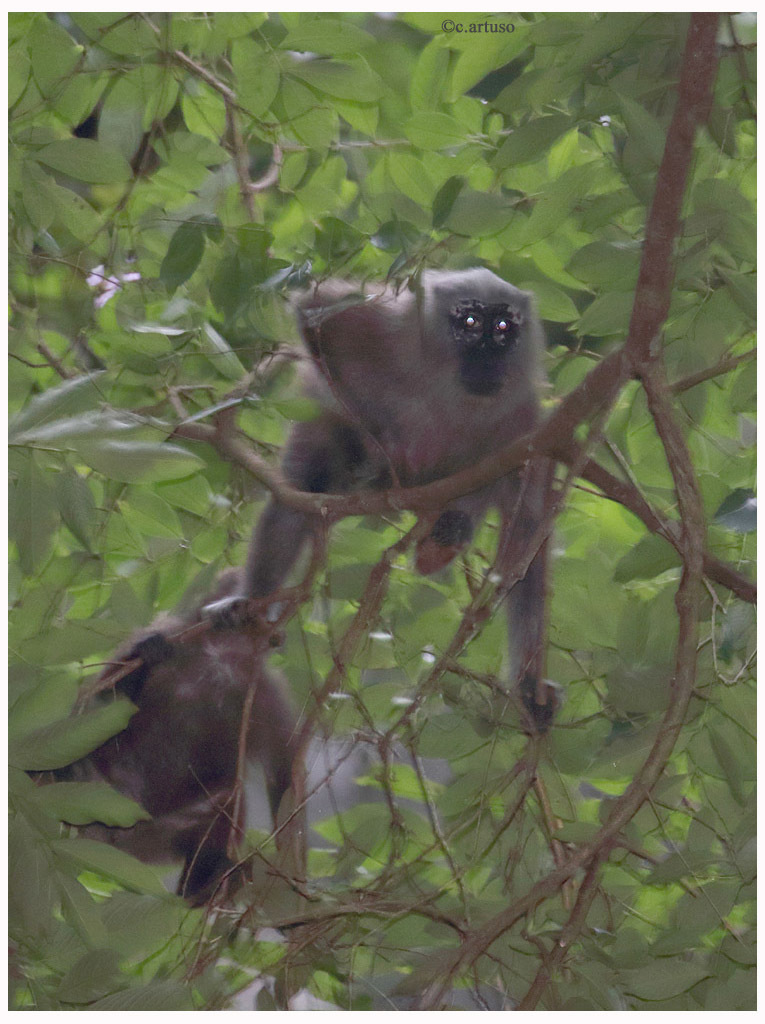
Moor Macaque
Macaca maura
The Moor macaque (Macaca maura) is a macaque species with brown/black body fur with a pale rump patch and pink bare skin on the rump. It has ischial callosities, which are oval-shaped. It is about 50–58.5 cm long, and eats figs, bamboo seeds, buds, sprouts, invertebrates and cereals in tropical rainforests. It is sometimes called "dog-ape" because of its dog-like muzzle, although it is no more closely related to apes than any other Old World monkey is. It is endemic to the island of Sulawesi in Indonesia, which is an important biodiversity hotspot.
The Moor macaque is threatened mostly due to habitat loss from an expanding human population and deforestation to increase agricultural land area. The Macaca maura population is estimated to have decreased from 56,000 in 1983 to under 10,000 in 1994. In 1992, Supriatna et al. 1992 conducted an extensive survey and found 6.3–63.2 individuals/km2. They usually live in groups of 15-40 individuals, with female philopatry and male dispersal and they are diurnal and semi-terrestrial. They spend a lot of their time in trees foraging and on the ground travelling.
From the article Moor macaque on Wikipedia (CC BY-SA), quoted section by section
Range & habitat
The Indonesian island of Sulawesi hosts 7 species of macaques with one of them being the Moor macaque. Unfortunately, the Moor macaque is endemic to the island and is considered to be endangered by the IUCN Red List of Threatened Species. The Moor macaque is the only species of macaques that existed naturally in South Sulawesi. Moor macaques have significant ecological flexibility that enables them to use several forest strata, including secondary habitats. They have a different ecological environment compared to other nonhuman primates since they have no major predators or competitors except where their ranges overlap. The home range of the Moor macaque group is usually 20-30 ha wide, with a total distance of roughly 6.64 km. They can be found in lowland forests, grasslands, limestone areas and even near human habitations, and they are commonly found with the endemic Malkoha birds that feed on grasshoppers, which are pushed out of the canopy by the macaques' movements. Those living near humans have been observed to be more present in areas where domestic animals are found, as these areas do not have a lot of traps that endanger them. They are predominantly found in the karst forest ecosystem of South Sulawesi. The karst plain forest is more resourceful for these macaques as the latter contains an abundance of food. …
Wikipedia: “Distribution and habitat”
What it does
The most common behavioural activities of Moor macaques are feeding, followed by moving, resting, and social interaction. Moor macaques are a male dispersing species. Males leave the groups in which they are born between the ages of 7 and 9, while females stay in their birth groups. This has an important purpose, it avoids inbreeding and broadens the genetic pool of the groups. Moor macaques groups have been observed to be tolerant and not very aggressive. Group fission occurs in Moor macaques, competition between females for food does not seem to be the reason for fission. However, some studies relate group fission to competition among females for food resources, others attribute it to increased sexual competition among males, and some others relate this phenomenon to establishing home ranges, specifically in Moor macaque groups with overlapped home ranges. The Sulawesi macaques, including Moor macaques, are further distinguishable from other macaques by their quiet bared-teeth display and the uttering of a loud call. Rather than conveying submission, as in most macaque species, the quiet bared-teeth display is thought to express the emitter's peaceful intentions, promoting positive interactions. …
Wikipedia: “Behavior”
Listen
Looking for field recordings…
Where it lives
Recorded sightings
—
geo-referenced records in GBIF, from museums, herbaria and field observers.
Drag the globe to turn it. Dots are where records exist, not a range map; darker means more records.
In the stacks
Searching the stacks…
Every page naming Macaca maura in the Biodiversity Heritage Library →
This page is assembled live from iNaturalist, GBIF, Wikipedia, the Source Library and the Internet Archive. It is not yet part of the hand-edited codex. iNaturalist taxon 43449.