- Animals
- ›Chordates
- ›Vertebrates
- ›Mammals
- ›Therians
- ›Placental Mammals
- ›Primates, Rodents, and Allies
- ›Primates
- ›Monkeys, Apes, and Tarsiers
- ›Monkeys and Apes
- ›Apes and Old World Monkeys
- ›Old World Monkeys
- ›Cercopithecines
- ›Guenons, Vervet Monkeys, and Talapoins
- ›Erythrocebus
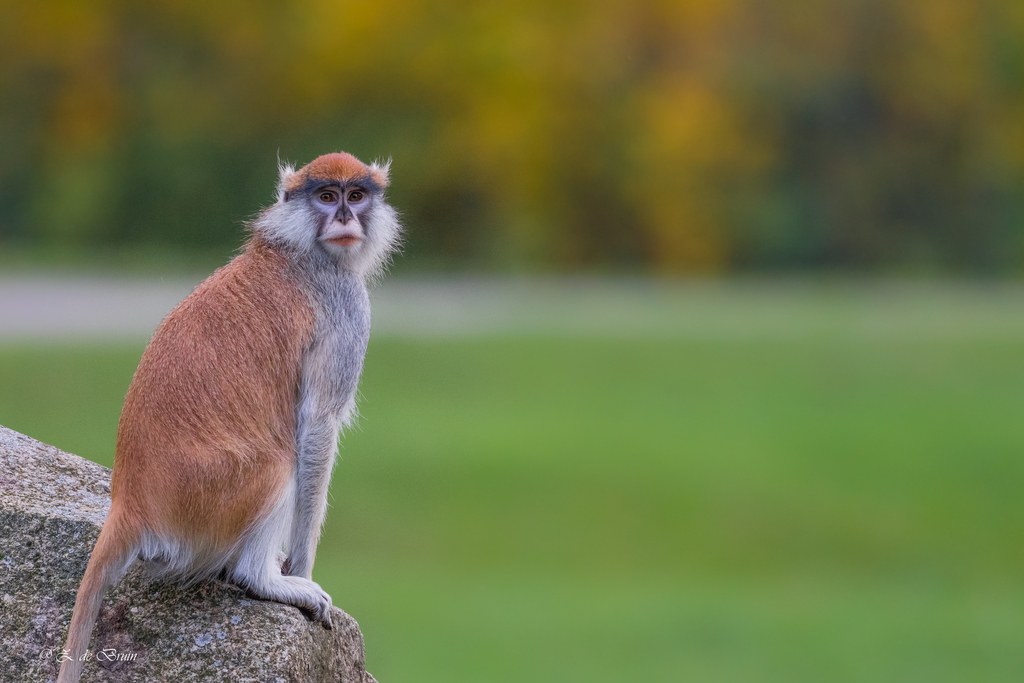
Patas Monkey
Erythrocebus patas
The patas monkey (Erythrocebus patas), also known as the wadi monkey or hussar monkey, is a ground-dwelling monkey distributed over semi-arid areas of West Africa, and into East Africa. It is the only species classified in the genus Erythrocebus. Recent phylogenetic evidence indicates that it is the closest relative of the vervet monkey (Chlorocebus aethiops), suggesting nomenclatural revision.
From the article Common patas monkey on Wikipedia (CC BY-SA), quoted section by section
Description
The male common patas monkey grows to 60 cm (24 in) to 87 cm (34 in) in length, excluding the tail, which measures 75 cm (30 in). Adult males are considerably larger than adult females, which average 49 cm (19 in) in length. Adult males average 12.4 kg (27.3 lb) and adult females 6.5 kg (14.3 lb), showing a high degree of sexual dimorphism. Males have the longest canine teeth of all the African long-tailed monkeys and the size of their canines plays a role in establishing a pecking order among males. Reaching speeds of 55 km/h (34 mph), it is the fastest runner among the primates. The life span in the wild can be up to about 20 years.
Range & habitat
Patas monkeys live in dry, open woodland. They are found in many parts of central, western, and eastern Africa. They have also been introduced to Puerto Rico, where they are an invasive species.
Wikipedia: “Distribution and habitat”
What it does
The common patas monkey lives in multi-female groups of up to 60 individuals (although much larger aggregations have been reported). The group contains just one adult male for most of the year. During the breeding season, outside males come into the group to mate with the females. Among primates, patas monkeys have the longest daily travel distances and the largest home ranges for their body size. The adult females in the group initiate movement of the group with the male following their lead. The common patas monkey feeds on insects, gum, seeds, and tubers, a diet more characteristic of much smaller primates.
Mating. Mating in common patas monkeys is seasonal and occurs for roughly one month each year. A female solicits mating by running past a male with her tail curled up and crouching in front of him. On some occasions, she'll also drool and puff out her cheeks.
Female social organization. Variation in the female social structure of patas monkeys has been observed across different populations. This variation may be dependent on food resources, as conflict between individuals is often a result of competition for limited resources. Higher rates of conflict over dense, but limited, food, such as fruit bushes, is associated with more stable, well defined dominance hierarchies than habitats with more diffuse resources, such as insects. …
Wikipedia: “Behavior”
In human culture
The relationship between the patas monkey and the whistling thorn acacia may have inspired The Lorax by Dr. Seuss.
Wikipedia: “In popular culture”
Listen
Looking for field recordings…
Where it lives
Recorded sightings
—
geo-referenced records in GBIF, from museums, herbaria and field observers.
Drag the globe to turn it. Dots are where records exist, not a range map; darker means more records.
In the old herbals & bestiaries

In the stacks
Searching the stacks…
Every page naming Erythrocebus patas in the Biodiversity Heritage Library →
This page is assembled live from iNaturalist, GBIF, Wikipedia, the Source Library and the Internet Archive. It is not yet part of the hand-edited codex. iNaturalist taxon 43462.