- Animals
- ›Chordates
- ›Vertebrates
- ›Mammals
- ›Therians
- ›Placental Mammals
- ›Primates, Rodents, and Allies
- ›Primates
- ›Monkeys, Apes, and Tarsiers
- ›Monkeys and Apes
- ›Apes and Old World Monkeys
- ›Old World Monkeys
- ›Cercopithecines
- ›Baboons, Macaques, and Mangabeys
- ›Cercocebus
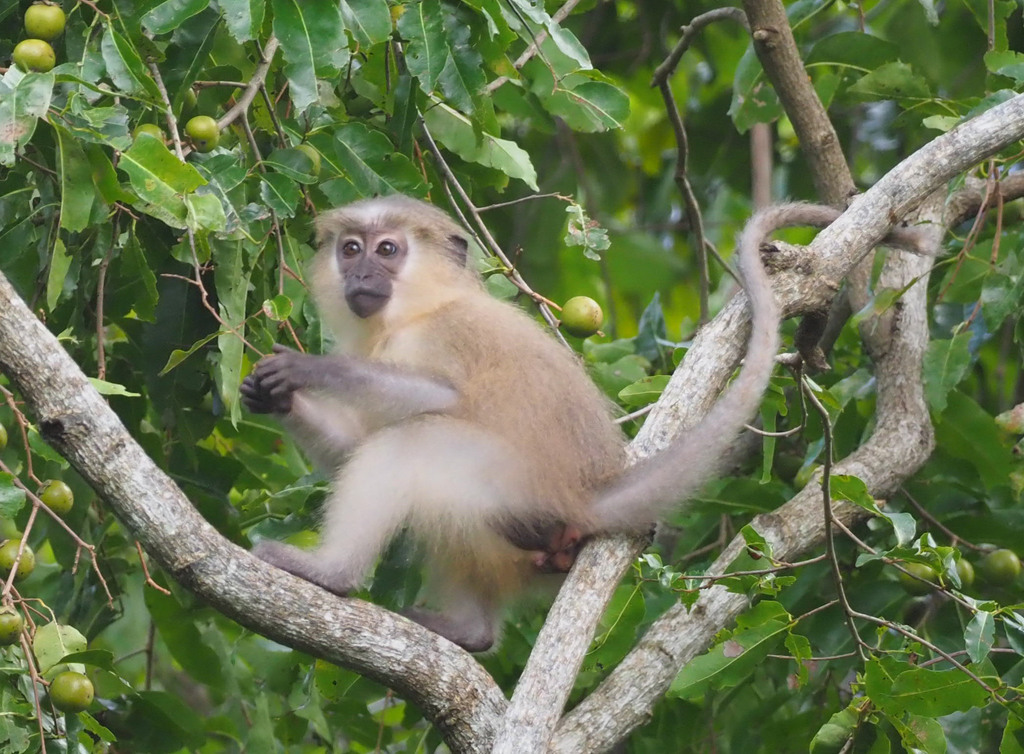
Tana River Crested Mangabey
Cercocebus galeritus
The Tana River mangabey (Cercocebus galeritus) is a highly endangered species of primate in the family Cercopithecidae. Some authorities have included the taxa agilis and sanjei as subspecies of this species, while others award these full species status.
It is endemic to riverine forest patches along the lower Tana River in southeastern Kenya. It is threatened by habitat loss and degradation, which has increased in recent years. This species was, together with the equally endangered Tana River red colobus, the main reason for the creation of the Tana River Primate Reserve in 1978, but human encroachment within this reserve continues. Recently, it has been suggested that 20,000 hectares of the Tana River Delta should be transformed into sugarcane plantations, but this has, temporarily at least, been stopped by the High Court of Kenya.
From the article Tana River mangabey on Wikipedia (CC BY-SA), quoted section by section
Range & habitat
The Tana River mangabey is found in the southeastern portion of Kenya along the Tana River, within 27 forest fragments along a 60 km stretch of floodplain forests. The gallery forest along the Tana River is home to several primate species - the Tana River mangabey, Tana River red colobus, blue monkey, yellow baboon, vervet monkey, and two species of bush babies. This species is restricted to riverine gallery forests in this area. The forests in which it is found are naturally fragmented due to the meandering of the Tana River and its fluctuating water levels. The forest is becoming even more fragmented due to habitat loss from human disturbance, which may reduce species' survival.
Wikipedia: “Geographic range and habitat”
What it does
The Tana River mangabey is diurnal and semiterrestrial. It spends most of its time on the ground, but is still considered arboreal due to its sleeping area. The species sleeps in trees about 27–37 m in height, which have a sparse canopy cover of 25–60%. The primate sleeps in the forks of the branches of these trees or near the main trunk. It is believed to sleep in trees to reduce the risk of predation and chooses this site according to its last feeding position in the area. Group size ranges from 13–36 individuals, and sometimes combining to form aggregations of 50 to 60 individuals. These groups consist of multiple males and multiple females. The species has an average day-range length of 1.25 km. During the dry season when food is limited, groups maintain discrete territories with minimal overlapping. To maintain these territories, males give spatial vocalizations and territorial displays at fixed boundaries. The males within the group may also engage in active combat with outside group leaders invading the territory. In the wet season when food is abundant, boundaries are broken down. Foraging ranges for different groups extend, and considerable overlap occurs between the different groups. …
Wikipedia: “Behavior and ecology”
Listen
Looking for field recordings…
Where it lives
Recorded sightings
—
geo-referenced records in GBIF, from museums, herbaria and field observers.
Drag the globe to turn it. Dots are where records exist, not a range map; darker means more records.
In the stacks
Searching the stacks…
Every page naming Cercocebus galeritus in the Biodiversity Heritage Library →
This page is assembled live from iNaturalist, GBIF, Wikipedia, the Source Library and the Internet Archive. It is not yet part of the hand-edited codex. iNaturalist taxon 43468.