- Animals
- ›Chordates
- ›Vertebrates
- ›Ray-finned Fishes
- ›Spiny-rayed fishes
- ›Puffers and Filefishes
- ›Triggerfishes, Boxfishes, and Filefishes
- ›Triggerfishes
- ›Canthidermis
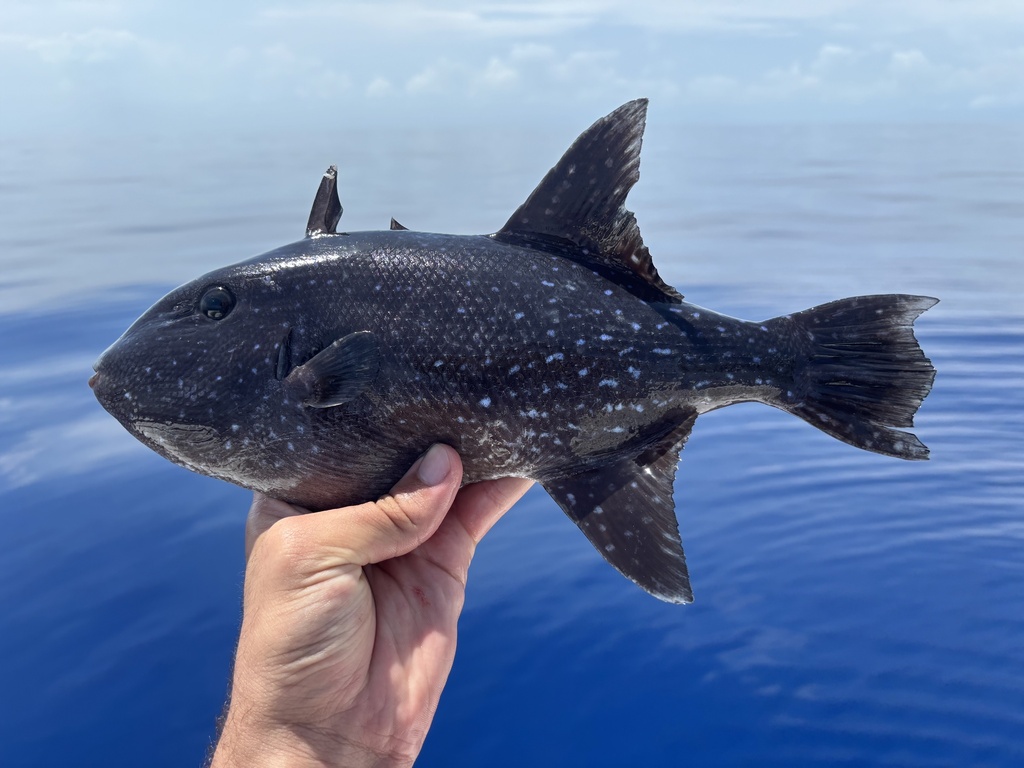
Spotted Oceanic Triggerfish
Canthidermis maculata
Canthidermis maculata, also known as rough triggerfish or spotted oceanic triggerfish, is a species of triggerfish native to the tropical and subtropical oceans worldwide. Unlike most triggerfish, they are mostly pelagic.
In the Philippines, the species is locally called Tikos in the Cebuano language and is abundant in the Visayas and Mindanao island groups.
From the article Canthidermis maculata on Wikipedia (CC BY-SA), quoted section by section
Description
The maximum length for this species is 50 centimetres (20 in), but usually grows up to 35 centimetres (14 in). Adults and juveniles have different coloration. Adults are blue grayish, while juveniles are grayish black with white spots that fade over age. Adults may be seen with dark blotches appearing on the face and pectoral fins during mating. These markings are also present on females hovering above their nests, and may disappear within a few seconds once they ascend through in the water column, away from their nest (Clark et al., 2014). In this fish, the dorsal and anal fins are curved on the back. The dorsal fin of this species has from 23 to 27 rays; its first dorsal fin’s rays are spinous, with the first two rays more like sharp thorns. The smaller second thorn props up the longer first thorn, giving it the appearance of a trigger, after which the fish is named (Tupongov, 2015). Its anal fin has 20 to 27 rays. Adults and juveniles also have different caudal fin shapes: juveniles have rounded caudal fins and adults have concave ones.
Range & habitat
In the western Pacific Ocean it ranges from the Gulf of Thailand north to the Yellow Sea and Japan, also extending eastward to the Philippines, Indonesia, and all the way to Polynesia and Hawaii. In the eastern Pacific Ocean, they are found from Mexico and around the Gulf of California down to Peru and the Galapagos Islands. Around the Indian Ocean, it ranges from the Red Sea and eastern Africa to the Seychelles, the Maldives, the Persian Gulf, India, Sri Lanka, the Andaman Sea, Australia, and Indonesia. Populations in the Atlantic Ocean range from New York down to the Gulf of Mexico, the Bahamas, the Caribbean Sea and down to Brazil on the western side. Around the eastern Atlantic Ocean, it ranges from the British Isles and the Bay of Biscay to the Azores, the Canary Islands and western Africa. Some populations are also found in South Africa. The spotted oceanic triggerfish inhabits warm waters high in biodiversity, characterized by strong surface currents and upwelling systems (Lezama-Ochoa et al., 2016). It can be found on deep slopes right offshore, in open water (Matsuura, 2001) and under fish aggregating devices (FADs), where they have been seen in groups of hundreds or thousands (Taquet et al., 2007).
Wikipedia: “Distribution and habitat”
What it does
Canthidermis maculata are noted hosts of sea lice (Copepoda: Caligidae) in the Neotropical region (Morales-Serna et al., 2016). Additionally, they have been recorded as visitors of cleaning stations hosted by the black-nosed butterflyfish and the Mexican hogfish, at Malpelo Island in the tropical eastern pacific (Quimbayo et al., 2016).
Diet. Spotted oceanic triggerfish display plasticity in their eating habits, being considered either a carnivorous or a planktivorous fish. Upon examination, they have been shown to consume smaller fish, Halobates (sea skaters), Siphonophores, and smaller cartilaginous fish (Senta et al., 1993).
Predation. The oceanic triggerfish falls prey to large pelagic fish such as the Indo-Pacific Sailfish (Varghese et al., 2013), the dolphinfish (Mahi-mahi) (Oxenford et al., 1999), and sea birds such as Streaked Shearwaters which are found in Japan (Matsumoto et al., 2012). Additionally, eggs in nests that are not defended by a mother oceanic triggerfish are known to be preyed upon by smaller opportunistic fish such as the goatfish, Parupeneus multifasciatus, the checkerboard wrasse, Halichoeres hortulanus, as well as other triggerfish such as the orange-lined triggerfish, Balistapus undulates, and the titan triggerfish, Balistapus viridescens (Clark et al., 2014).
Behavior. …
Wikipedia: “Ecology”
Where it lives
Recorded sightings
—
geo-referenced records in GBIF, from museums, herbaria and field observers.
Drag the globe to turn it. Dots are where records exist, not a range map; darker means more records.
In the stacks
Searching the stacks…
Every page naming Canthidermis maculata in the Biodiversity Heritage Library →
This page is assembled live from iNaturalist, GBIF, Wikipedia, the Source Library and the Internet Archive. It is not yet part of the hand-edited codex. iNaturalist taxon 179646.