- Animals
- ›Chordates
- ›Vertebrates
- ›Mammals
- ›Therians
- ›Marsupials
- ›Kangaroos, Possums, Wombats, and Allies
- ›Macropods
- ›Kangaroos, Wallabies and Allies
- ›Kangaroos, Wallabies, Pademelons, and Dorcopsises
- ›Kangaroos and Wallabies
- ›Notamacropus
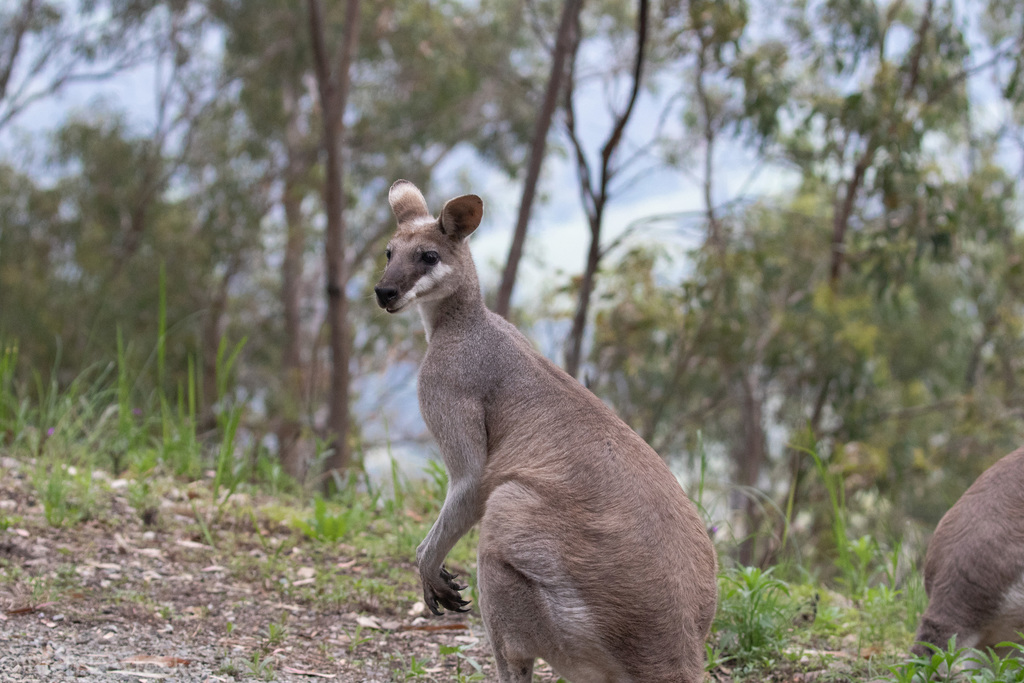
Whiptail Wallaby
Notamacropus parryi
The whiptail wallaby (Notamacropus parryi), also known as the pretty-faced wallaby, is a species of wallaby found in eastern Australia. It is locally common from Cooktown in Queensland to near Grafton in New South Wales.
From the article Whiptail wallaby on Wikipedia (CC BY-SA), quoted section by section
Description
It is distinguished by its paler colouring and white stripe under its face. Their faces have a chocolate-brown fur covering their muzzle. They are black and white on its chest and the rest is grey to brown fur. Males weigh from 14 to 26 kg (31 to 57 lb) and stand at a height from 70 to 93 cm (28 to 37 in). Females weigh from 7 to 15 kg (15 to 33 lb) and stand at a height from 65 to 75 cm (26 to 30 in).
What it does
The whiptail wallaby is a sociable species, sometimes coming together in mobs of up to 50. They live in a home range of up to 110 hectares (270 acres). The mob usually gathers in the afternoon during feeding. Some home ranges may overlap with others and the members of the mob take turns resting and guarding. The mobs contain all ages and sexes throughout the year, but seldom if ever are all members of a mob together at one time. Mobs often split into continually changing subgroups of fewer than 10 animals. Whiptail wallaby mobs have a linear hierarchy that is determined by ritualized "pawing", which is non-violent. They may also pull grass. Whiptail wallabies will cough to show submission. These bouts function only to determine access to oestrous females.
Wikipedia: “Social behavior”
Listen
Looking for field recordings…
Where it lives
Recorded sightings
—
geo-referenced records in GBIF, from museums, herbaria and field observers.
Drag the globe to turn it. Dots are where records exist, not a range map; darker means more records.
In the stacks
Searching the stacks…
Every page naming Notamacropus parryi in the Biodiversity Heritage Library →
This page is assembled live from iNaturalist, GBIF, Wikipedia, the Source Library and the Internet Archive. It is not yet part of the hand-edited codex. iNaturalist taxon 1453430.