- Animals
- ›Chordates
- ›Vertebrates
- ›Mammals
- ›Therians
- ›Placental Mammals
- ›Primates, Rodents, and Allies
- ›Rodents
- ›Squirrels, Dormice, and Mountain Beavers
- ›Squirrels
- ›Ground and African Tree Squirrels
- ›Holarctic Ground Squirrels
- ›Spermophilus
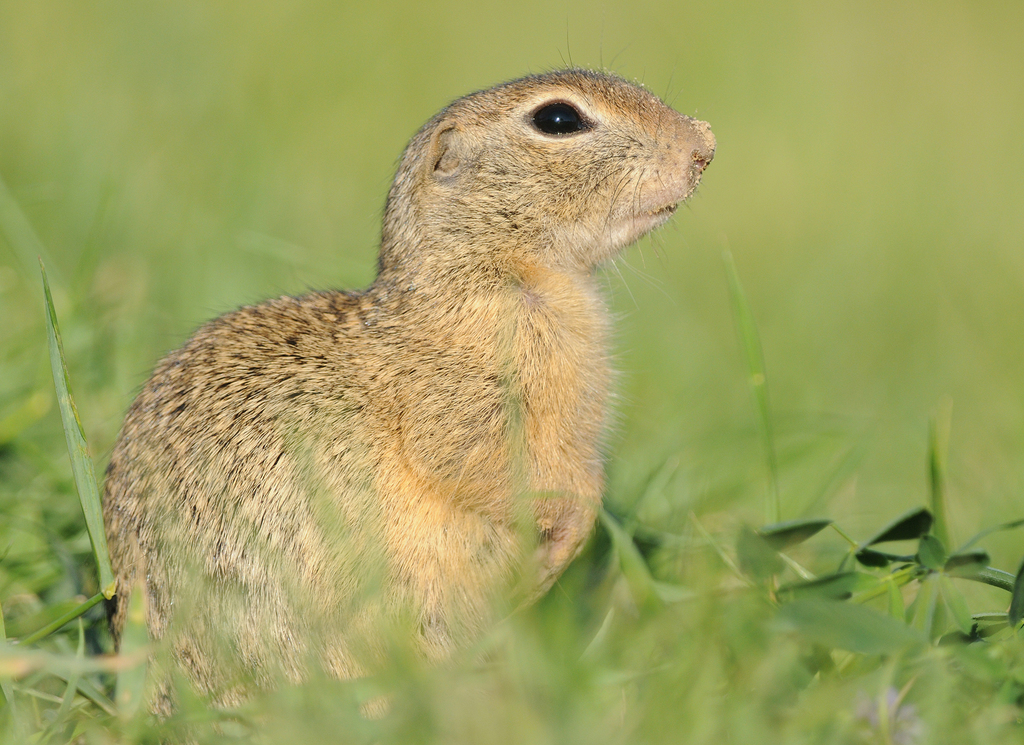
European Ground Squirrel
Spermophilus citellus
The European ground squirrel (Spermophilus citellus), also known as the European souslik, is a species from the squirrel family, Sciuridae. It is among the few European species in the genus Spermophilus. Like all squirrels, it is a member of the rodent order. It is to be found in eastern and central Europe from southern Ukraine, to Asia Minor, Austria, the Czech Republic, Slovakia, Serbia, Hungary, Greece, Romania, Moldova, Bulgaria, North Macedonia and north as far as Poland but the range is divided in two parts by the Carpathian Mountains.
The European ground squirrel grows to a length of approximately 20 cm (8 in) and a weight of approximately 300 grams (11 oz). It is a diurnal animal, living in colonies of individual burrows in pastures or grassy embankments. The squirrels emerge during the day to feed upon seeds, plant shoots and roots or flightless invertebrates. The colonies maintain sentinels who whistle at the sight of a predator, bringing the pack scurrying back to safety.
From the article European ground squirrel on Wikipedia (CC BY-SA), quoted section by section
Description
The European ground squirrel is about the size of a brown rat, with an adult measuring 20 to 23 cm (8 to 9 in) and a weight of 240 to 340 g (8.5 to 12.0 oz). It has a slender build with a short bushy tail. The short dense fur is yellowish-grey, tinged with red, with a few indistinct pale and dark spots on the back. The underside is pale with a sandy-coloured abdomen. The large dark eyes are placed high on the head and the small, rounded ears are hidden in the fur. The dental formula is 1.0.2.31.0.1.3. The legs are powerful with sharp claws well adapted for digging. Males are slightly larger than females otherwise they look alike. The European ground squirrel has a shrill alarm call that will cause all other individuals in the vicinity to dive for cover. It also makes various soft chirruping and growling noises. The European ground squirrel could be confused with the speckled ground squirrel which occurs in Poland (Lublin Voivodeship), Moldova, Russia, Belarus and Ukraine, but that species has dark brown fur spotted with white and a thin tail and lives in areas with coarser vegetation.
Range & habitat
The European ground squirrel is native to central and southeastern Europe where its range is divided by the Carpathian Mountains. Its range includes land at altitudes of up to 2,593 metres (8,507 ft) in southern Ukraine, Asia Minor, Austria, the Czech Republic, Slovakia, Serbia, Hungary, Greece, Romania, Moldova, Bulgaria, North Macedonia and north as far as Poland. It has become locally extinct in Germany and Poland but was reintroduced successfully into the wild in Poland in 2005. Some of the animals were sourced from the Budapest Ferenc Liszt International Airport. The European ground squirrel has very specific habitat requirements. It needs short turf in order to dig its tunnel system. It finds this on the steppes and in pasture, in dry banks, on sports fields, parks and lawns. These conditions are lost when changes in agricultural practice convert grassland into arable land and forest, or grazing ceases and the grass grows coarse and scrubland develops. Other places with short vegetation that sometimes provides suitable habitat are railway embankments and road cuttings and verges.
Wikipedia: “Distribution and habitat”
What it does
The European ground squirrel is a colonial animal and is mainly diurnal. It excavates a branching system of tunnels up to 2 metres (6 ft 7 in) deep with several entrances. At other places in the home range it digs unbranched bolt holes in which to hide if danger threatens. If alarmed it emits a piercing whistle and when it is out in the open it often sits upright and looks around for predators. These include the least weasel, red fox, domestic cat and some species of birds of prey. It feeds on grasses, other plants, flowers, seeds, cultivated crops, insects and occasionally the eggs of ground nesting birds or their chicks. A study in Bulgaria found that the squirrel spent about eleven hours a day outside its burrow in mid-summer but by early autumn this has reduced to seven hours. Rather over half of the day was spent foraging but other activities observed included exploration, running, sitting, grooming, digging, scent marking and vigilance. During the winter it stops up the entrances to its burrow and hibernates in a nest of dry vegetation. Each individual occupies a separate chamber and during this period, the body temperature drops to 2.0 °C (36 °F), and the heart rate slows to a few beats per minute. …
Wikipedia: “Behaviour”
Listen
Looking for field recordings…
Where it lives
Recorded sightings
—
geo-referenced records in GBIF, from museums, herbaria and field observers.
Drag the globe to turn it. Dots are where records exist, not a range map; darker means more records.
In the stacks
Searching the stacks…
Every page naming Spermophilus citellus in the Biodiversity Heritage Library →
This page is assembled live from iNaturalist, GBIF, Wikipedia, the Source Library and the Internet Archive. It is not yet part of the hand-edited codex. iNaturalist taxon 46037.